Ukrainian Skeleton Athlete Disqualified from Winter Games Over “Helmet of Remembrance”
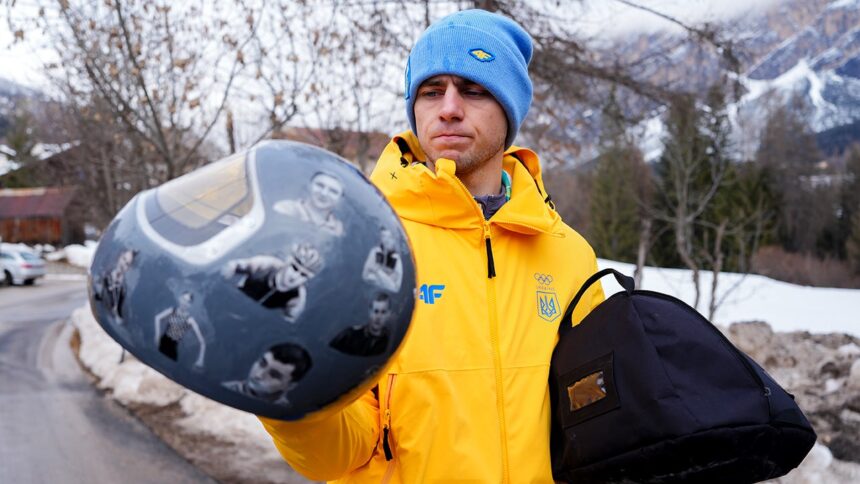
The icy track at Cortina d’Ampezzo is designed to test the limits of human courage and precision. But for Ukrainian slider Vladyslav Heraskevych, the most formidable obstacle at the 2026 Winter Olympics wasn’t the notorious Curve 9. It was a standoff over a piece of equipment that, for him, carried the weight of a nation’s grief. In a dramatic and emotionally charged controversy, Heraskevych was disqualified from the men’s skeleton event after refusing to compete without his custom helmet—a stark, solemn tribute to Ukrainian athletes killed in the ongoing war with Russia.
A Stand on Principle: The “Helmet of Remembrance” Controversy
For three tense days leading up to his competition, Heraskevych and the International Olympic Committee were locked in a battle of wills. The helmet in question, which he had worn in training, was emblazoned with the names and, in some cases, the portraits of fallen Ukrainian sports figures. A powerful, silent memorial, it transformed his high-speed descent into a rolling act of remembrance.
The IOC, steadfast in its enforcement of Rule 50 of the Olympic Charter which prohibits political, religious, or racial propaganda on the field of play, deemed the helmet a violation. The organization argued that the sanctity of the competition arena must be preserved from overt political statements. In an unprecedented personal intervention, IOC President Kirsty Coventry met with the athlete in a final attempt to find a compromise.
“They offered me a plain helmet, or the chance to wear a sticker with a generic ‘for peace’ message,” Heraskevych stated in a post-disqualification press conference, his voice steady but resolute. “But these were not just symbols. They were people. My friends, my colleagues, my heroes. To remove their names was to erase their sacrifice a second time. I could not do that.”
Analysis: The Unyielding Conflict Between Principle and Protocol
This incident is not merely a disciplinary footnote; it is a microcosm of the immense pressure facing Ukrainian athletes competing on the world stage since 2022. For them, sport is inextricably linked to national identity and survival. Every appearance is a statement of resilience.
Sports ethicists are deeply divided on the IOC’s decision:
- Pro-IOC Stance: Purists argue that the Olympics, as a rare global gathering, must remain a neutral territory. Allowing individualized political statements, however righteous, opens a floodgate that could splinter the event into a platform for countless grievances, diluting the focus on athletic excellence and unity.
- Pro-Athlete Stance: Critics counter that the IOC’s application of Rule 50 is often inconsistent and lacks contextual nuance. They ask: Is a memorial for the dead truly “political propaganda,” or is it a fundamental human expression of mourning and respect? The line between a political act and a profoundly personal one appears dangerously blurred.
The personal involvement of President Coventry underscores the IOC’s acute awareness of the sensitivity. It was a recognition that this was no ordinary protest, but a profound moral dilemma for the athlete. Yet, the rules were ultimately upheld, revealing the limits of the Committee’s flexibility.
Repercussions and Predictions: A Watershed Moment for Athlete Expression
The disqualification of Vladyslav Heraskevych will reverberate far beyond the sliding track in Cortina. It sets a stark precedent and forces a critical examination of the future of athlete expression at the Games.
Immediate Fallout:
- Ukrainian Response: Heraskevych has been hailed as a national hero in Ukraine. The government and National Olympic Committee have issued statements of unwavering support, framing his stand as one of patriotic duty.
- IOC Scrutiny: The Committee will face intensified criticism for perceived coldness in the face of a humanitarian tragedy. The argument that “rules are rules” may ring hollow to a global audience witnessing a war play out in real time.
- Athlete Solidarity: Expect visible, though likely Rule 50-compliant, shows of support from athletes of other nations—perhaps black armbands or moments of silence—testing the boundaries of what is deemed acceptable.
Long-Term Predictions:
- This event will become a central case study in the inevitable reform of Rule 50. Pressure will mount to create clearer, more compassionate guidelines that distinguish between hateful propaganda and acts of memorial or social justice.
- Future athletes from conflict zones may feel emboldened to find more creative, technically legal ways to convey their messages, leading to an “arms race” of symbolic expression.
- The very definition of “political” in sport will be debated more intensely. Is remembrance political? Is a call for peace political? The Heraskevych case proves the current framework is inadequate for a complex world.
Conclusion: The Medal That Won’t Be Won and the Legacy That Will Endure
Vladyslav Heraskevych came to Cortina d’Ampezzo to race for gold. He leaves having won something else entirely: a profound moral victory that exposes the aching conflict at the heart of modern sport. No time will be recorded next to his name in the official skeleton results. But history will record his stance.
In choosing his Helmet of Remembrance over competition, he made a calculation that honor outweighs glory. He transformed his disqualification into a platform far taller than any Olympic podium, forcing the world to look, once more, at the human cost of war. While the IOC guards the neutrality of the playing field, Heraskevych reminded us that athletes are not neutral beings—they are citizens, mourners, and witnesses.
The 2026 Winter Games will crown champions in skeleton, but the image that may endure longest is of a young man walking away from the track, helmet in hand, having already carried the weight of his nation further than any slide ever could. His empty lane on the track speaks louder than any finish time, a chilling silence that asks the Olympic movement, and all who watch it, a difficult question: In the pursuit of peaceful competition, what are we willing to forget?
Source: Based on news from Fox Sports.