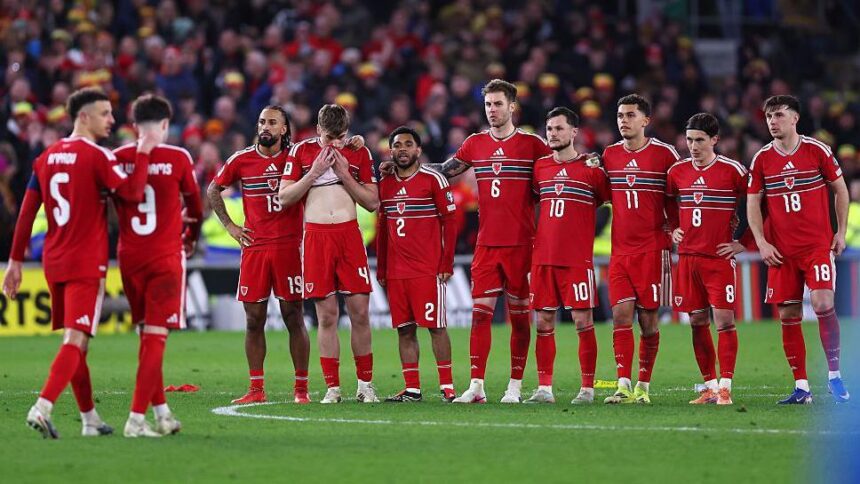
Wales Forced to Look Ahead as World Cup Dream Ends in Familiar Penalty Agony
The cruelest sound in football is not the roar of a rival crowd, but the silence that follows a missed penalty. In that vacuum on a Thursday night in Zenica, the World Cup dream of a nation evaporated once more. For Wales, the path to the globe’s greatest tournament was once again blocked by the lottery of spot-kicks, a recurring nightmare that leaves a talented generation staring at an empty summer. The immediate aftermath is for raw emotion—tears on the pitch, a hollow feeling for a nation. But as the dust settles on defeat to Bosnia-Herzegovina, the hard truth emerges: Wales, with eyes still stinging, have no choice but to lift their gaze to the horizon.
The Unbearable Weight of History Repeating
This was not just a play-off defeat; it was a psychological blow steeped in recent history. The ghost of Euro 2020, where Wales fell to Denmark in the round of 16, and the heartbreak of the 2022 World Cup play-off final loss to Ukraine, loomed large. The narrative of “so near, yet so far” is becoming a painful trope for this squad. Under the intense pressure of a one-off shootout, the fine margins of international football were laid bare. Craig Bellamy’s squad, inheriting the formidable legacy of the Gareth Bale era, did not want to be contemplating cycles and future campaigns. Their focus was firmly on this summer, on breaking the cycle. Yet, football’s fickle nature had other plans.
The performance itself was a microcosm of Wales’s modern identity: resilient, organized, and fiercely competitive, but ultimately lacking the killer instinct in the final third when it mattered most. The transition from the golden generation, defined by Bale and Aaron Ramsey, to a new era is a process, and processes are rarely linear. This defeat, brutal as it is, serves as the starkest possible punctuation mark between two chapters.
Building on the Bellamy Blueprint: Reasons for Optimism
While the result is a devastating setback, the foundations laid under Craig Bellamy provide a compelling case for future optimism. The manager has instilled a clear tactical identity, blending defensive solidity with rapid transitions—a system that perfectly suits the attributes of his most dynamic players. The core of this squad is not just young; it is gaining invaluable experience at the highest levels of club football.
- Dan James, whose searing pace remains a weapon, spoke for the group post-match: “We’ve got so much more to come.” This isn’t just platitude; it’s a statement of intent from a player entering his prime.
- Brennan Johnson of Tottenham possesses a ceiling that seems to rise with each season, offering a multifaceted attacking threat.
- The defensive trio of Chris Mepham, Joe Rodon, and Connor Roberts provides a seasoned, Premier League-caliber backbone.
- In midfield, Jordan James and Charlie Savage represent the next wave, bringing technical guile and energy.
This is not a squad in decline. It is a squad in evolution, and the pain of Zenica will become a part of its collective DNA. The challenge for Bellamy is to transmute that pain into fuel, ensuring this setback becomes a defining moment of growth, not a permanent scar.
The Road Ahead: Navigating a New Tournament Landscape
With the 2026 World Cup expanding to 48 teams, Wales’s path theoretically becomes more navigable. The automatic qualification spots from UEFA increase, and the margin for error widens slightly. However, this also changes the competitive dynamic. The focus now shifts immediately to the UEFA Nations League this autumn, a competition that has served Wales well in the past as both a trophy opportunity and a potential backdoor route to major tournaments.
The long-term vision must be clear: to ensure that by the time 2026 qualifying begins, this Welsh team is not just hoping to scrape through, but is positioned as a confident, cohesive unit expected to qualify. This means:
- Developing a consistent goal scorer to convert the chances created.
- Integrating the next wave of talent from successful youth sides seamlessly into the senior setup.
- Mastering the art of game management in tight, high-stakes matches to avoid the penalty shootout purgatory.
The Nations League, Euro 2028 qualifying, and the expanded World Cup format offer a packed calendar of opportunity. The slate is far from blank.
A Nation’s Hope: The Unbreakable Bond
Perhaps Wales’s greatest asset remains unchanged: the symbiotic relationship between the team and the Red Wall. The connection forged during the historic runs to Euro 2016 semi-finals and the 2022 World Cup is not conditional on success. It is a cultural pillar. This generation of players now carries the responsibility of honoring that legacy and pushing it forward. The fans will travel to Zenica, to Cardiff, and everywhere in between, not just to witness victory, but to bear witness to the effort and identity of their team.
This bond is the bedrock upon which future success will be built. It provides the home advantage in Cardiff, the unwavering support in difficult moments, and the collective will that can sometimes turn a game. As the team looks ahead, they do so with the certainty that a nation is looking with them.
Conclusion: Tears Today, Resolve for Tomorrow
The dream of the 2026 World Cup begins today, in the disappointment of a Bosnian night. The tears shed are not a sign of weakness, but of passion—a passion that must now be channeled. Wales stands at a crossroads familiar to many footballing nations: the moment a celebrated era gives way to a promising, yet unproven, new dawn. The pain of penalties is a cruel teacher, but its lessons are indelible.
Craig Bellamy’s task is to ensure this heartbreak is a catalyst, not a conclusion. With a young, talented squad, a clear style of play, and the unwavering support of a nation, the tools are there. The story of Welsh football did not end in Zenica; a challenging, but potentially glorious, new chapter has just begun. The eyes are dry now. The gaze, fixed firmly on the future.
Source: Based on news from Yahoo Sports.