The Great Stoppage Time Divide: Was West Ham’s 11-Minute Lifeline Excessive or a Refereeing Masterclass?
The beautiful game is governed by laws, but their application often feels more like an art form—a subjective interpretation that can define seasons and shatter dreams. This past weekend, the FA Cup quarter-finals served up a stark, almost theatrical, contrast in this very art, placing the role of the fourth official and their stoppage time board under a searing spotlight. At the London Stadium, Craig Pawson’s decision to add 11 minutes of stoppage time became the catalyst for a stunning West Ham comeback. A day later at the Etihad, Michael Oliver’s choice to add zero additional seconds to Manchester City’s dominant win over Liverpool sparked a firestorm of debate. This discrepancy hasn’t just raised eyebrows; it has ignited a fundamental question about consistency, the laws of the game, and what modern football fans can rightfully expect from its officials.
A Tale of Two Halves: The Stoppage Time Chasm
To understand the controversy, one must first examine the two incidents side-by-side. The facts are clear, but the context is king.
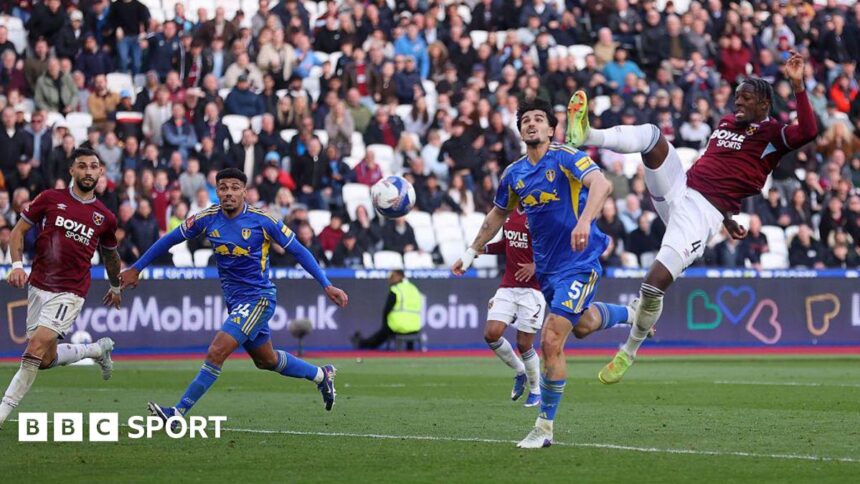
At the London Stadium, West Ham found themselves 2-0 down to a vibrant Leeds United side as the 90-minute mark approached. The game had seen its share of interruptions: three goals, five substitutions, and a handful of injuries requiring treatment. When the fourth official’s board lit up with the number 11, even some home fans were surprised. What followed was pure FA Cup drama. Michail Antonio struck in the 91st minute, and an own goal from young Leeds defender Mateo Joseph in the 98th minute sent the tie to extra time, where West Ham eventually prevailed on penalties. Pawson’s added time was the oxygen that kept West Ham’s cup hopes alive.
Contrast this with the scene at the Etihad Stadium. Manchester City’s 4-0 victory over Liverpool was a controlled, albeit physical, affair. The match featured four goals, six substitutions, and several instances of player treatment. Yet, as the clock struck 90 minutes with City in possession, referee Michael Oliver blew his whistle immediately. No additional time was deemed necessary. The decision was met with bewilderment from pundits and a torrent of criticism on social media, where fans and analysts alike dissected the laws of the game, arguing that such a clean half of football was a statistical improbability.
Decoding the Directive: What Do the Laws Actually Say?
The root of the debate lies in the International Football Association Board’s (IFAB) Law 7, which deals with match duration. It states that the referee must add time for:
- Substitutions
- Assessment and/or removal of injured players
- Wasting time
- Disciplinary sanctions
- Stoppages for drinks or other medical reasons
- Any other cause, including significant delays to a restart
Critically, the law concludes: “The fourth official indicates the minimum additional time decided by the referee.” This last word—”minimum”—is crucial. It grants the referee the discretionary power to play beyond the indicated time, especially if further delays occur within the added period itself.
So, was Pawson’s 11 minutes excessive? Given the events of the second half, it likely fell within the upper bounds of acceptability. Was Oliver’s zero minutes a breach of protocol? Statistically, it appears an outlier. Even in a relatively fluid half, six substitutions alone consume, on average, 90-120 seconds. The absence of any added time suggests a refereeing philosophy focused on the flow of the game over strict accounting, a stance that clashes with the current directive from IFAB and FIFA to more accurately calculate lost time.
Expert Analysis: Philosophy, Pressure, and the “Game Management” Dilemma
From an expert lens, this isn’t merely about arithmetic; it’s about refereeing philosophy and in-game pressure. Craig Pawson, at a raucous London Stadium with a cup tie on the line, may have felt a compulsion to ensure every possible second was accounted for, erring on the side of maximum time. This “clear the ledger” approach is what fans have been told to expect since the 2022 World Cup’s lengthy added times.
Michael Oliver, one of the world’s elite referees, is known for his assertive game management. In a match already decided, at 4-0, his immediate whistle could be interpreted as a judgment that no further time would change the contest’s outcome—a pragmatic, if not strictly by-the-book, conclusion. However, this opens a dangerous precedent. The laws are not meant to be applied based on the scoreline. A foul is a foul whether it’s 0-0 or 4-0, and lost time is lost time.
The real issue exposed here is a lack of consistency. When two high-profile matches on consecutive days produce such wildly different applications of the same law, it undermines trust in the system. It fuels accusations of bias, even when none exists, and turns the fourth official’s board into a symbol of unpredictability rather than clarity.
Predictions and Ramifications: The Road to Consistency
This incident is not an anomaly but a symptom. We can therefore predict several potential outcomes:
- Increased Scrutiny on Fourth Officials: The role of the fourth official in calculating time will become more transparent and possibly more collaborative with the on-field referee.
- Clarification from PGMOL: The Premier League’s refereeing body may issue internal guidance to narrow the range of acceptable added time, aiming for greater uniformity.
- Technology’s Role: The conversation around independent timekeeping—stopping the clock for dead-ball situations—will gain momentum. While not imminent, this weekend’s events are a powerful argument for taking timekeeping out of the referee’s hands entirely.
- Fan and Media Pressure: Expect every significant discrepancy in added time to be met with immediate comparison to the “West Ham-Leeds vs. Man City-Liverpool” divide. It has set a new benchmark for debate.
Final Whistle: Excessive or Overdue? The Verdict
So, was 11 minutes at West Ham excessive? In the strictest sense, probably not. It was a dramatic but legally justifiable response to a half with multiple clear stoppages. The greater excess was found at the Etihad, where the refusal to add any time, however symbolic, represented a more significant deviation from the current interpretation of the laws.
The conclusion is not that Craig Pawson was wrong, but that Michael Oliver’s decision highlighted an inconsistent standard. Football has asked its officials to be meticulous timekeepers. They cannot then be surprised when fans and analysts hold them to that standard in every match, not just in those where a comeback is brewing. The 11 minutes at West Ham weren’t excessive; they were a symptom of a game still struggling to define time itself. Until a consistent philosophy is adopted, these weekend controversies will be as much a part of the cup magic as the giant-killings themselves. The whistle may blow, but the debate, it seems, has only just begun.
Source: Based on news from BBC Sport.