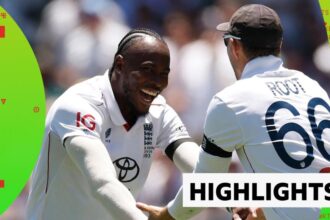
What a Stunner! Zak Crawley’s Gravity-Defying Catch Rocks Australia in Adelaide
The Ashes, cricket’s oldest and fiercest rivalry, is a theatre built on pressure. It’s a stage where moments of individual brilliance can tilt the axis of an entire series. On the opening day of the pivotal third Test in Adelaide, with the series poised at 0-0, England’s Zak Crawley authored one such moment—a catch of such instinctive, athletic genius that it momentarily silenced the Australian crowd and sent shockwaves through the home dressing room. To dismiss the dangerous Travis Head, Crawley didn’t just take a catch; he produced a stunner for the ages.
The Pivotal Moment: A Flash of Blonde and a Clenched Fist
Australia, having been asked to bat under brooding skies, were already reeling at 12-1. The atmosphere was electric, charged with the promise of early English inroads. Travis Head, Australia’s aggressive middle-order lynchpin and a hero of the 2021-22 series, walked out to a roaring home welcome. His intent was clear: counter-attack. But England’s bowlers, led by the relentless Stuart Broad, were probing.
The fateful delivery came from Ollie Robinson. It was a good length ball on off-stump, tempting Head into a drive. The left-hander leaned into it, the ball flying off the bat at a rapid pace. It seemed destined to scream through the covers for four. But at a wide gully position stood Zak Crawley. The reaction was pure instinct. Crawley’s full-stretch dive to his right was a blur of concentration and commitment. His right hand, seemingly guided by radar, plucked the ball out of the air an inch from the turf. The disbelief was instantaneous—from Head, from the crowd, and then, the eruption from the England players. At 33-2, with Head gone for just 10, the balance of power had visibly shifted.
Anatomy of a Game-Changing Catch
This was not a routine slip catch. It was a work of art born from preparation, athleticism, and nerve. Let’s break down why this particular catch resonates so deeply:
- Positioning is Everything: Crawley was stationed in a wide gully, a specialist position for the cover drive. England’s plan to Head was evident, and Crawley’s placement was a key part of the trap.
- Reaction Time Measured in Milliseconds: The ball traveled from bat to hand in a fraction of a second. Crawley had no time to think, only to act. His lightning-fast reflexes were the product of supreme hand-eye coordination.
- The Difficulty of the Take: Diving at full stretch, he had to control his body mid-air. Catching with one hand, especially at that speed, offers no margin for error. The softness of his hands upon impact prevented the ball from rebounding out.
- The Psychological Impact: This transcends the mere loss of a wicket. It removed a proven Ashes aggressor. For Australia, it was a demoralizing blow. For England, it was a massive momentum swing, proving their hunger and sharpness in the field.
More Than a Catch: A Symbol of England’s Renewed Intent
Under the new leadership of Ben Stokes and Brendon McCullum, England have championed a philosophy of positive, fearless cricket. Crawley’s catch is the ultimate embodiment of that ethos. It’s not just about scoring runs quickly; it’s about seizing every single moment in the field. This was a proactive, game-changing intervention.
For Crawley personally, this moment is monumental. A batter of sublime talent, his place has often been scrutinized. Yet, in the field, he has now contributed a career-defining highlight that will be replayed for decades. It reinforces a vital lesson in Test cricket: you can change a match even when you don’t have the bat in your hands. This catch will inject immense confidence into his own game and solidify his value to the side beyond his batting.
The Ripple Effect: What This Means for the Adelaide Test and Beyond
The dismissal of Travis Head did more than just add a wicket to the scoreboard. It fundamentally altered the complexion of the first day and potentially the match. Australia were forced into a shell, losing early wickets and ceding the initiative to an England attack buzzing with energy. The catch set a tone of English excellence in the field that the rest of the team will strive to maintain.
Looking ahead, this moment could be a critical turning point in the series. Consider the potential long-term impacts:
- Psychological Warfare: Australian batters will now second-guess driving through the off-side, knowing Crawley’s presence in that gully region. It creates a mental hurdle as potent as any bowling threat.
- Series Momentum: If England goes on to win this Test, Crawley’s catch will be pinpointed as the catalyst. In a tight Ashes battle, these moments are the difference between holding the urn and losing it.
- Legacy of the Catch: It immediately enters the pantheon of great Ashes catches, alongside the likes of Andrew Strauss at Trent Bridge in 2005 or Ben Stokes at The Oval in 2019. It’s a moment that defines a player’s career and a series’ narrative.
Conclusion: A Moment Etched in Ashes Lore
Zak Crawley’s one-handed, diving catch to remove Travis Head was more than just a brilliant piece of fielding. It was a statement. A statement of England’s unwavering commitment under their new regime, a statement of individual brilliance under extreme pressure, and a statement that this Ashes series will be fought for every inch. In the genteel city of Adelaide, Crawley provided a jaw-dropping moment of sporting theatre.
As the series unfolds, the scoreboard will record Head’s dismissal as a mere 10 runs. But those who witnessed it will remember the arc of Crawley’s dive, the secure grip of the ball, and the raw emotion that followed. It was the moment England announced they were here not just to compete, but to conquer, one impossible catch at a time. The 2023 Ashes has its first iconic image, and it was painted in the flash of a fielder’s glove.
Source: Based on news from BBC Sport.