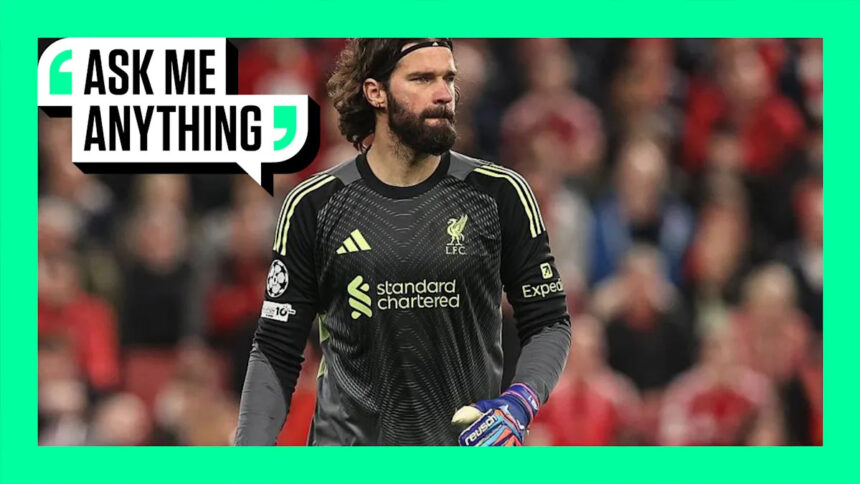
Alisson’s Anfield Farewell? The Real Chance of Liverpool’s No.1 Leaving This Summer
The summer transfer window is a time of fevered speculation, but for Liverpool supporters, the 2025 edition feels particularly ominous. Already, the club is bracing for life without two legendary figures. Mohamed Salah and Andy Robertson have confirmed their departures, stripping Arne Slot’s squad of immense experience and leadership. Now, a third pillar of the recent golden era could be set to fall. The future of Alisson Becker has become the dominant question in our latest Ask Me Anything segment, and the answer from the manager’s mouth was anything but reassuring.
When asked directly about the Brazilian goalkeeper’s prospects, Liverpool head coach Arne Slot offered no guarantees. He did not give the standard “he is not for sale” or “he is our future” soundbite. Instead, he delivered a highly analytical, almost clinical assessment. “The people who make these decisions take everything into account,” Slot stated. “They try to make the best decisions with the interest of the club. It [experience] is definitely one argument to keep him but there are other arguments.”
That single sentence has sent shockwaves through the fanbase. For a manager to publicly acknowledge “other arguments” for selling a player of Alisson’s caliber signals that the door is very much ajar. So, just how likely is a departure? Let’s break down the factors, the math, and the potential outcomes.
The Slot Verdict: Why “Other Arguments” Matter More Than Sentiment
Arne Slot is not a sentimental manager. He arrived at Anfield with a reputation for ruthless squad management, and his recent comments confirm that philosophy. When he points to “other arguments” against keeping Alisson, he is likely referring to the cold, hard realities of modern football finance and squad planning.
First, there is the contract situation. Alisson’s current deal runs until the summer of 2026. This means Liverpool have a finite window to extract a significant transfer fee. After this summer, his value will begin to depreciate rapidly. Selling a 33-year-old goalkeeper with one year left on his deal is textbook smart business.
Second, there is the wage bill. Alisson is among the highest earners at the club. With Salah and Robertson leaving, Liverpool are clearly trying to reset their wage structure. Keeping a veteran goalkeeper on top-tier wages while rebuilding the squad might not align with the long-term financial model Slot and the recruitment team are implementing.
Third, there is the succession plan. Liverpool have invested heavily in Caoimhín Kelleher. The Irish international has proven himself to be a Premier League-quality goalkeeper in cup runs and spot starts. He is 26 years old, hungry for a number one role, and his value will only decrease if he remains on the bench. Selling Alisson now allows Kelleher to step into the spotlight and provides a massive cash injection for other areas of the pitch—like a new defensive midfielder or a winger to replace Salah.
Slot’s admission that “experience is one argument” but not the only one suggests the club is seriously weighing a financial and strategic pivot. The chance of Alisson leaving is not just a rumor; it is a live, internal debate.
The Juventus Link: A Perfect Fit or a Financial Mirage?
The strongest link in the transfer rumor mill points to Juventus. The Italian giants are in a state of flux, looking to re-establish themselves as Serie A and Champions League contenders. Their current goalkeeping situation is unstable, and they crave a world-class, authoritative figure between the sticks. Alisson fits that profile perfectly.
But can Juventus afford him? This is the critical question. Liverpool will demand a fee in the region of €40-50 million for a player of Alisson’s stature, even at 33. While that is a significant sum, it is a bargain compared to the cost of a younger, unproven replacement. Juventus have the prestige and the need, but their financial fair play constraints are well-documented.
However, there are other potential suitors. A move to the Saudi Pro League cannot be ruled out. Clubs in Saudi Arabia have shown a willingness to pay massive fees and wages for established stars. While Alisson has not publicly expressed interest, the financial lure for both the player and the club could be irresistible for Liverpool’s hierarchy. A Saudi move would likely fetch a higher fee than any European club would offer.
The key factor here is Alisson’s personal ambition. At 33, he has won the Premier League, the Champions League, the Club World Cup, and the Copa America. He has nothing left to prove. A new challenge—whether in Italy’s tactical league or a lucrative final payday in the Middle East—might appeal to him. If he pushes for a move, Liverpool will not stand in his way.
The Ripple Effect: What Losing Alisson Means for Liverpool’s Rebuild
Let’s be clear: losing Alisson Becker would be a seismic blow. He is not just a goalkeeper; he is the last line of defense and the team’s primary ball-playing outlet. His sweeping ability and one-on-one prowess have saved Liverpool countless points. Replacing him is statistically impossible with a like-for-like signing.
If Alisson leaves, the immediate consequence is that Caoimhín Kelleher becomes the undisputed number one. This is a risk. Kelleher is excellent, but he has never carried the burden of a 50-game season as a starting Premier League goalkeeper. He is also prone to the occasional lapse in concentration. Slot would be moving from a Ferrari to a very good sports car.
The second consequence is the loss of leadership. With Salah and Robertson gone, Alisson was expected to be the vocal leader of the dressing room. His departure would leave a massive void in experience. Virgil van Dijk remains, but the Dutch defender is also entering the twilight of his career. Liverpool would be entering the 2025/26 season with a very young, inexperienced core.
This is why the decision is so complex. Slot’s “other arguments” might include the need to fund a rebuild. Selling Alisson could provide the capital to buy a top-class center-back or a dynamic attacking midfielder. It is a painful trade-off, but one that data-driven clubs like Liverpool are increasingly willing to make.
Prediction: I believe the chance of Alisson leaving this summer is 60%. The club is in a transitional phase. The combination of a manager who is not emotionally attached to the past, a promising backup waiting in the wings, and a contract that is running down creates a perfect storm for a sale. If a bid of €45 million or more comes in—especially from Juventus or a Saudi club—Liverpool will likely accept. The smart money is on a farewell tour this summer, with Kelleher taking the gloves for the new era.
Conclusion: The End of an Era?
The departure of Mohamed Salah and Andy Robertson already signaled that the 2019-2020 dynasty was officially over. Alisson’s potential exit would be the final nail in the coffin. It would mark the end of the most successful period in Liverpool’s modern history.
From a purely sporting perspective, keeping Alisson is the obvious choice. He is still one of the top three goalkeepers in world football. But football is no longer a purely sporting game. It is a business of asset management, wage structures, and long-term planning. Arne Slot has made it clear that the club’s interest comes before the individual.
For Liverpool fans, the next few weeks will be agonizing. Every interview, every leaked report, every social media post from Alisson’s representatives will be dissected. But the writing is on the wall. The manager did not deny the possibility. He did not offer comfort. He offered logic.
The chance of Alisson leaving this summer is real, significant, and growing by the day. Prepare for an emotional goodbye. The Brazilian wall at Anfield may be coming down.
Source: Based on news from Yahoo Sports.