The Night Football Changed Forever: The ‘Cruel’ Coin Toss and the World’s First Penalty Shootout
For generations, football’s knockout dramas were often resolved not by skill, but by chance. When teams couldn’t be separated after extra time, the fate of a cup tie, or even an entire tournament, was decided by the spin of a coin. It was a system deemed so unsatisfactory, so cruel, that the game’s lawmakers sought a radical solution. That search led, on a warm August evening in 1970, to a modest ground in Hull, where a young boy, a global superstar, and a revolutionary new rule collided to create sporting history.
The “Cruel” System: A Flip of the Coin Decided Destiny
Before we arrive at Boothferry Park, it’s essential to understand the problem the penalty shootout was designed to solve. For decades, drawn knockout matches that remained deadlocked after extra time were settled by one of two methods: a replay (which could be logistically and financially draining) or, more infamously, the toss of a coin.
This practice reached its most absurd and heartbreaking apex in the 1968 European Championship semi-final. Italy advanced to the final after a coin landed in their favour against the Soviet Union. The image of a distraught Soviet captain, Albert Shesternev, walking away as the Italians celebrated a literal lucky break, was a public relations disaster for football. The narrative was clear: a team’s entire campaign, built on months of toil and talent, could be undone by pure luck. The IFAB (International Football Association Board), the game’s rule-making body, knew it had to act. The coin toss was not a test of footballing merit; it was a relic that undermined the sport’s competitive integrity.
Six weeks before that fateful night in Hull, IFAB ratified a new, dramatic procedure: the penalty kick shootout. The basic format we know today—five designated takers from each team, alternating kicks from 11 yards—was born. It was a deliberate move to inject a definitive, skill-based conclusion, transferring the pressure from blind luck to the nerve and technique of the players.
Boothferry Park, 5 August 1970: A Slice of History Unfolds
The stage for this historic experiment was the Watney Cup, a pre-season invitational tournament in England. Its significance is often overlooked, but its timing was perfect. The 1970/71 season was the first under the new rules, and the Watney Cup, kicking off before the Football League, became the unwitting pioneer.
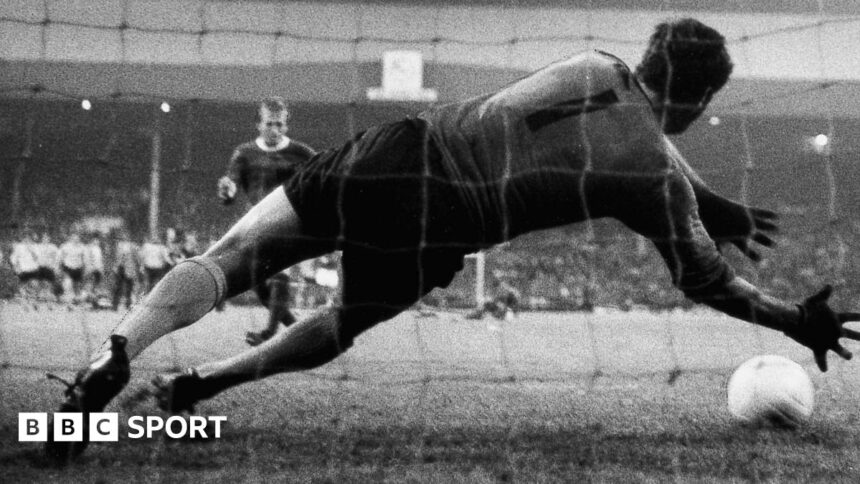
On August 5th, second-division Hull City hosted the mighty Manchester United, a team featuring the iconic George Best. The match ended 1-1 after 90 minutes and remained tied after extra time. The referee, Keith Walker, consulted his notes. The new procedure was now in effect. Among the 25,000 spectators was 11-year-old Martyn Kelly, a devoted Hull City fan. His memory of the event is vividly human. “I remember wishing I had a stool to climb on like the rest of the kids in the ground to get a better view,” Kelly recalls. “The world’s first official penalty shootout was not something I wanted obscured by other people’s heads.”
The air crackled with unprecedented tension. No one knew what to expect. There was no blueprint, no archive of pressure to study. As the players gathered at the centre circle, a realization dawned on young Kelly. “Blimey,” he thought. “It’s George Best, one of the greatest players ever. He’s going to take the first penalty in the world’s first penalty shootout.”
The sequence that followed is now legendary:
- George Best stepped up first for United and scored, sending Hull keeper Ian McKechnie the wrong way.
- Hull’s John Hawley replied, coolly slotting past Alex Stepney.
- United’s Brian Kidd and Hull’s Chris Simpkin both converted their kicks.
- Then, the twist: Denis Law, United’s other legendary striker, saw his effort saved by McKechnie.
- Hull’s Terry Neill scored, putting the underdogs ahead 3-2.
The drama culminated with Hull’s goalkeeper, Ian McKechnie, having to take his team’s fifth penalty. He missed, hitting the crossbar. The shootout ended 4-3 to Manchester United, but the real winner was the format itself. It was an instant, visceral success. It had provided a clear, dramatic, and fair winner, replacing the anticlimactic coin toss with heart-stopping theatre.
From Novelty to Nerve-Shredding Norm: The Evolution of the Shootout
That night in Hull was just the beginning. The penalty shootout rapidly evolved from a curious experiment into the ultimate crucible of sporting nerve. Its adoption was global and its moments iconic. It has decided World Cup finals (1994, 2006), European Championships (1976, famously with Panenka’s chip), and countless club finals. It created a new breed of hero—the specialist penalty-saving goalkeeper—and a new type of villain, the player who “blazes over.”
Expert analysis of the shootout reveals a fascinating psychological duel. It strips the game of its fluid, team-based nature and reduces it to a series of isolated, high-stress confrontations. Studies show it is less a test of technical skill—most professionals can score a penalty in training—and more a battle of mental fortitude, coping with what psychologists call “catastrophic thinking.” The goalkeeper’s role transformed from passive participant to active disrupter, using gamesmanship, studied tells, and sheer presence to get inside the taker’s head.
The format itself has seen minor tweaks, most notably the switch from the “sudden death” sequence starting immediately after the initial five kicks to the current “ABBA sequence” (similar to a tennis tie-break) in some competitions, designed to reduce the supposed advantage of shooting first. Yet, the core principle remains unchanged from that night in 1970: a test of skill under maximum pressure to find a winner.
The Future of Decisive Drama: Predictions and Lasting Legacy
Will football ever move beyond the penalty shootout? Proposals surface periodically: increasing the distance, introducing a run-up limit, or even adopting hockey-style alternating attacks from a moving ball. However, the shootout’s brilliance lies in its brutal simplicity. It is instantly understandable, universally applicable, and delivers unparalleled drama. It is unlikely to be replaced entirely.
Looking ahead, we can predict several trends:
- Advanced data analytics will play a bigger role. Teams will have even more detailed dossiers on opponents’ penalty tendencies, from preferred corner to run-up patterns.
- Goalkeeper psychology and movement science will become even more specialized, with training using VR and biometric feedback to simulate the intense pressure.
- The debate over “fairness” will continue, but the shootout’s status as football’s most iconic and dreaded tiebreaker is secure. It is the purest form of sporting gladiatorial combat the modern game has.
The legacy of August 5, 1970, is immeasurable. It ended the genuinely “cruel” system where a coin decided fates. In its place, it gave us a gallery of unforgettable images—of joy, despair, and incredible individual bravery. It gave us Baggio’s miss in Pasadena, Southgate’s saved effort at Wembley, and Drogba’s winning kick in Munich.
It all started when a young boy in Hull searched for a better view, and George Best walked nervously to a spot 11 yards from goal. Football, that night, didn’t just find a new way to decide a match. It discovered the perfect recipe for everlasting drama, ensuring that skill, not chance, would have the final, nerve-shredding word.
Source: Based on news from BBC Sport.