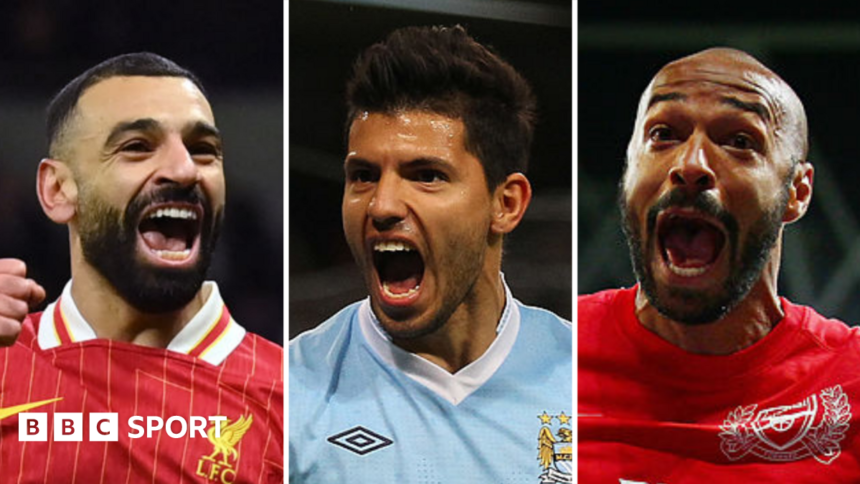
Where Does Mohamed Salah Rank Among the Greatest Premier League Forwards?
The Kop will sing his name for generations, but the song is nearing its final chorus. Mohamed Salah’s epoch-defining Liverpool career, a saga of relentless goals, shattered records, and rediscovered glory, is drawing to a close. With the announcement that this season will be his last at Anfield, the football world is compelled to assess a legacy. With 255 goals in 435 games, standing as Liverpool’s third-highest scorer of all time, his status as a Reds immortal is sealed. Yet, a broader, more contentious debate beckons: in the pantheon of Premier League greats, where does the Egyptian King truly rank among the competition’s most lethal forwards?
A Statistical Colossus in the Modern Era
Any discussion of greatness must begin with the cold, hard numbers, and Salah’s are simply staggering. Since his 2017 arrival, he has been a model of ruthless, consistent efficiency. He is not merely a scorer; he is a statistical anomaly. Salah is one of only three players in Premier League history to both score and assist 150+ goals, entering an exclusive club with Ryan Giggs and Wayne Rooney. He has hit 20+ goals in all competitions in six of his seven seasons at Liverpool—a feat of remarkable durability.
Consider these bullet-point achievements that frame his dominance:
- Most goals in a 38-game Premier League season (32) – a record that still stands.
- Four-time winner of the Premier League Golden Boot.
- Over 200 Premier League goal involvements at a rate faster than Thierry Henry.
- First Liverpool player to score in nine consecutive matches.
- Only player to score on the opening weekend of six consecutive Premier League seasons.
This isn’t just volume; it’s sustained, record-breaking excellence at the sharpest end of the most physically demanding league. In an era of intense pressing and tactical complexity, Salah’s output has been a constant, propelling Liverpool to every major honour.
The Intangibles: Defining an Era for Liverpool
Statistics capture the *what*, but they struggle to encapsulate the *how* and the *why*. Salah’s legacy is inextricably linked to Liverpool’s renaissance under Jürgen Klopp. He wasn’t just a finisher; he was the catalytic spearhead of one of the most devastating counter-attacking machines the league has seen. His signing was a statement, transforming Liverpool from top-four hopefuls to relentless champions.
His game is built on a potent trinity of attributes: blistering acceleration, a lethal left foot, and an unwavering mental resilience. He has shouldered the scoring burden for nearly a decade, facing double-marking, physical challenges, and the immense pressure of expectation, yet his performance levels rarely dip. Beyond the goals, his work rate set a new standard for modern forwards. Tracking back, pressing defenders, and sacrificing himself for the system became hallmarks of his play, embodying Klopp’s “heavy metal football.”
Furthermore, his cultural impact cannot be overstated. As a proud Arab and Muslim athlete, Salah became a global icon, transcending sport. He challenged stereotypes and inspired millions, adding a profound social dimension to his sporting achievements. At Anfield, he evolved from a talented winger into a legendary figure—a symbol of belief and success.
The Pantheon Debate: Comparing Icons Across Generations
This is where the debate heats up. Ranking forwards across eras is fraught with difficulty, as styles, tactics, and league competitiveness evolve. Salah must be measured against the undisputed legends: Alan Shearer, the ultimate traditional number nine and record scorer; Thierry Henry, the archetype of the modern, graceful forward; Wayne Rooney, the complete English talent; and Sergio Agüero, the most clutch finisher of the modern age.
Each has a compelling claim. Shearer’s sheer goal volume and longevity are unmatched. Henry redefined the position with his elegance and combination play, delivering iconic moments and titles. Rooney offered unparalleled all-around contribution, while Agüero’s penchant for decisive goals is legendary.
Salah’s argument rests on a unique blend. He lacks Shearer’s physical dominance but boasts superior creative numbers. He may not have Henry’s effortless aura, but his goal-scoring consistency in a single club era is arguably superior. Unlike Agüero, he has been the undisputed main man for his entire tenure, carrying the offensive load year after year. His trophy haul—a Premier League, Champions League, FA Cup, and League Cup—validates his impact in a way that, for example, Shearer’s individual brilliance could not achieve at Blackburn and Newcastle.
The Verdict and Anfield’s Inevitable Void
So, where does he rank? A purely statistical and trophy-based analysis places him firmly in the top five. However, to limit him to fifth feels like a disservice to the transformative nature of his career. Mohamed Salah is not just a great Premier League forward; he is a defining forward of his generation and, without question, the greatest African player in the league’s history.
He sits just below the untouchable tier of Shearer and Henry—two players who, for a longer period, were the standard-bearers for the league globally. But he pushes shoulder-to-shoulder with Rooney and Agüero in the next echelon, with a strong case to be placed above them due to his role as the central figure in a historically successful Liverpool side.
His departure will leave a chasm at Anfield. Replacing 25+ goals a season is a monumental sporting challenge, but replacing his mentality, his aura, and his symbolic importance is near impossible. The Premier League will lose one of its last remaining global superstars, a player whose very presence in a fixture guaranteed spectacle.
In conclusion, Mohamed Salah’s legacy is dual-faceted: a Liverpool god and a Premier League giant. He bridged the club’s storied past to its glorious present, delivering moments that will be replayed forever. Among the Premier League’s forward legends, he earns a podium finish—a relentless, record-breaking, era-defining force who didn’t just join the conversation of greatness but forcefully rewrote its parameters for the modern age. The King is leaving his castle, but his throne in history is permanently reserved.
Source: Based on news from BBC Sport.