The Next Wave: Who Can Challenge the Sinner-Alcaraz Duopoly in 2026?
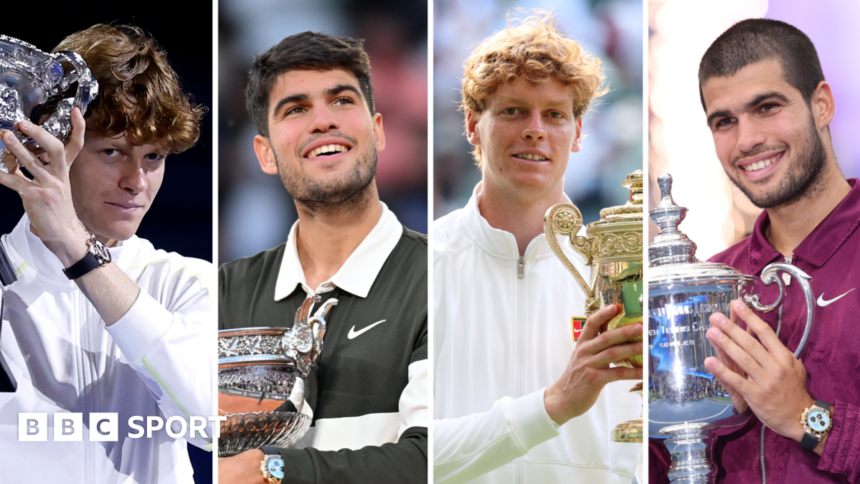
The landscape of men’s tennis has undergone a seismic shift, but the view from the summit remains remarkably exclusive. As age finally caught up with the legendary ‘Big Three’—Federer, Nadal, and Djokovic, who once hoarded 66 of 78 majors—a new, thrilling rivalry emerged to fill the void. Yet, the anticipated era of wide-open draws has been emphatically shut down by two generational talents: Carlos Alcaraz and Jannik Sinner. Having swept the last eight Grand Slam titles between them, with Sinner claiming the 2025 Australian Open and Wimbledon and Alcaraz seizing Roland Garros and the US Open, they have established a formidable duopoly. As we look ahead to the 2026 season, the defining question in the sport is no longer about their rivalry, but about who, if anyone, can break their stranglehold.
The Established Threats: Veterans and Near-Peers
Before scanning the horizon for new challengers, a handful of established stars possess the proven pedigree to disrupt the top two. These are the players who have been in the trenches, tasted major success, and understand the monumental task required.
Alexander Zverev remains a constant threat. His powerful baseline game, monstrous serve, and improved mental fortitude make him a nightmare on any surface. A former US Open champion and Olympic gold medalist, Zverev’s best-of-five stamina and experience in deep Slam runs make him the most likely candidate from the previous generation to spring an upset. His key to success in 2026 will be maintaining peak physical condition and converting his undeniable talent into a second major title.
Then there is Holger Rune. The mercurial Dane has shown flashes of brilliance capable of matching Alcaraz’s explosiveness and Sinner’s power. His all-court game and fearless attitude have already delivered Masters 1000 titles and deep Slam runs. For Rune, the challenge is one of tactical consistency and emotional control. If he can channel his fiery energy into a sustained, disciplined campaign, he has the raw tools to beat anyone on any given day. 2026 could be the year he puts it all together for a full fortnight.
One cannot discount the relentless Daniil Medvedev. While his unique, deep-court style has faced challenges against the explosive power of Sinner and Alcaraz, Medvedev’s chess-like intelligence and inhuman defensive skills make him a perpetual threat, particularly on hard courts. A former US Open champion and multiple finalist, he only needs a slight dip in his opponents’ level to storm through a draw.
The Dark Horses: Talent on the Cusp of Breakthrough
Beyond the established contenders lies a group of immensely talented players whose moment may arrive in 2026. These dark horses have shown the potential but now need to translate it into Slam-semifinal and final appearances.
- Ben Shelton (USA): The lefty’s rocket serve and explosive net game offer a stylistic contrast that can fluster even the best. His infectious energy and improving baseline consistency suggest a major breakthrough is imminent, likely first on the hard courts of New York or Melbourne.
- Luca Van Assche (France): While countryman Arthur Fils captures more headlines, Van Assche’s metronomic consistency and elite movement have drawn comparisons to a young Novak Djokovic. His mental resilience and point-construction mark him as a future top-10 staple, capable of grinding down opponents.
- João Fonseca (Brazil): The charismatic Brazilian brings a throwback style of aggressive, flamboyant tennis. His fearlessness in big moments and powerful groundstrokes make him a dangerous floater. With more tour-level seasoning, he could become a major disruptor.
This group represents the most volatile element in the 2026 equation. Their development curves are steep, and a single, confidence-boosting win over a top player could unlock a season of elite performance.
The X-Factors: Wildcards and Unknown Quantities
The journey to the top of tennis is nonlinear. Challenges to Sinner and Alcaraz could emerge from unforeseen places, driven by physical evolution, technical overhaul, or sheer luck.
First, consider the impact of injury or burnout. The physical demands of the modern game are brutal, and both Alcaraz and Sinner play an intensely physical style. A minor dip in fitness or a need for recovery could open a window for the chasing pack at a key tournament.
Second, a veteran could experience a late-career resurgence. Could a figure like Stefanos Tsitsipas, with his sublime clay-court game, put together two magical weeks in Paris? Or might a resurgent Taylor Fritz, armed with one of the best serves on tour, catch fire on Wimbledon’s grass? The motivation of proving oneself against a new era can be powerful.
Finally, tennis history is punctuated by breakout stars who arrive seemingly from nowhere. A teenager currently dominating the junior circuit or the Challenger tour could make a startling leap, much as Alcaraz himself did. The identity of this player is unknown today, but the ecosystem of the sport is always producing new talent hungry to make a mark.
Surface Analysis: Where Are They Most Vulnerable?
A unified challenge across all four Slams is unlikely. The path to dethroning the kings will be surface-specific.
Australian Open (Hard Court): Sinner’s dominion here is clear, but the fast, high-bouncing courts suit big servers and flat hitters. This is where a player like Shelton, Medvedev, or an in-form Zverev could ride a hot serving streak to an upset. The relatively early-season timing also introduces an element of unpredictability.
French Open (Clay): Alcaraz is the defending champion and a natural on the dirt, but clay remains the great equalizer. It rewards patience, physical endurance, and tactical nuance. This is the arena where a grinder like Van Assche, a clay specialist like Tsitsipas, or even a miraculously fit Rafael Nadal (should he still be competing) could extend rallies and test Alcaraz’s patience and point construction over five sets.
Wimbledon (Grass): Sinner’s 2025 title confirmed his grass-court prowess, but the surface’s low bounce and short points create volatility. A server like Fritz, Matteo Berrettini (if healthy), or a confident Rune, who can take time away and attack the net, could thrive. Grass-court tennis often produces surprise finalists.
US Open (Hard Court): The chaotic energy of New York and the typically faster DecoTurf courts make this the most unpredictable major. Alcaraz is a master here, but the tournament has a history of crowning first-time champions. This is the prime venue for a dark horse—a powerful, aggressive player riding a wave of crowd support—to make a historic run.
Conclusion: The Daunting Task Ahead
The ascent of Carlos Alcaraz and Jannik Sinner has been so swift and their mastery so comprehensive that the chasing pack faces a daunting psychological and technical hurdle. They are not just competing against two brilliant players; they are competing against a new standard of power, speed, and tactical versatility.
For 2026, the most plausible scenario is not the end of the duopoly, but its first credible cracks. We are likely to see a Zverev or a Medvedev snag a major, or a Rune finally break through. The dark horses will score more frequent wins in Masters events, building belief. The true “challenge” will initially manifest as consistent deep runs and finals appearances, applying pressure that even Alcaraz and Sinner cannot ignore forever.
Ultimately, the greatness of an era is defined by the strength of its rivalry and the quality of its challengers. While Alcaraz and Sinner have created a thrilling new chapter, the narrative of 2026 will be written by those with the courage, skill, and resilience to stare them down. The hunt is on, but the targets are moving at breathtaking speed.
Source: Based on news from BBC Sport.