Why Does a 2027 NFL Mock Draft Have the Lions Picking a QB in Round 1? The Shocking Jayden Maiava Projection, Explained
In the world of NFL draft analysis, looking three years into the future is usually reserved for the most optimistic of fan forums or the deepest of offseason rabbit holes. Yet, when The Athletic’s esteemed draft guru Dane Brugler releases a 2027 mock draft, the football world stops to listen. And his latest projection has sent a jolt through the Motor City: the Detroit Lions are selecting a quarterback with the No. 23 overall pick.
- The Quarterback Desert of 2026 vs. The Oasis of 2027
- Who is Jayden Maiava? The Heisman Contender in the Making
- The Ghost of Joey Harrington: Why Lions Fans Should Be Nervous (But Not Panic)
- What This Means for Jared Goff and the Lions’ Super Bowl Window
- Conclusion: A Mock Draft That Reveals a Deeper Truth
The pick? Jayden Maiava, the USC Trojans signal-caller. The reaction? Confusion, skepticism, and a healthy dose of “Wait, why?” After all, the Lions just invested heavily in Jared Goff, signing him to a four-year, $212 million extension in 2024. Goff has been the steady hand steering Dan Campbell’s ship to back-to-back NFC North titles and a trip to the NFC Championship game. So why would Brugler, one of the most respected evaluators in the business, project a quarterback in the first round for a team that appears set under center?
Let’s cut through the noise. The answer isn’t about Jared Goff’s performance in 2024 or 2025. It’s about the 2027 draft class, the Super Bowl odds, and the sheer depth of quarterback talent that Brugler sees on the horizon. This is not a condemnation of Goff. This is a strategic, long-range forecast that deserves a deep dive.
To understand the rationale, we must examine the state of the 2026 quarterback class (spoiler: it’s weak), the meteoric rise of Maiava, and the cold, hard math of NFL roster construction. Buckle up, Lions fans—this is a projection that could reshape your understanding of the team’s future.
The Quarterback Desert of 2026 vs. The Oasis of 2027
The single most important factor in Brugler’s projection is the stark contrast between the upcoming 2026 NFL Draft and the 2027 class. As of early 2025, the 2026 crop of quarterbacks is widely viewed as one of the weakest in recent memory. There is no surefire, can’t-miss prospect like Caleb Williams or Trevor Lawrence. The top names—such as Arch Manning (Texas) or Nico Iamaleava (Tennessee)—are raw, unproven, or simply not generating the same pre-draft buzz that usually fuels a first-round run.
Brugler, in his analysis, points to a “plethora of appetizing quarterbacks” in 2027. This is a massive shift. The 2027 class is shaping up to be a generational deep pool, headlined by names like DJ Lagway (Florida), Bryce Underwood (LSU), and, of course, Jayden Maiava. When you have a draft class that is loaded at the most important position, teams that are stable at quarterback often find themselves in a unique position: they can draft a developmental prospect without the pressure of immediate need.
Here’s the key takeaway: The Lions aren’t drafting a replacement for Goff in 2027. They are drafting a long-term insurance policy and a potential trade chip. Think of it as the Green Bay Packers model—drafting Jordan Love while Aaron Rodgers was still elite. The Lions, with a roster built to win now, can afford to take a quarterback at No. 23 and let him sit for two or three years. The 2027 class offers the depth to do that without reaching for a flawed prospect.
- 2026 QB Class: Thin, risky, no consensus top-10 talent.
- 2027 QB Class: Deep, athletic, multiple potential first-rounders.
- Lions Strategy: Capitalize on surplus value, not immediate need.
Brugler’s logic is simple: if you have a chance to draft a quarterback with Heisman potential at pick No. 23, you take it—even if your current starter is a Pro Bowler. The value is simply too great to pass up in a class this rich.
Who is Jayden Maiava? The Heisman Contender in the Making
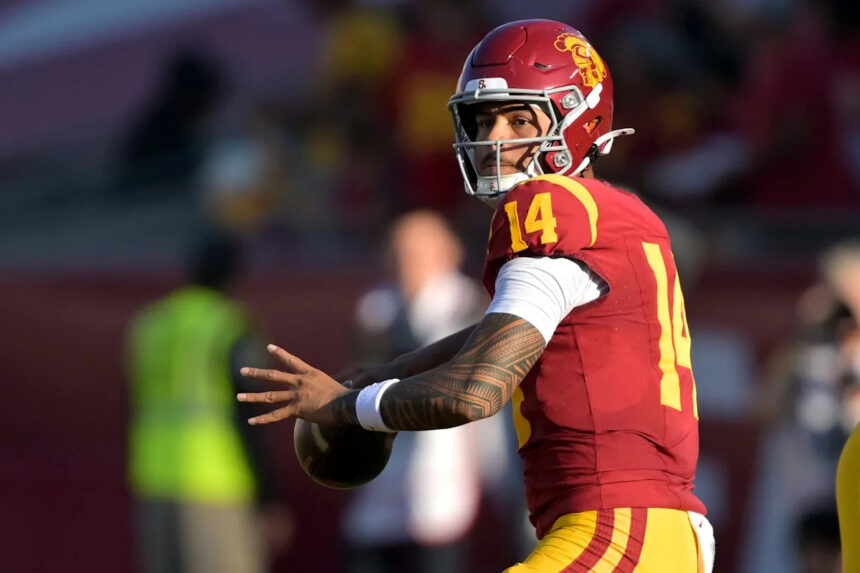
So, who exactly is Jayden Maiava? If you’re not a college football sicko, the name might be unfamiliar. But by 2027, you will know it well. Maiava is the USC Trojans quarterback who transferred from UNLV in 2024. He is a 6-foot-4, 220-pound dual-threat with a rocket arm and surprising mobility. In his lone season at UNLV (2023), he threw for over 3,000 yards and 17 touchdowns while rushing for 300 yards.
Brugler’s write-up is telling: “Despite losing Makai Lemon and Ja’Kobi Lane, Maiava is in a situation to become a Heisman contender and push for a spot in the first round.” This is a critical observation. Lemon and Lane were USC’s top two wide receivers. Their departure—likely to the NFL after 2025 or 2026—would normally cripple a quarterback’s production. But Brugler sees Maiava’s talent as transcendent enough to overcome that loss. He views Maiava as a system-proof talent who can elevate his supporting cast.
What makes Maiava so intriguing for the Lions? It’s the arm talent and the off-script ability. While Jared Goff is a master of the quick game and pre-snap reads, he is not a mobile quarterback who extends plays. Maiava offers a different dimension: the ability to escape the pocket, throw on the run, and make plays with his legs. In a league trending toward Patrick Mahomes and Josh Allen prototypes, Maiava fits the modern mold.
However, there are risks. Maiava has only one full season of starting experience at the FBS level. His accuracy on deep balls and decision-making under pressure are still question marks. But the raw tools are undeniable. If he develops under Lincoln Riley at USC—a quarterback whisperer who produced Baker Mayfield, Kyler Murray, and Caleb Williams—Maiava could be the top quarterback taken in 2027.
For the Lions, drafting Maiava would be a bet on ceiling over floor. It’s a bet that his physical gifts can be refined into a starting-caliber NFL quarterback, even if it takes two or three years of seasoning behind Goff.
The Ghost of Joey Harrington: Why Lions Fans Should Be Nervous (But Not Panic)
Let’s address the elephant in the room: the 2002 NFL Draft. The Lions selected Joey Harrington with the No. 3 overall pick. Harrington, a charismatic quarterback from Oregon, was supposed to be the franchise savior. He was not. He went 18-37 as a starter, threw more interceptions than touchdowns, and became a symbol of the Lions’ decades-long quarterback misery.
Seeing a mock draft that connects the Lions to a first-round quarterback—especially one from a Pac-12 program (now Big Ten)—immediately triggers PTSD for long-suffering Detroit fans. The memory of Harrington’s “Joey Blue Skies” hype is still fresh. But here’s the critical difference: context.
In 2002, the Lions were a desperate franchise. They had no quarterback, no offensive line, and no winning culture. They reached for a quarterback out of necessity. In 2027, the Lions are a Super Bowl contender. They have a top-five offensive line, a dynamic running game, a stifling defense, and a head coach who has changed the entire organizational mindset. Drafting a quarterback at No. 23 is a luxury, not a lifeline.
Furthermore, the Lions’ current front office, led by Brad Holmes and Dan Campbell, has proven they can evaluate talent. They hit on Amon-Ra St. Brown (fourth round), Penei Sewell (first round), and Sam LaPorta (second round). They are not the same organization that whiffed on Harrington. If Holmes and Campbell decide to draft a quarterback in 2027, it will be because they see a specific, calculated advantage—not because they are panicking.
The comparison to Harrington is a cautionary tale, but not a prophecy. The 2027 Lions are a completely different animal. They have the infrastructure to develop a quarterback the right way. They can afford to let Maiava sit, learn, and grow without the pressure of starting as a rookie. That is the exact opposite of the Harrington situation.
What This Means for Jared Goff and the Lions’ Super Bowl Window
The most obvious question: Does this projection mean the Lions are moving on from Jared Goff? The answer is a resounding no—at least not in the short term. Goff is 30 years old, entering his prime, and coming off the best statistical season of his career (4,629 yards, 37 touchdowns, 12 interceptions in 2024). He is the leader of the offense and the emotional heartbeat of the locker room.
However, the NFL is a brutal business. Goff’s contract is structured so that the Lions can get out of it after 2026 with minimal dead cap. If Goff regresses, or if the Lions win a Super Bowl and decide to reset the cap, drafting a quarterback in 2027 provides a seamless transition. It’s the ultimate hedge.
Consider the Kansas City Chiefs model. They drafted Patrick Mahomes while Alex Smith was playing at an All-Pro level. Smith was traded a year later, and the Chiefs never missed a beat. The Lions could replicate that. If Maiava develops into a star, Goff becomes a valuable trade asset. If Goff continues to play at a high level, the Lions have a cheap, talented backup or a trade chip to recoup draft capital.
The Super Bowl odds used to create this mock draft place the Lions at No. 23 overall—a pick that indicates a playoff team, but not a top-tier contender. This is crucial. A pick in the early 20s is the sweet spot for a developmental quarterback. You’re not picking high enough to land a generational prospect, but you’re picking late enough that the risk is manageable. The Lions are in a position to win now and build for the future simultaneously.
My prediction? If the Lions select Jayden Maiava in 2027, it will be one of the most debated picks in franchise history. But it will also be the smartest. It signals that the Lions are not just a one-hit wonder. They are building a dynasty. They are preparing for the day when Goff’s contract becomes untenable or his play declines. And they are doing it by leveraging the deepest quarterback class in a decade.
Conclusion: A Mock Draft That Reveals a Deeper Truth
Dane Brugler’s 2027 mock draft is not a prediction. It is a thought experiment. It forces us to ask uncomfortable questions about roster construction, quarterback value, and the ever-shifting landscape of the NFL. For the Detroit Lions, the pick of Jayden Maiava is a vote of confidence in the future, not a knock on Jared Goff.
The Lions are no longer the team that reaches for a Joey Harrington out of desperation. They are a team with a culture, a plan, and the luxury of patience. Drafting a quarterback in the first round of 2027 is not a sign of panic. It is a sign of sustained excellence. It means the Lions are thinking about the next five years, not just the next five games.
Will it happen? Only time will tell. But one thing is certain: the Detroit Lions are no longer a franchise that gets mocked for drafting a quarterback. They are a franchise that strategically plans for one. And that, above all, is the most encouraging sign for Lions fans everywhere.
So, when you see that 2027 mock draft, don’t cringe. Smile. It means your team is finally playing chess while everyone else is playing checkers.
Source: Based on news from Yahoo Sports.