Why the 2026 Masters Must Be Justin Rose’s Time to Finally Wear Green
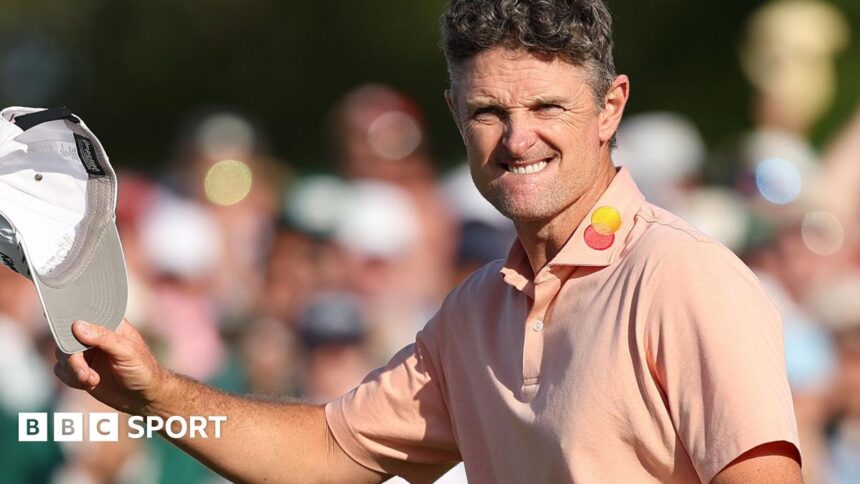
The scene on Augusta National’s 18th green in 2025 was one of the most visceral in modern golf history. Rory McIlroy, finally, cathartically, had his Masters moment. The weight of a career-long quest lifted in a roar of relief and joy. But in that same frame, just steps away, stood the poignant counterpoint: Justin Rose, a gracious but hollowed-out figure in the Georgia dusk. He had just authored a final-round masterpiece—a 66 featuring a back-nine 32 and a closing birdie—only to be denied in a play-off. It was his third runner-up finish at Augusta, a statistic that places him in a heartbreaking, yet historically significant, tier. As the golf world turns its gaze forward, a compelling narrative is crystallizing: if McIlroy’s victory was the perfect ending to one story, the 2026 Masters must be the long-awaited beginning of another for Justin Rose.
The Agony of Augusta: A History of Heartbreak
Justin Rose’s relationship with Augusta National is a complex tapestry of brilliance and anguish. With three runner-up finishes, he stands in an exclusive, yet frustrating, club. Only golf legends Jack Nicklaus, Ben Hogan, and Tom Weiskopf have more Masters second places. This isn’t the record of a player who stumbled into contention; it is the hallmark of a man whose game is perpetually sculpted for the test, yet who has been pipped at the post by fate, fortune, and otherworldly performances.
His 2025 defeat was perhaps the most crushing. At 45, he summoned a round for the ages. Consider the statistics:
- 10 birdies in a final round pressure cooker.
- An inspired back nine of 32, birdieing the last to force the play-off.
- A tying low total of the week at 11 under par.
This was not a case of a veteran hanging on; it was a commanding statement. As Rose himself reflected to BBC Sport: “Augusta was painful, but at the same time I was proud at how I played.” That duality—the pride in performance wrestling with the pain of outcome—defines his Masters journey. Each close call has been a lesson in granite temperament and shot-making excellence, banking experience that may prove invaluable.
Anatomy of an Augusta Specialist: Why Rose’s Game Fits
What makes Rose’s near-misses more than mere misfortune is the undeniable synergy between his skill set and the demands of the course. He is not a boom-or-bust player who catches a hot week; his game is built on a foundation that travels perfectly to Georgia.
Iron Play is King, and Rose has long been one of the game’s premier ball-strikers. His high, penetrating ball flight allows him to attack Augusta’s treacherous, sloping greens with the necessary stopping power. His strategic mind allows him to dissect the course’s complex angles, playing away from sucker pins and into the correct quadrants. Furthermore, his short game, particularly his touch on Augusta’s lightning-fast greens, has been refined over two decades of competition. The 2025 performance proved that, even as the power-hitting generation matures, Rose’s complete, controlled style can still go shot-for-shot with anyone on that layout.
The emotional maturity he displayed in defeat is also a critical asset. He watched McIlroy’s celebration not with bitterness, but with the quiet understanding of a man who has seen golf’s highest highs and lowest lows. That perspective is a form of armor.
The 2026 Prediction: A Narrative Too Powerful to Deny?
The stars are aligning for a storybook 2026 Masters. Golf, at its core, thrives on these narratives of redemption and rightful coronation. The sport witnessed it with McIlroy. It witnessed it with Phil Mickelson’s long-awaited breakthrough. The Green Jacket in 2026 carries with it a sense of poetic destiny for Rose.
He will be 46, likely aware that his windows at major championships are narrowing. This awareness can be a powerful motivator, sharpening focus and eliminating peripheral noise. The memory of the 2025 play-off will be fresh, not as a scar, but as a blueprint. He knows exactly what it takes to post a winning number on Sunday; he has done it, only to find one man better on the day. The golfing public, having shared in McIlroy’s catharsis, is now primed to invest emotionally in Rose’s quest.
Predicting a major winner is a fool’s errand, but predicting a primary contender is not. Rose will arrive at Augusta National in 2026 as:
- A proven, perennial contender with unmatched course pedigree.
- A player with recent, scintillating form on that very stage.
- The central figure in the tournament’s most compelling human story.
The combination of skill, timing, and narrative momentum creates a perfect storm.
Conclusion: The Final Act of a Masterful Career
Justin Rose’s career is Hall of Fame-worthy: an Olympic Gold Medalist, a U.S. Open champion, a former world number one. Yet, the absence of a Green Jacket leaves a conspicuous gap in a magnificent resume. His three runner-up finishes are not a curse, but a testament to his sustained excellence at the most exclusive tournament in golf. They are proof of concept.
The 2025 Masters provided the final, brutal, beautiful piece of evidence. He played “some of the best final day golf ever seen at Augusta National” and came up one shot short. That performance didn’t diminish him; it confirmed that his game, and his heart, are still more than capable. The romance of sport often demands a fitting finale. After serving as the gracious foil in McIlroy’s fairy tale, it is now Justin Rose’s turn to author his own. The stage is set, the history is written, and the opportunity is ripe. In 2026, it is time—past time—for Justin Rose to come of age at the Masters, and finally claim the jacket that has been waiting for him all along.
Source: Based on news from BBC Sport.