Why the Bernabeu is Swapping Football for Tennis: Inside the Madrid Open’s Iconic Crossover
The hallowed turf of the Santiago Bernabéu Stadium has witnessed the magic of Di Stéfano, the artistry of Zidane, and the sheer dominance of Cristiano Ronaldo. But this April, the echoes of “¡Hala Madrid!” will be joined by the distinctive *thwack* of tennis balls. In a stunning move, Real Madrid’s iconic fortress will temporarily host the world’s top tennis stars, including Spain’s homegrown hero Carlos Alcaraz, as a practice venue for the Mutua Madrid Open. This is more than a logistical decision; it’s a symbolic passing of the baton between Spanish sporting royalty, a masterstroke in event spectacle, and a testament to the soaring status of a tournament—and a player—demanding a stage of mythical proportions.
A Collision of Titans: Football’s Cathedral Embraces Clay
For decades, the Madrid Open has carved out its prestige at the modern, purpose-built Caja Mágica (Magic Box). Yet, the tournament’s ambition has consistently bumped up against the shadow of its location. Madrid is, first and foremost, a football city, and the Bernabéu is its beating heart. By installing a **regulation clay practice court** within the stadium from April 23-30, organizers aren’t just offering players a novel training venue; they are orchestrating a powerful narrative. They are fusing the legacy of **Real Madrid’s global brand** with the elite appeal of top-tier tennis, creating a halo effect that elevates the entire event.
The logistics are as fascinating as the symbolism. The court will precisely **mirror the playing surfaces at the Caja Mágica**, ensuring players get authentic preparation. This isn’t a gimmick surface; it’s a high-performance tool. For stars like Alcaraz, practicing in an 80,000-seat coliseum, even an empty one, replicates the unique atmospheric pressure and spatial awareness needed for the tournament’s later stages. It’s a psychological edge, a chance to feel the weight of history while fine-tuning a drop shot.
- Unprecedented Access: Players are granted exclusive use of one of the world’s most famous sporting venues.
- Performance Precision: The court is an exact replica of Caja Mágica clay, ensuring no adjustment shock.
- Psychological Preparation: Training in a cavernous stadium builds mental fortitude for big-match moments.
- Symbolic Statement: It signals the Madrid Open’s desire to be seen as an event of equal cultural weight to elite football.
Carlos Alcaraz: The Heir Apparent Needs a Throne Room
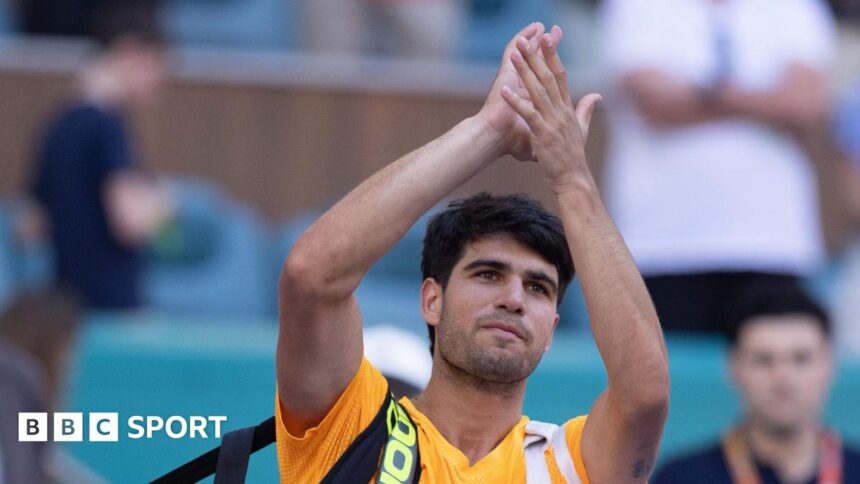
At the center of this convergence is Carlos Alcaraz. The young phenom from Murcia isn’t just the world number one and defending champion; he is a cultural force in Spain whose explosive, joyful style has drawn comparisons to a young Rafael Nadal. His connection to football is also well-documented—a passionate fan, often seen celebrating with players from Spain’s national team and his beloved FC Cartagena. Having Alcaraz practice at the Bernabéu is a story that writes itself: the nation’s newest sporting prince honing his craft in the kingdom of its established kings.
This move is a strategic masterclass in leveraging local hero appeal. While sessions are closed to the public, the imagery alone is priceless. Photographs and social media content of Alcaraz rallying on clay with the iconic stadium seats as a backdrop will flood global media. It creates a “where greatness trains” narrative, intrinsically linking his quest for a **Madrid Open title defense** with the legacy of Real Madrid’s Champions League triumphs. For other players, from Djokovic to Sabalenka, it’s an irresistible opportunity to tap into that same aura, making the practice court a coveted privilege rather than a mere facility.
Expert Analysis: The Business of Sporting Spectacle
From a commercial and operational standpoint, this decision is brilliant. The Madrid Open competes in a crowded spring clay-court calendar, nestled between Monte-Carlo and Rome, and just before Roland Garros. To stand out, it must offer something beyond points and prize money. It must offer an experience. By utilizing the Bernabéu, the tournament generates immense pre-event buzz without disrupting the actual competition at the Caja Mágica.
“This is event elevation 101,” notes a veteran sports marketing analyst. “You’re borrowing equity from a brand with hundreds of millions of fans worldwide. You’re generating headlines in football-crazed markets that might not normally follow tennis. For the players, it’s a unique perk that increases tournament loyalty. For Real Madrid, it showcases the versatility and year-round utility of their newly renovated stadium. It’s a win-win that blurs the lines between sporting disciplines.”
Furthermore, it positions the **Madrid Open as a trendsetter**. We’ve seen tennis played on aircraft carriers and in shopping malls for exhibition, but this is a serious, integrated use of a legendary venue for a core component of a top ATP/WTA event. It sets a new bar for how tournaments can think creatively about their footprint and partner with other sporting institutions.
Predictions: A Legacy Play for the Future
The immediate impact will be a surge in global media attention in the week leading up to the tournament. Look for carefully curated behind-the-scenes footage of players’ reactions to practicing in the stadium to dominate sports news cycles. The long-term implications, however, are even more intriguing.
- Could this lead to exhibition matches at the Bernabéu? The success of this trial makes a future “Clasico” of tennis—Nadal vs. Alcaraz, for instance—in a filled Bernabéu a tangible possibility.
- Will other tournaments follow suit? Might Rome partner with the Stadio Olimpico, or Canada’s event with an iconic NHL arena? The Madrid Open may have started a new arms race in venue prestige.
- A permanent fusion? While logistically complex, the positive reaction could see the Bernabéu practice court become an annual tradition, a unique selling point that becomes synonymous with the Madrid Open brand.
For Carlos Alcaraz, the pressure and inspiration of that environment could be the catalyst for another deep run. Training where his football idols have made history could forge a champion’s mindset, potentially fueling him to **successfully defend his Madrid crown** and carry formidable momentum into the French Open.
Conclusion: More Than a Practice Court, A Statement of Intent
The sight of tennis stars at the Santiago Bernabéu is not a quirky anomaly; it is a deliberate and powerful statement. The Mutua Madrid Open has declared its ambition to be more than just a tennis tournament—it aims to be a landmark event in the global sporting calendar, worthy of sharing the stage with football’s grandest theatre. By bringing its players to the cathedral of Spanish sport, it borrows legacy to build its own. For the athletes, it is the ultimate practice environment, blending high-performance needs with unparalleled inspiration. And for fans, it is a thrilling narrative of crossover and convergence, where the spirit of *madridismo* meets the intensity of elite tennis. When Carlos Alcaraz steps onto that clay court inside the Bernabéu, he won’t just be practicing his groundstrokes. He’ll be embodying the future of Spanish sport, in a venue that has always been home to its brightest stars.
Source: Based on news from BBC Sport.