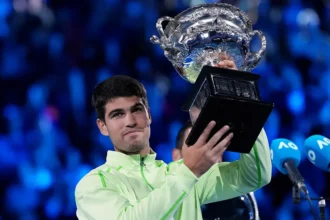
How a ‘Lucky’ Heat Rule Saved Jannik Sinner’s Three-Peat Dream in Scorching Melbourne
The Australian Open is a tournament forged in fire. Its identity is inextricably linked to the searing, unrelenting Melbourne sun, a test of physical fortitude as much as tennis skill. For Jannik Sinner, the ice-cool Italian seeking a historic third consecutive crown, that fire nearly consumed his campaign in its infancy. In a dramatic third-round clash under a merciless sky, the world number one didn’t find victory through his trademark ballistic groundstrokes alone. He found it, by his own admission, in a stroke of regulatory luck—a twist of fate where the very element threatening to end his reign became the unlikely architect of its salvation.
The Crucible: 40 Degrees and on the Brink
By the third set against American qualifier Eliot Spizzirri, the narrative was writing itself as a monumental upset. The temperature on Rod Laver Arena was creeping towards a blistering 40C (104F). Sinner, typically a model of fluid, efficient movement, was visibly deteriorating. Cramps gripped his legs. His service motion lost its pop. Spizzirri, ranked 85th in the world and with nothing to lose, was playing inspired, disciplined tennis, exploiting his opponent’s distress. Sinner had already dropped the first set and was locked in a battle of attrition. The Australian Open heat stress scale, which combines temperature, humidity, and radiant heat, was ticking into the red zone. The Melbourne heat rule, known as the Extreme Heat Policy (EHP), was the only potential reprieve—and for Sinner, it was becoming a lifeline.
“I was struggling a lot,” Sinner would later confess. “The conditions were extreme. He was playing very well, and I couldn’t find my best level physically.” The match was a stark reminder that in these conditions, ranking and reputation can melt away faster than ice in the sun. Sinner’s Grand Slam title defense was hanging by a thread, frayed by cramps and the relentless aggression of an opponent sensing the kill.
The Lifeline: How the Heat Rule Changed Everything
At the pivotal moment, with Sinner visibly compromised, tournament officials invoked the Extreme Heat Policy. The decision was made to close the roof on Rod Laver Arena, leading to a suspension of play. This protocol isn’t just about comfort; it’s a fundamental reset of the playing environment. For Spizzirri, it meant the evaporation of his greatest ally: the debilitating sun and heat that were systematically breaking down the champion. For Sinner, it was a medical timeout, a chance to regroup, and a complete transformation of the contest.
- Physical Reset: Off the court, Sinner’s team could administer fluids, electrolytes, and begin the crucial process of cooling his core body temperature. The crippling cramps could be addressed.
- Tactical Reset: The closed roof eliminated wind, sun glare, and, most importantly, the extreme heat. Conditions became slower, more predictable, and less physically taxing.
- Psychological Reset: The momentum, firmly with Spizzirri, was halted. The pressure of closing out a monumental upset had time to settle on the young American’s shoulders during the break.
When play resumed in the controlled, indoor environment, it was a different match. Sinner, his movement restored, began to strike the ball with familiar authority. “I got lucky with the heat rule,” he conceded with stark honesty after the match. That “luck” wasn’t a random chance; it was the activation of a rule designed for player safety that inadvertently became the most consequential moment of his tournament. The testing third-round match was no longer a war of survival against the elements, but a pure tennis battle—a domain where Sinner’s superior quality could finally shine.
Expert Analysis: From Survival to Dominance
This moment underscores a critical, often overlooked, aspect of championship mentality: the ability to survive. Great champions don’t always win by brute force; they often win by enduring, by finding a way through when their ‘A’ game is inaccessible. Sinner’s performance post-roof closure was a masterclass in seizing a second chance.
Tennis analysts noted the immediate shift. Spizzirri’s depth and precision, so effective in the heat, now landed in Sinner’s strike zone. The Italian’s cramping Italian physique was replaced by the elastic, powerful movement that defines him. He broke Spizzirri’s serve early in the third set, and from that point, the outcome felt inevitable. Sinner won the match 4-6, 6-3, 6-4, 6-4, the scoreline telling a story of adversity overcome.
“The greats find windows where others see walls,” noted one former champion in commentary. “Sinner was handed a window—a literal one, as the roof closed—and he climbed right through it. That’s not just luck; that’s the mindset of a player who believes he is destined to win, even when he’s not at his best.” This match transitioned from a potential tragedy into the defining hard-court resilience exhibit of Sinner’s title run.
Predictions: Forged in Fire, Ready for History
Surviving this scare does not diminish Sinner’s status; it potentially fortifies it. History shows that champions who navigate a near-catastrophe early in a Slam often gather an unstoppable momentum. The fear of loss is confronted and conquered, leaving a purified focus. For Sinner, the message is clear: his game can win matches, but his champion’s resilience can save them.
Looking ahead, this experience massively benefits his pursuit of a third straight Australian Open title. The field now knows that even debilitating conditions and a inspired opponent may not be enough. Sinner has proven he can win from the brink, a psychological edge as valuable as any weapon in his arsenal. It also highlights his team’s ability to manage a crisis, a non-negotiable for any dynasty.
Furthermore, this incident will reignite debates about scheduling and the Grand Slam tournament’s heat rule. Was Sinner “lucky,” or was the rule correctly applied to protect health, with competitive consequences being a secondary effect? It places Sinner at the center of a larger conversation about the sport and its relationship with climate extremes.
Conclusion: The Unlikely Stepping Stone
Jannik Sinner’s path to a potential third Australian Open crown will be remembered for glorious victories and dazzling shot-making. But its foundation may well have been laid in the desperate, cramped hours under a 40C sun, and the merciful whirr of a closing roof. His candid admission of luck reveals a champion secure enough to acknowledge fortune’s role, yet fierce enough to exploit it utterly.
In the end, the Melbourne heat that sought to break him instead forged him. It provided the ultimate test of his title credentials, one he passed not with ease, but with grit and a timely assist from the rulebook. The biggest winner in near 40C Melbourne heat wasn’t just the player who lifted the trophy days later; it was the player who, in that crucible of a third round, refused to be burned. Sinner’s legacy at Melbourne Park is no longer just about dominance, but about durability—a champion who can win with style, and survive with sheer will.
Source: Based on news from BBC Sport.