From Olympic Ice to the Capitol: Jack Hughes and Team USA Embrace Historic State of the Union Invite
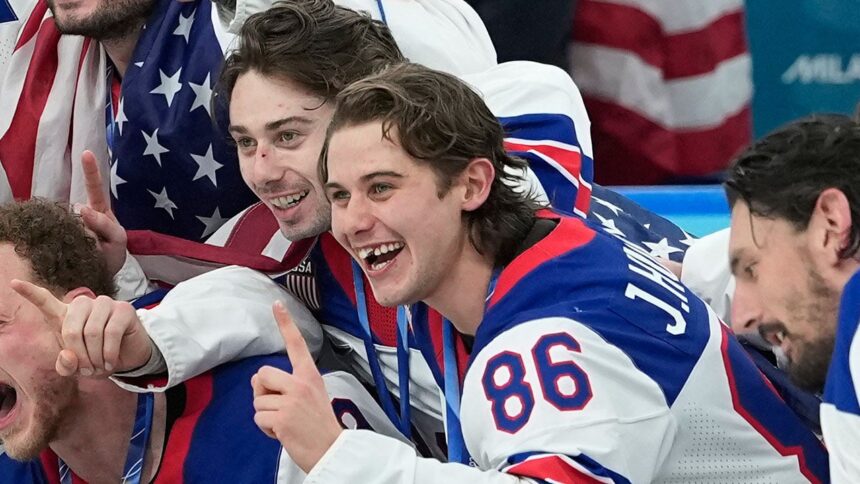
The champagne had barely dried in Milan, the gold medals still cool against their chests, when a new chapter in Team USA men’s hockey’s historic victory began to unfold. Following a dramatic 2-1 overtime win against archrival Canada, sealed by the stick of star forward Jack Hughes, the team received an invitation as monumental as their achievement: a summons to the nation’s capital. President Donald Trump, extending a tradition of honoring American champions, invited the gold medalists to attend his State of the Union address. In the whirlwind that followed, the poised reaction of young superstar Hughes offered a glimpse into a team comfortable on the world stage, now navigating a unique moment at the intersection of sports and state.
A Golden Goal and a Presidential Call
The scene in Milan was one of pure, unadulterated jubilation. After a tournament marked by grit and a deeply emotional tribute to Johnny Gaudreau—the American hockey icon whose brother’s passing cast a solemn shadow over the campaign—the U.S. found itself in a familiar, pressure-cooker final against Canada. The game was a defensive masterclass, a goaltending duel that stretched into overtime. Then, Jack Hughes, the dynamic center known for his elite playmaking, found himself in the right place at the right time, burying the puck and setting off a red, white, and blue celebration. “It’s a moment you dream about a thousand times as a kid,” Hughes later reflected. “To do it for these guys, after everything this group has been through, is something I’ll never forget.”
Within hours, the victory transcended the sports world. From the White House, President Trump issued the invitation, praising the team’s “tremendous heart and skill” in defeating Canada. For team leaders like Dylan Larkin and Zach Werenski, veterans of NHL battles and now Olympic champions, the offer was a staggering postscript to their gold medal. “You think the pinnacle is standing on that podium,” said Larkin. “Then you get a call about going to the State of the Union. It’s surreal. It’s an honor for our sport and for every guy in that locker room.”
Hughes’s Poise: Athlete in the Arena, Citizen in the Capitol
In the modern era, where athletes are often pressed for political commentary, Jack Hughes’s response to the invite was notably grounded in the moment’s significance rather than partisan politics. Appearing to have no qualms about the potential of going to Washington, Hughes framed the event as a civic honor and a celebration of team accomplishment. “It’s the President of the United States,” Hughes stated matter-of-factly. “It’s the State of the Union. That’s a pretty cool thing to be a part of, especially representing USA Hockey. We’re going there as gold medalists, as a team.”
This perspective underscores a nuanced reality in today’s sporting landscape. For many athletes, especially those in the midst of a career-defining high, an invitation to a hallowed state ceremony is viewed first through the lens of their representative achievement. Expert analysis suggests Hughes’s stance is both pragmatic and symbolic.
- National Representation: The team is invited not as individuals with political allegiances, but as embodiments of a national triumph.
- Unity Moment: Events like the State of the Union, while politically charged, are also designed as ceremonies of state, where national accomplishments are highlighted above the fray.
- Athlete Focus: For competitors like Hughes, whose life is dedicated to peak performance, the invitation is seen as another arena to represent their craft and their country.
Zach Werenski echoed this team-first sentiment, calling the upcoming trip “the cherry on top of an incredible journey” and emphasizing the bond forged through the emotional tribute to Johnny Gaudreau. “That moment put everything in perspective,” Werenski noted. “This trip to D.C. feels like an extension of that—it’s about us as a group, carrying that memory and this medal with us.”
Predictions: Navigating the Spotlight Beyond the Rink
The team’s appearance at the Capitol will inevitably place them in a brighter, more complex spotlight. The State of the Union address is one of the most-watched political events of the year, and cameras will eagerly pan to the gold medalists in the gallery. The key predictions for how this moment will unfold and impact the players are clear.
- Bipartisan Recognition: The team will likely receive a standing ovation from both sides of the aisle, a rare moment of unified celebration in a divided political climate.
- Increased Scrutiny: Individual players, particularly high-profile ones like Hughes and Larkin, may face increased media questions about politics in the future, a lane they have so far deftly avoided.
- Legacy for USA Hockey: The visit will cement this team’s legacy not just as champions on ice, but as cultural ambassadors who brought positive attention to American hockey during a pinnacle event.
- Inspiration for Youth: The image of Olympians being honored at the highest level of government will serve as a powerful motivator for the next generation of American players, linking athletic excellence with national pride.
The team’s handling of the heart-wrenching tribute to Johnny Gaudreau demonstrated a profound maturity. That same poise will be their greatest asset in Washington. They will likely approach the event with the same disciplined unity they showed on the penalty kill in Milan—as a cohesive unit, focused on the role they are there to play: honored guests and champions.
A Lasting Legacy: More Than Gold
The 2026 U.S. men’s Olympic hockey team’s story has evolved into an American sports epic. It is a narrative that now contains multitudes: thrilling victory over a bitter rival, profound collective grief and tribute, and now, a historic honor from the nation’s commander-in-chief. Their historic victory over Canada secured their place in the record books, but the ensuing days are defining their place in the broader national consciousness.
Jack Hughes, whose golden goal triggered this cascade of events, embodies the modern American athlete—fiercely competitive on the global stage, yet measured and respectful when called upon to step into a ceremonial national role. His apparent comfort with the invitation, shared by his teammates, reflects a group secure in its identity and achievement.
As they trade their team jackets for suits and enter the halls of the U.S. Capitol, Dylan Larkin, Zach Werenski, Jack Hughes, and the rest of the gold medal squad will carry more than their hard-earned medals. They will carry the pride of a sport that has fought for this moment, the memory of a fallen teammate’s family, and the weight of representing a nation, if only for one night, as a unified symbol of excellence. From the icy battlegrounds of Italy to the heated chambers of American democracy, this team’s journey proves that some victories resonate far beyond the final buzzer, echoing in the places where a nation takes stock of its pride.
Source: Based on news from Fox Sports.