Raiders Part Ways with Jamin Davis: Unpacking the Fallout from a First-Round Bust
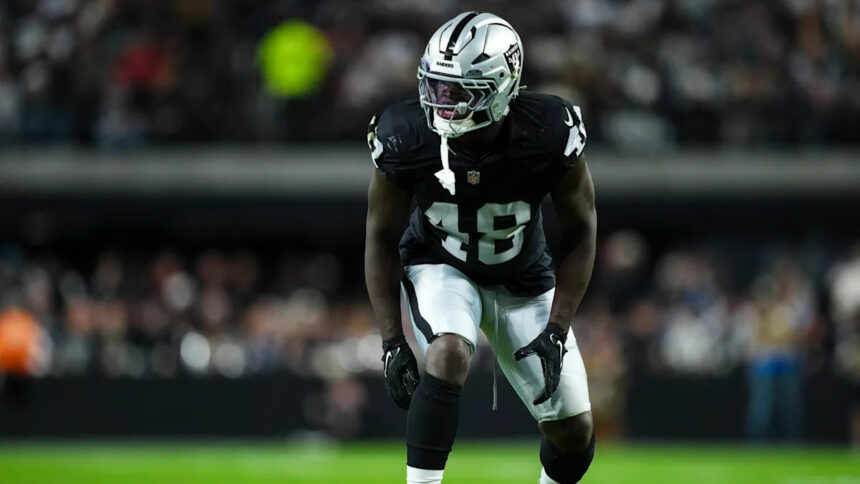
The Las Vegas Raiders have made a quiet but telling roster adjustment ahead of their rookie minicamp. On Thursday afternoon, the team officially announced the release of veteran linebacker Jamin Davis. While the move did not generate the seismic shockwaves of a blockbuster trade, it closes another chapter on a career that has been defined by unfulfilled potential since the moment he heard his name called in the first round of the 2021 NFL Draft.
For the Raiders, this transaction is a low-risk departure. Davis signed with the team’s practice squad last October, providing depth during a season of defensive transition. He suited up for just two games in the Silver and Black, recording three total tackles. The team did not announce a corresponding roster move, but the open spot—which could be filled before or after this weekend’s rookie minicamp—signals that the front office is already looking toward younger, more moldable talent.
But for Davis, this release carries a heavier weight. It represents the latest—and perhaps final—stop on a journey that began with sky-high expectations in Washington and has since devolved into a pattern of short-term stints and roster cuts. Let’s break down exactly what happened in Las Vegas, why Davis never found his footing, and what this means for the Raiders moving forward.
The Brief Raiders Tenure: A Snapshot of Minimal Impact
When the Raiders brought Jamin Davis onto the practice squad in October of last season, the move was viewed as a low-cost flier on a player with elite athletic traits. General Manager Tom Telesco and head coach Antonio Pierce were in the midst of reshaping a defense that needed speed and range at the second level. Davis, a 6-foot-3, 234-pound linebacker who ran a 4.47-second 40-yard dash at the NFL Combine, fit the physical profile.
Yet, the on-field production never matched the measurables. In his two appearances with the Raiders, Davis played primarily on special teams and in limited defensive snaps. His stat line—three tackles—reflects a player who was not trusted to handle a significant workload in defensive coordinator Patrick Graham’s scheme.
Key factors behind his lack of playing time in Las Vegas:
- Scheme Fit: Graham’s defense relies heavily on instinctual, gap-sound linebackers who can diagnose runs quickly. Davis, despite his speed, has often been criticized for processing plays a beat too slow.
- Depth Chart Clog: The Raiders already had a solid rotation with Robert Spillane, Divine Deablo, and Luke Masterson. There was simply no room for a developmental project mid-season.
- Practice Squad Ceiling: Davis was elevated from the practice squad for those two games, but he never earned a permanent spot on the 53-man roster. That lack of elevation speaks volumes about how the coaching staff viewed his readiness.
The release now frees up a roster spot just as the team prepares to integrate its 2025 draft class and undrafted free agents during rookie minicamp. This timing suggests the Raiders are prioritizing youth and development over veteran reclamation projects.
The Fall of a First-Rounder: Tracing Jamin Davis’s Career Arc
To understand the full weight of this release, we have to go back to 2021. The Washington Commanders (then Football Team) selected Jamin Davis with the 19th overall pick. He was coming off a breakout season at Kentucky, where he posted 102 tackles, 4.5 sacks, and an interception. His combination of sideline-to-sideline speed and raw power made him a tantalizing prospect for a defense that needed a modern, three-down linebacker.
But the NFL is unforgiving, especially for first-round linebackers who are expected to contribute immediately. Davis appeared in 50 games for Washington over parts of four seasons (2021-2024), but he never solidified himself as a cornerstone player. His best statistical season came in 2022, when he recorded 104 tackles and three sacks. However, even that production was marred by missed assignments and inconsistency in coverage.
The turning point came during the 2024 season. Washington, under a new coaching regime led by Dan Quinn and Adam Peters, decided to move on. Davis was released mid-season, a stunning fall for a player who was once viewed as a building block.
He quickly latched on with the Minnesota Vikings, a team known for its aggressive defensive scheme under coordinator Brian Flores. The hope was that a change of scenery and Flores’s blitz-heavy system could revive Davis’s career. He played in five games for Minnesota, but the results were similar: flashes of athleticism overshadowed by hesitation and poor gap discipline. The Vikings released him before the end of the season, making Las Vegas his third team in less than 12 months.
Here is a stark look at his career trajectory:
- 2021-2024 (Washington): 50 games, 246 tackles, 6 sacks, 1 interception. Never played a full 17-game season as a starter.
- 2024 (Minnesota): 5 games, minimal impact. Released before season’s end.
- 2024-2025 (Las Vegas): 2 games, 3 tackles. Released in May.
The gap between his draft capital and his on-field production is now a cautionary tale. Davis is a cautionary reminder that elite athletic testing does not always translate to elite football IQ.
Expert Analysis: What Went Wrong for Davis in Las Vegas?
From a tactical standpoint, the Raiders’ decision to cut Davis is not surprising. When you examine his tape from his brief stint in Las Vegas, the issues that plagued him in Washington and Minnesota were still present. Let’s break down the specific technical and mental hurdles that Davis could not overcome:
1. Processing Speed in Zone Coverage
In Patrick Graham’s defense, linebackers are often asked to read the quarterback’s eyes and break on routes from zone drops. Davis frequently appeared hesitant, taking an extra half-second to diagnose route combinations. In the NFL, half a second is the difference between a pass breakup and a 20-yard completion. This hesitation made him a liability on passing downs.
2. Gap Integrity Against the Run
Davis’s athleticism allows him to chase plays from the back side, but he struggles with initial gap responsibility. On several run plays during his two games, he over-pursued or failed to set the edge, allowing running backs to cut back into cutback lanes. Against a physical AFC West featuring running backs like Isiah Pacheco and Javonte Williams, that kind of mistake is fatal.
3. Special Teams Value
For a backup linebacker, special teams production is non-negotiable. Davis logged only a handful of special teams snaps for the Raiders and did not stand out. In a league where roster spots are at a premium, a player who cannot contribute on coverage units is often the first to go.
4. The Mental Reset
Being a first-round pick carries immense pressure. Davis has now been cut by three different organizations in less than two years. That kind of instability can erode a player’s confidence. In Las Vegas, he was given a fresh start, but he never seized the opportunity. The Raiders coaching staff likely saw a player who was still thinking too much rather than reacting.
Prediction: At 27 years old, Davis still has the physical tools to be a rotational linebacker in a simplified scheme. A team like the Los Angeles Rams or Dallas Cowboys, known for maximizing veteran reclamation projects, could take a flier on him as a training camp body. However, his days of being a starter in this league are likely over. He is now a depth piece fighting for a roster spot.
What This Means for the Raiders’ Roster Strategy
The release of Jamin Davis is a minor move in the grand scheme of the Raiders’ offseason, but it provides insight into the team’s philosophy under Telesco and Pierce. The Raiders are clearly prioritizing scheme fit and football IQ over raw athletic potential. Davis was a lottery ticket that did not pay off, and the organization is not afraid to cut bait quickly.
Looking ahead, the open roster spot creates an opportunity. The Raiders are hosting their rookie minicamp this weekend, which will feature their 2025 draft class and a slew of undrafted free agents. This is a critical evaluation period for the coaching staff. They will be looking for players who can contribute immediately on special teams and develop into rotational defenders.
Key areas of focus for the Raiders at linebacker:
- Depth Behind Spillane and Deablo: Robert Spillane is a reliable veteran, and Divine Deablo is an ascending talent, but the depth behind them is unproven. The team may look to sign a veteran free agent after minicamp, or they could promote a young player from the undrafted pool.
- Special Teams Ace: The Raiders struggled with coverage units last season. A linebacker who can run down kicks and punts will have a clear path to a roster spot.
- Versatility: Graham loves linebackers who can rush the passer from the edge or drop into coverage. The team will prioritize players with multiple skill sets.
By cutting Davis now, the Raiders avoid paying him a guaranteed salary for the season and free up a spot for a player who fits their long-term vision. It is a cold, calculated business move—and in the NFL, that is how championships are built.
Conclusion: The End of a Disappointing Chapter
The release of Jamin Davis is a quiet but significant moment for the Las Vegas Raiders. It underscores the harsh reality of the NFL: draft status means nothing once the pads come on. Davis was a first-round pick with all the physical gifts a team could ask for, but he could never translate that potential into consistent, reliable production. His tenure in Las Vegas was brief and forgettable—two games, three tackles, and a roster spot that will soon be filled by a hungrier, younger player.
For the Raiders, this move is a sign of a disciplined front office that is not afraid to admit a mistake and move on. As they welcome their rookie class this weekend, the message is clear: performance, not pedigree, will determine who makes the final 53. For Davis, the road ahead is uncertain. He will likely get another chance somewhere—perhaps on a practice squad or as a training camp invite—but the clock is ticking. The window for first-round picks to become impact players closes fast, and for Jamin Davis, that window may have just slammed shut.
The Raiders are building something new. And in that construction, there is no room for players who cannot deliver. Davis is the latest casualty of that unforgiving standard.
Source: Based on news from Yahoo Sports.