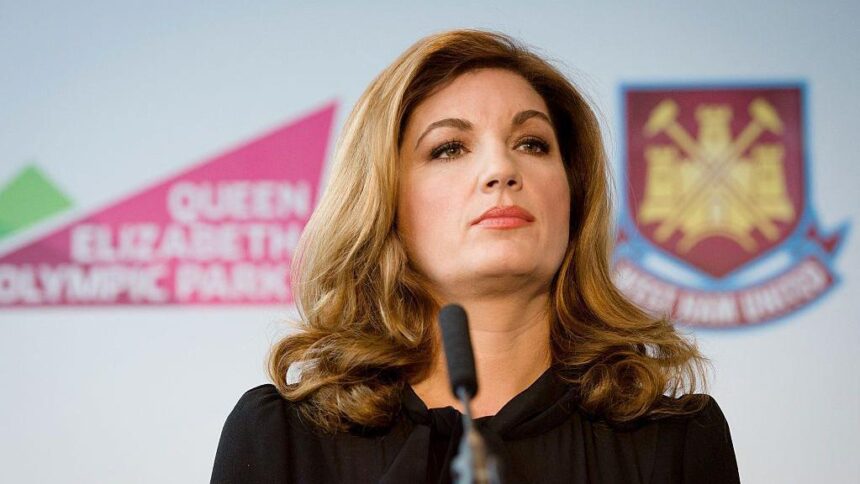
Baroness Brady’s Era Ends: West Ham’s Vice-Chair Steps Down After 16 Transformative Years
The corridors of power at the London Stadium have witnessed a seismic shift. Baroness Karren Brady CBE, the formidable and instantly recognisable vice-chair of West Ham United, has stepped down from her role after 16 years, marking the end of a defining chapter for the Premier League club. Her departure, effective April 15th, closes a tenure that began in January 2010 under the ownership of David Sullivan and David Gold and spanned an era of profound transition, controversy, and ultimately, European glory. Brady’s exit is not merely a boardroom change; it is the closing of a playbook that blended sharp business acumen with the raw passion of East End football.
A Calculated Departure: The Timeline and the Tributes
According to her revelation in The Times, Brady’s decision was a measured one. She first began contemplating her exit in January, before formally deciding in mid-February. This timeline suggests a period of reflection, likely following the culmination of a long-term project: securing the club’s financial and operational footing and, critically, delivering silverware. Her official statement was gracious and focused on collective achievement. “It has been a privilege to work alongside the board, management, players, staff and supporters,” she said, reserving special mention for the “remarkable milestones” achieved. The pinnacle, for her, was crystal clear: “Lifting the UEFA Europa Conference League trophy – a moment that will stay with me forever.” This victory in Prague in June 2023 provided the perfect, tangible climax to her football executive story.
The Brady Blueprint: Analysis of a Transformative Tenure
To understand the magnitude of Brady’s departure, one must analyse the landscape she inherited and the empire she helped build. Her appointment was a statement of intent from Sullivan and Gold, bringing a high-profile business operator into the heart of a club with a storied past but an uncertain future at its historic Boleyn Ground.
Key pillars of the Brady era include:
- The Controversial Stadium Move: The 2016 relocation from Upton Park to the former Olympic Stadium was the most divisive episode of her tenure. Brady was the deal’s chief architect and negotiator. While it dramatically increased commercial revenue and capacity, it fractured a portion of the fanbase, creating a rift over atmosphere and identity that took years to heal.
- Commercial Revolution: Unquestionably, Brady’s core strength. She leveraged her media profile and business networks to transform West Ham’s commercial operations. Sponsorship deals, partnerships, and non-matchday revenue streams grew exponentially, providing the financial muscle to compete in the hyper-inflated Premier League market.
- A Visible and Vocal Figurehead: In an industry still dominated by men, Brady was a constant, powerful presence. From the directors’ box to the pages of a national newspaper, she was the public face of West Ham’s board. This visibility brought scrutiny but also a distinct brand of corporate leadership to the fore.
- From Turmoil to Triumph: The journey was rarely smooth. The club navigated relegation battles, managerial merry-go-rounds, and persistent fan discontent over the stadium and ambition. The Conference League win, however, under David Moyes, served as validation—a trophy that cemented a new, winning layer onto the club’s identity.
What Comes Next? Predictions for a Post-Brady West Ham
Brady’s departure coincides with a new era of ownership, with Czech billionaire Daniel Křetínský acquiring a significant 27% stake in the club. Her exit raises immediate and critical questions about the future structure and strategy at West Ham.
The immediate void will be felt in three key areas:
- Commercial Leadership: Who will spearhead the next phase of commercial growth? Brady’s relationships and deal-making prowess were central. The club must now find a successor with the clout to navigate an increasingly globalised sport.
- Stadium Relations: The London Stadium legacy remains a work in progress. Any new executive will inherit the ongoing challenge of enhancing the fan experience and further integrating the club into the venue, a complex political and logistical task.
- Boardroom Dynamics: With Gold having passed away, Sullivan now the sole full owner, and Křetínský a major influence, Brady’s departure removes a key pillar of the old guard. This could accelerate a shift in strategic thinking, potentially aligning more with a data-driven, European model of club management favoured by the new investor.
We predict the club will look externally for a successor, likely targeting a seasoned commercial director from another elite sports franchise or a corporate heavyweight. The role may also be redefined, possibly splitting responsibilities between a purely commercial CEO and a more traditional football-focused director of football, working under Technical Director Tim Steidten.
A Legacy Forged in Steel
Karren Brady’s tenure at West Ham United defies simple categorization. She was a polarising figure who engineered a move that many supporters still lament, yet she also stewarded the club to its first major trophy in 43 years. She embodied a brash, business-first approach that often clashed with football’s traditional emotional core, but the financial stability she helped create enabled the club to sign the players who made that European glory possible.
Her legacy is one of unapologetic modernisation. She forced a historic club to confront the economic realities of 21st-century football, for better and for worse. The West Ham that exists today—a globally recognised brand playing in a vast stadium, with a European trophy in its cabinet—is indelibly stamped with her influence. The challenge for the new regime is to now build upon that commercial foundation while deepening the emotional connection with the fanbase, a balance Brady often wrestled with. As the curtain falls on this act, the Premier League loses one of its most distinctive and influential voices. The Brady era at West Ham was never quiet, never simple, but it was, ultimately, historic.
Source: Based on news from Yahoo Sports.