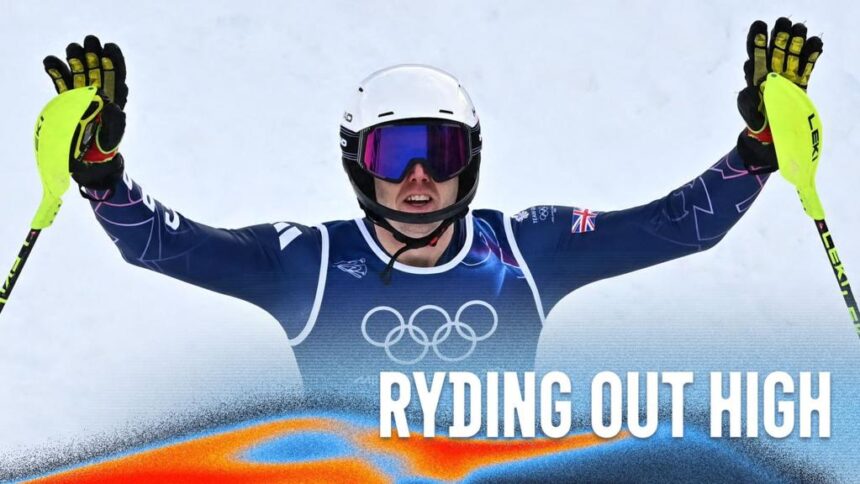
Dave Ryding Takes His Final Olympic Gate: A Legacy of Grit and British Belief
The curtain has fallen on one of British winter sport’s most compelling and transformative careers. At 39, Dave Ryding, the ‘Rocket from Rosendale’, has skied his final Olympic run, finishing 17th in the men’s slalom at his fifth and final Winter Games. While the podium remained just out of reach, the result does little to dim the luminous legacy of a man who single-handedly redefined what was possible for a British alpine skier. His journey from the plastic slopes of Pendle to the pinnacle of World Cup glory is a testament to relentless perseverance, a story not of natural alpine privilege, but of manufactured excellence and unshakeable self-belief.
From Dry Slopes to World Cup Peak: The Improbable Ascent
To understand the magnitude of Dave Ryding’s career, one must first grasp the sheer improbability of his ascent. Great British skiers have historically been curiosities, often excelling in the speed events. The technical discipline of slalom, a dizzying dance of precision and aggression, was considered a continental fortress. Ryding, learning his craft on the unforgiving dry slopes of Britain, was the ultimate outsider. His early career was a grind of funding shortfalls and solitary travel, far from the sleek academies of the Alps. Yet, it was this very background that forged his unique technical mastery and granite mental fortitude.
His breakthrough was seismic. In January 2022, at the age of 35, Ryding erupted onto the top step of the podium at the Kitzbühel slalom, the most hallowed race in skiing. This wasn’t just a win; it was a historic first British Alpine World Cup victory in the 55-year history of the circuit. The image of Ryding, overcome with emotion in the finish area, transcended sport. It was a victory for every late-bloomer, every underdog, and a nation not known for its alpine prowess. He proved that with a unique methodology—focusing on razor-sharp technique to compensate for a lack of glacier-born mileage—the impossible was achievable.
An Olympic Chapter of Near-Misses and Unwavering Pride
Ryding’s Olympic narrative, spanning from Vancouver 2010 to his final bow, is one of agonizing near-misses and consistent top-tier performance, always battling against the sport’s established giants. His ninth-place finish in PyeongChang 2018 was a then-best for a British alpine skier, a result that felt like a launchpad for Beijing 2022. However, the Olympics, with their unique pressure and singular chance, remained elusive. His 17th-place finish in his final Games, while not the fairytale ending, was met with characteristic class and perspective.
“I’m proud,” Ryding stated succinctly after his run. This pride isn’t rooted in a single result, but in the body of work. At an age where most slalom specialists have long retired, Ryding was still mixing it with the world’s best. His Olympic career, viewed as a whole, is a masterclass in longevity and high-level consistency against the odds.
- Vancouver 2010: A learning experience, finishing 27th.
- Sochi 2014: A solid 17th, signaling his arrival as a world-class competitor.
- PyeongChang 2018: A historic 9th, proving he could contend on the very biggest stage.
- Beijing 2022 & Final Games: Carrying the weight of expectation as a recent World Cup winner, concluding with a dignified 17th.
The Ryding Effect: A Transformed Landscape for British Skiing
Dave Ryding’s impact cannot be measured in rankings alone. His true legacy is the cultural shift he engineered within British skiing. Before Ryding, a British skier winning a World Cup was a fanciful notion. Now, it is a documented fact, a precedent etched in history. He has changed the mindset of a generation.
Young British skiers now look at the slalom course not with hope, but with expectation. They have a blueprint, a role model who walked the path from Halifax to Kitzbühel. The “Ryding Effect” is visible in the increased investment, the more serious technical focus at the grassroots level, and the belief that Britain can produce world-beaters in a technical discipline. He didn’t just open the door; he demolished the wall, showing that British skiing excellence is not an oxymoron but an achievable reality.
What’s Next for the Rocket and British Alpine?
While the Olympics are now behind him, Ryding has hinted that his World Cup career may have a little more fuel in the tank. His expertise and race-craft remain invaluable. One can foresee a graceful final season, potentially culminating at a place like Kitzbühel, where he made history. Beyond his skis, his future undoubtedly lies in mentorship and development. His deep, analytical understanding of slalom technique and sports psychology makes him a potentially transformative coach or guiding figure for the next wave of British talent.
The immediate question for Team GB’s alpine future is: who steps up? The spotlight now turns to athletes like Billy Major, who has shown flashes of World Cup potential. The system, buoyed by Ryding’s success, must prove it can be sustainable. The challenge is to institutionalize his mindset—the work ethic, the technical obsession, the fearless approach—to ensure the pipeline doesn’t dry up.
A Final Run, An Indelible Legacy
As Dave Ryding pushes out of the Olympic start gate for the last time, he leaves not with a medal, but with something perhaps more enduring: a revolutionized sport. He was more than an athlete; he was a pioneer, a proof-of-concept, and an icon of resilience. His story is the ultimate underdog narrative, a man who took the limitations of his geography and background and turned them into the very foundations of his greatness.
His final Olympic slalom was not a decline, but a dignified full stop on a chapter that re-wrote British skiing history. The numbers—one historic win, 13 World Cup podiums, multiple top-10 finishes—tell only part of the story. The full measure of Dave Ryding is found in the belief he instilled, the path he carved, and the proud, unwavering standard he set. The Rocket from Rosendale’s trajectory has forever altered the landscape, ensuring his legacy will inspire long after the final gate has been cleared.
Source: Based on news from BBC Sport.