Eagles at a Crossroads: The A.J. Brown Conundrum and the Art of the NFL Offseason
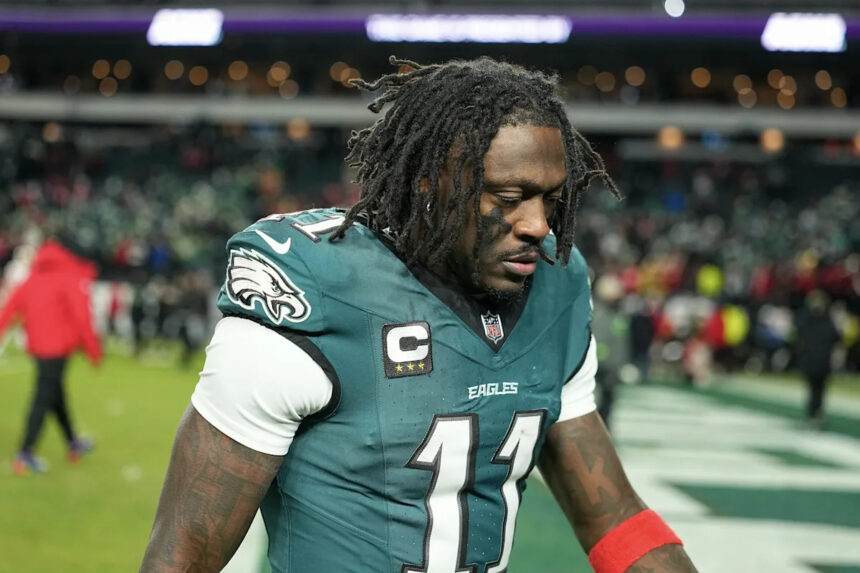
The NFL Scouting Combine is less about 40-yard dash times for established veterans and more about the verbal sparring and strategic posturing that sets the stage for the league year. In Indianapolis this week, Philadelphia Eagles head coach Nick Sirianni and general manager Howie Roseman delivered a masterclass in calculated ambiguity, centering on the future of All-Pro wide receiver A.J. Brown. The message was clear: the Eagles love A.J. Brown, but in the ruthless calculus of NFL roster building, love has its price.
The Podium Dance: Reading Between the Lines in Indy
When asked directly if Brown would be on the team in 2025, Sirianni’s response was a study in NFL coach-speak. “I can’t guarantee how anything is going to play out,” he stated, juxtaposing that with effusive praise for Brown’s talent and character. This is the classic “soft launch” of potential availability. By not offering a full-throated, definitive guarantee, Sirianni and Roseman intentionally cracked a window open. Roseman, the architect of the roster, then pushed that window open wider. He confirmed he would “listen to offers for everything and anything,” citing a philosophical duty to never shut down a conversation that could unexpectedly benefit the team.
This two-part act is not accidental. It serves multiple purposes:
- Maintains Leverage: Publicly declaring a player “untouchable” weakens your position. Expressing a desire to keep him while acknowledging the business sets a high opening price.
- Manages the Locker Room: It shows respect to Brown, affirming his value publicly, while preparing the ecosystem for any potential outcome.
- Signals to the League: For other general managers, Roseman’s comments are a direct line. They translate to: “If you want an elite, 28-year-old receiver in his prime, your offer better start with a first-round pick and escalate from there.”
The Howie Roseman Playbook: A History of Strategic Moves
To understand the gravity of this situation, one must study Roseman’s history. He is a pragmatic opportunist, not sentimental about assets. The Carson Wentz trade to Indianapolis netted a first and a third-round pick when the quarterback’s value was at its lowest. The Haason Reddick trade to the New York Jets this offseason followed a similar pattern: a productive player with a contract situation or future uncertainty was moved for value before the team’s leverage evaporated.
A.J. Brown’s scenario is different, yet familiar. He is still a premier player, coming off a 1,456-yard season. However, the Eagles face a looming financial pivot. Brown’s cap hits balloon to over $26 million in 2025 and nearly $32 million in 2026. The team also has DeVonta Smith awaiting a massive extension, and Jalen Hurts’ record-setting contract is about to hit the books in earnest. In the modern NFL, it is exceedingly difficult to allocate top-tier money to two wide receivers, a quarterback, and still field a competitive defense.
Roseman’s comments suggest he is proactively exploring the market to see if a team, desperate for a true WR1, will make an offer he cannot refuse. This is the essence of his management style: constantly assessing the value of every asset against both the present and future cap landscape.
The Case For and Against an A.J. Brown Trade
This is not a simple decision. Trading a player of Brown’s caliber creates immediate and significant ripple effects across the entire organization.
The Case FOR a Trade:
- Capital Acquisition: A trade likely brings a first-round draft pick, replenishing assets for a team that has traded several away. This pick could be used on a cost-controlled young receiver or to address other glaring needs (linebacker, secondary).
- Financial Flexibility: Moving Brown’s contract would free up substantial cap space to extend DeVonta Smith, reinforce the offensive line, and rebuild a defense that collapsed in 2023.
- Proactive Move: It avoids any potential for future discontent or a messy contract standoff, allowing the team to retool on its own terms.
The Case AGAINST a Trade:
- Diminishing Jalen Hurts: Brown is Hurts’ security blanket and the engine of the passing game. His departure would place immense pressure on Smith and a yet-to-be-proven third option, potentially stunting the offense’s ceiling.
- Win-Now Window: The Eagles’ core is in its prime. Trading a top-5 player at a premium position is rarely the move of a true Super Bowl contender.
- Leadership Void: Beyond stats, Brown brought a fierce, competitive edge to the team. That intangible swagger is hard to replace.
Predictions and the Path Forward for Philadelphia
So, what will actually happen? The tea leaves from Indianapolis point toward a genuine, open-ended evaluation. My prediction hinges on the market.
I believe Roseman has a specific price in mind—likely a 2025 first-round pick plus a mid-round selection, or a high second-round pick in 2024 with additional future capital. Teams like the Kansas City Chiefs, New York Jets, or Jacksonville Jaguars could be potential suitors desperate for a player of Brown’s caliber.
Scenario 1: The Blockbuster If a team meets or exceeds that price before or during the draft, I believe Roseman will pull the trigger. The Eagles would then likely use their No. 22 overall pick or acquired capital to select a receiver in a deep class, banking on Kellen Moore’s offensive system to distribute targets more evenly.
Scenario 2: The Status Quo If offers linger around a single second-round pick, the Eagles will almost certainly keep Brown. They will run it back with their elite duo, restructuring contracts to create cap space, and address the defense through other means. The public comments then become a successful exercise in due diligence.
The wild card is the player himself. Brown has been a consummate professional in Philadelphia, but his competitive fire burns hot. How would he react to being shopped? The Eagles must carefully manage this relationship if he remains.
Conclusion: An Offseason Defining Moment
The A.J. Brown saga is the first major plotline of a critical Eagles offseason. The comments from Sirianni and Roseman were not a declaration of intent to trade, but a declaration of process. They have placed a “For Sale: Best Offer” sign on the lawn of one of the league’s most valuable properties, not because they want to sell, but because they are obligated to see what the market will bear.
This is the high-stakes poker of NFL management. The decision Roseman makes—whether to cash in a blue-chip stock for future assets or double down on a known superstar—will define the Eagles’ trajectory for the next half-decade. It is a test of philosophy, valuation, and nerve. One thing is guaranteed: Howie Roseman is listening, and the entire league now knows the line is open. The next move, and the price tag attached to it, will reveal just how much one of the NFL’s most aggressive team builders still believes in his current hand.
Source: Based on news from Yahoo Sports.