Eggs and Fury: Italy’s World Cup Failure Sparks Fan Revolt Against FIGC
The night air in Rome was thick with frustration. In the quiet hours following Italy’s catastrophic failure to qualify for the 2026 FIFA World Cup, the headquarters of the Italian Football Federation (FIGC) on Via Allegri became the target of a visceral, if messy, protest. Eggs splattered against its entrance, a raw and symbolic act of disgust from a nation whose passionate relationship with its national team has curdled into despair. This was not a calculated political statement, but the spontaneous, yolk-stained outburst of a heartbroken footballing culture. The Azzurri, reigning European champions just three years ago, have now missed three consecutive World Cups—a staggering fall from grace that has left the federation’s leadership, particularly President Gabriele Gravina, squarely in the line of fire.
A Stain on the Crest: From European Glory to Global Obscurity
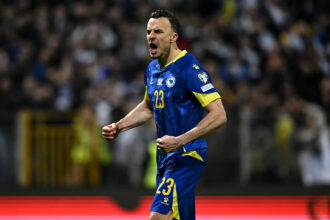
The contrast could not be more jarring. In July 2021, Italy stood atop Europe, conquering Wembley in a penalty shootout to claim the UEFA Euro 2020 title. The narrative was one of glorious rebirth under Roberto Mancini, a tactical maestro who had welded a cohesive, exciting unit from a nation still reeling from the trauma of missing the 2018 World Cup. Fast forward to March 2025, and that renaissance lies in ruins. Defeat in the play-off final to Bosnia and Herzegovina was not just a loss; it was a confirmation of a deep, systemic rot. The FIGC headquarters vandalised is merely the physical manifestation of a deeper stain on Italian football’s soul. The cycle of failure—qualifying for the Euros but collapsing on the World Cup stage—has become a debilitating pattern, suggesting issues far beyond a single bad game or unlucky playoff draw.
Anatomy of a Failure: Systemic Issues Laid Bare
To blame one coach, one player, or one missed penalty is to miss the forest for the trees. Italy’s absence from the world’s biggest sporting event for 12 years and counting is a multi-layered institutional failure. The egg-throwing incident, while crude, points to a fanbase that correctly identifies the problem’s source: the leadership in Rome.
- Grassroots Neglect: For years, experts have warned of a youth development crisis. Academies prioritize physicality over technical creativity, and a clogged pathway to first-team football in Serie A, dominated by foreign stars, stifles the growth of the next generation of Italian talent.
- Club vs. Country Tension: The relentless schedule and financial pressures of club football, particularly in the post-pandemic era, often leave national team players physically depleted and mentally fatigued for crucial international breaks.
- Leadership Vacuum: The FIGC President Gabriele Gravina has overseen this second consecutive World Cup qualifying disaster. His tenure, which began in 2018, is now defined by this failure. The banner demanding his resignation upon his arrival at the egg-bespattered headquarters underscores a total erosion of public trust.
- Tactical and Selection Flux: The transition from Mancini to Luciano Spalletti, while logical on paper, failed to provide stability. Debates over player selection, formation, and identity have plagued the Azzurri throughout the qualifying campaign, reflecting a lack of a clear, long-term footballing project from the federation.
The Gravina Dilemma: Resign or Reform?
The figure of Gabriele Gravina now stands as the most pivotal in Italian football. The calls for his resignation are loud, clear, and emotionally justified. However, his immediate departure risks creating a power vacuum and allowing for a superficial scapegoating ritual rather than genuine reform. The critical question is whether Gravina can be the architect of the painful revolution required. Can the man who presided over the failure be trusted to fix its root causes? His next moves must be drastic and transparent to have any hope of restoring credibility.
Potential immediate steps must include: a full, independent audit of the youth system; a summit with Serie A clubs to negotiate better player release and youth integration protocols; and the appointment of a technical director with a clear, long-term vision that survives beyond any single coach. The federation’s response must be structural, not ceremonial. Polishing the egg off the front door is the easiest part; cleansing the internal decay is the real challenge.
Road to 2028: A Painful Rebuild or Continued Decline?
With the 2026 World Cup in the United States, Canada, and Mexico now a missed opportunity, the horizon for the Azzurri shifts to the 2028 European Championship. The predictions for Italian football are bifurcated between two stark paths.
The Optimistic Scenario: This shock becomes the catalyst Italy needs. The federation uses the next four years to implement a brutal, German-style overhaul of its development pyramid. Young talents are given meaningful minutes in Serie A, a cohesive playing philosophy is adopted from the U-15s up, and the national team embraces a rebuild around a new core. The 2028 Euros become a realistic target for a competitive, hungry young team.
The Pessimistic Scenario: The cycle continues. Token changes are made, Gravina clings to power or is replaced by a similarly insular figure, and the systemic issues fester. Italy, lacking a new generation of world-class talent, struggles even in European qualification. The Azzurri risk becoming a peripheral force, a once-great footballing nation living off past memories, with fan apathy replacing the current fury.
Conclusion: More Than Just Eggs at the Door
The eggs smeared across the FIGC headquarters are more than a childish prank. They are a potent symbol of a nation’s patience cracking. Italian fans have expressed their anger not with the players on the pitch, who gave their all, but at the administrators in Rome who have, in their view, failed in their fundamental duty. Missing one World Cup was a tragedy. Missing two was a farce. Missing three is an indictment. The World Cup play-off elimination is the symptom; the disease is institutional. The road back begins not with a new coach or a promising striker, but with the courageous, transparent, and radical reform of the very structure that has allowed Italian football to fall so far from its exalted standard. The clean-up on Via Allegri is underway. The clean-up of Italian football must start now.
Source: Based on news from Yahoo Sports.