Italian Football in Crisis: Gravina and Buffon Fall on Their Swords After Historic World Cup Failure
The unthinkable has become a recurring nightmare. Italian football, home to the four-time World Cup champions, the Azzurri, has plunged into its deepest institutional crisis in living memory. In the wake of a catastrophic penalty shootout defeat to Bosnia-Herzegovina, which sealed Italy’s failure to qualify for a third consecutive FIFA World Cup, the pillars of the establishment have crumbled. FIGC President Gabriele Gravina and national team legend Gianluigi Buffon have both resigned, a seismic double departure that signals a profound reckoning for a footballing superpower now languishing in the international wilderness.
A Stain on History: The Unprecedented Scale of Failure
To understand the magnitude of this moment, one must grasp the historic nature of Italy’s failure. No previous winner of the men’s World Cup has ever missed three tournaments in a row. Italy, the nation of Pirlo, Baggio, and Rossi, now holds that ignominious record. The scars from missing Russia 2018 were still fresh; the shock of a second failure for Qatar 2022, just months after winning Euro 2020, was paralyzing. The play-off defeat to North Macedonia was seen as a tragic anomaly. The loss to Bosnia, however, confirms a systemic disease.
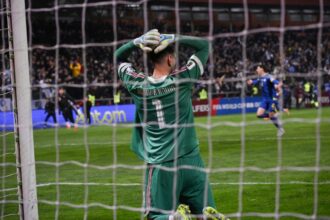
The match itself was a microcosm of Italy’s modern struggles: dominant in possession, creatively sterile, and psychologically fragile. After a 0-0 draw, the penalty shootout defeat was a cruel but fitting conclusion. It wasn’t a loss to a traditional powerhouse; it was a stumble against a nation they were expected to beat, mirroring the North Macedonia disaster. This pattern transforms misfortune into a damning trend.
- Historic Low: First-ever World Cup champion to miss three consecutive tournaments.
- Cycle of Collapse: Failure in 2018, 2022, and now 2026 qualification is in severe jeopardy.
- Institutional Accountability: The resignations acknowledge failure goes beyond the pitch.
The Fall of the Architects: Gravina and Buffon’s Symbolic Exit
The dual resignations of Gravina and Buffon are not coincidental; they represent the collapse of both the administrative and spiritual leadership of Italian football.
Gabriele Gravina’s presidency was a complex tenure. His reign oversaw the glorious Euro 2020 victory and the successful qualification of Italy’s women’s team for the 2023 Women’s World Cup. Yet, his legacy will be irrevocably tarnished by the men’s team’s consistent World Cup absence. His resignation statement, acknowledging the need for “a new course,” is an admission that the current system is broken. Critics argue his leadership failed to address the deep-rooted issues in youth development, stadium infrastructure, and the league’s reliance on foreign talent that have eroded the national team’s pipeline.
More poignant was the exit of Gianluigi Buffon. As delegation head, his role was part logistical, part spiritual. He was the living bridge between the glory of the 2006 World Cup win and the current generation. His resignation via Instagram, stating he would “step aside and leave room for others,” is a powerful symbolic act. When a figure of his stature, who embodied resilience and success, feels compelled to leave, it screams that the soul of the team is lost. His departure removes a foundational pillar of the Azzurri identity.
Expert Analysis: Diagnosing the Azzurri’s Terminal Decline
The problems are multifaceted and have been festering for over a decade. This is not a simple case of a bad coach or an unlucky game. It is a structural collapse.
Generational Failure in Talent Production: Serie A clubs, focused on short-term results and financial survival, have drastically reduced opportunities for Italian youth. The league is saturated with imported talent, leaving few minutes for homegrown players to develop at the highest level. The pipeline that produced generations of world-class defenders, creative midfielders, and clinical strikers has run dry.
Tactical and Philosophical Stagnation: While other nations evolved, Italian football has often seemed trapped between its legendary defensive heritage and a desire to play modern, possession-based football. This identity crisis is evident on the pitch. The team lacks a clear, cohesive style and the mental fortitude that once defined it.
The Weight of History and Psychology: The Azzurri shirt, once a source of immense pride, now appears a burden of unbearable expectation. The players seem paralyzed by fear of failure, a stark contrast to the cynical confidence of past generations. The play-off final defeat to Bosnia was a psychological capitulation as much as a technical one.
The Road to Redemption: Predictions for a Painful Rebuild
The resignations are not the end, but a brutal beginning. The path to redemption is long and requires radical, unpopular change.
1. A Root-and-Branch Reform of Youth Football: The FIGC must enforce stricter rules on youth development and homegrown player quotas in Serie A. Investment in coaching education and a unified football philosophy from the youth levels up is non-negotiable. This is a 10-year project, not a quick fix.
2. The Right Managerial Appointment: The new coach must be a unifying figure, a pragmatist who can build a resilient team identity without the luxury of world-class talent. He must be a teacher and a psychologist, capable of rebuilding the shattered mentality of the squad.
3. Lowering Expectations and Building Anew: Italy must accept it is no longer a top-tier international force. The focus must shift to qualifying for major tournaments as the primary objective, not winning them. This humility is essential for growth.
Prediction: The immediate future is bleak. Qualification for the 2026 World Cup, with its expanded format, is now an absolute necessity but is fraught with peril. Failure to reach that tournament would represent a point of no return. The women’s team’s success offers a contrasting blueprint, but the men’s game requires its own, painful revolution.
Conclusion: An End and a Faint Glimmer of Hope
The resignations of Gabriele Gravina and Gianluigi Buffon are the necessary catharsis for a nation in footballing mourning. They represent the final admission that the old guard and its methods have failed. Italy’s failure to qualify for a third consecutive World Cup is a historic stain, a sporting tragedy of epic proportions. Yet, in the rubble of this disaster lies a sliver of hope. True change is only possible after a crisis of this magnitude. The entire Italian football system has been forced to look into the abyss. The question now is whether it has the courage to tear itself apart and rebuild from the grassroots up. The glory of 2006 feels like a distant, fading dream. The hard work of awakening from this nightmare begins today. The world is watching, waiting to see if the fallen Azzurri giants can find the strength to rise again.
Source: Based on news from BBC Sport.