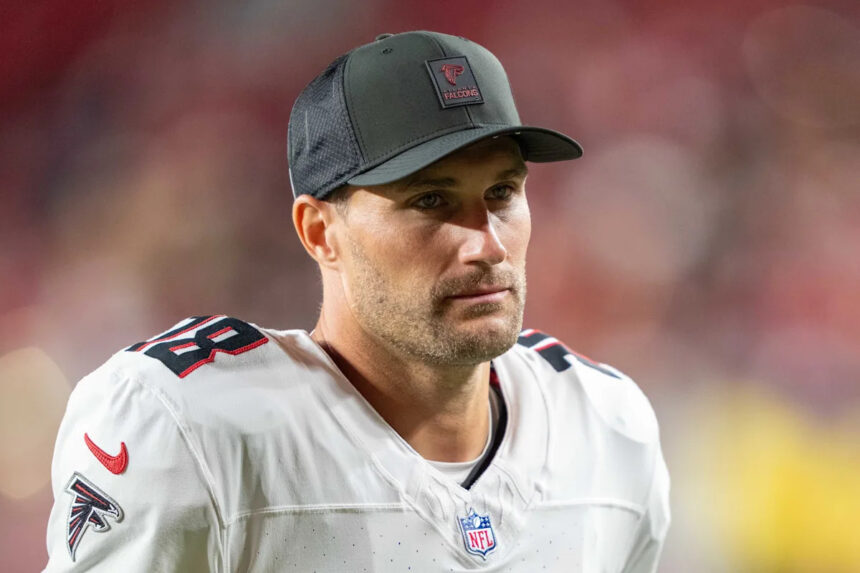
Falcons’ Stunning Reversal: Kirk Cousins Expected to Hit Free Agency in Major Cap Move
The Atlanta Falcons’ grand experiment with veteran quarterback Kirk Cousins appears to be ending after just two seasons in a dramatic and costly front-office reset. According to a report from ESPN’s Adam Schefter, the Falcons are expected to release Kirk Cousins before the new league year begins in March, a move that would send the 37-year-old quarterback back into free agency and leave Atlanta absorbing a significant financial hit. This potential decision, telegraphed by a recent contract restructure, marks a shocking pivot for a franchise that once viewed Cousins as the final piece to its playoff puzzle.
The Financial Trigger: A Contract Designed for an Exit
The roadmap to Cousins’ departure was laid out in plain financial terms. Schefter’s report details a critical alteration to Cousins’ contract, a maneuver that all but guarantees his release. The Falcons converted a portion of his salary into a signing bonus, lowering his 2026 base salary to a mere $2.1 million. However, this created a massive trigger: a staggering $67.9 million in fully guaranteed money that would lock in if Cousins is on the roster after March 11.
This is a classic “poison pill” structure designed to force a decision. By creating this hard deadline, the Falcons’ new leadership under general manager Terry Fontenot and head coach Raheem Morris has signaled a clear intent to turn the page, regardless of the dead-cap consequences. The team is choosing financial flexibility in future years over committing to an aging quarterback coming off a disappointing and injury-plagued season.
- Contract Signed: 4 years, $180 million (2024)
- Key Stat: $67.9 million becomes fully guaranteed if on roster March 11, 2026.
- Cap Implication: Falcons will absorb a large dead-cap hit in 2026 to avoid future guarantees.
A Promising Start Derailed by Injury and Inconsistency
When Kirk Cousins signed with Atlanta in 2024, the vision was clear: provide elite stability and precision to an offense brimming with young skill talent. For a time, it worked. The Falcons roared to a 6-3 start in 2024, with Cousins operating efficiently in a system tailored to his strengths. His connection with tight end Kyle Pitts was particularly potent, and the offense showed a level of competency not seen in years.
The turning point came in a Week 11 clash with the New Orleans Saints. Cousins suffered a shoulder injury that, while not season-ending, fundamentally altered his performance. His arm strength and accuracy visibly diminished. The Falcons subsequently plunged into a four-game losing streak, with Cousins throwing critical interceptions and the offense stalling. After a narrow, ugly victory over a Desmond Ridder-led Las Vegas Raiders team—a ironic twist given Atlanta’s own QB history—the Falcons made the decisive move to bench Cousins in favor of rookie John Paddock. The trust was broken, and the trajectory of the partnership was irrevocably changed.
His final Atlanta line—5,229 yards, 28 touchdowns, and 21 interceptions over 24 games—tells a story of flashes of brilliance overshadowed by costly mistakes and a failure to elevate the team when it mattered most.
Expert Analysis: Why This Move Makes Sense for Atlanta
From a football operations perspective, this expected release is a painful but logical reset. The new coaching regime, led by Raheem Morris and offensive coordinator Zac Robinson, inherits a quarterback who will be 38 at the start of the 2026 season and is clearly on the physical decline. The $67.9 million guarantee is a financial anchor they are unwilling to accept for a player who may no longer fit their long-term vision.
“This is about sovereignty for a new regime,” says an NFC front-office executive. “They don’t want to be handcuffed to a massive, aging contract for a player they didn’t choose. Eating the dead money now gives them a clean slate—and potentially a high draft pick—to find their own guy. It’s a short-term pain, long-term gain play, but it requires major ownership buy-in due to the cash outlay.”
The move also reflects the modern NFL’s harsh reality regarding quarterback valuation. Unless you have a top-tier, MVP-caliber player, committing nearly $70 million in guaranteed money to a late-30s quarterback is seen as prohibitive. The Falcons are essentially admitting the mistake and cutting their losses, opting to use their resources to either draft a quarterback of the future or pursue a different veteran option in a cheaper, shorter-term capacity.
What’s Next for Kirk Cousins and the Falcons?
Kirk Cousins will once again become one of the most intriguing names on the free agent quarterback market. While his age and recent injury are concerns, his pre-injury performance in 2024 proved he can still run an offense effectively. He will likely attract teams who believe they are a competent quarterback away from contention—think the Pittsburgh Steelers, Las Vegas Raiders, or even a return to the Minnesota Vikings if situations shift. His market will be a fascinating test of how the league values experienced but declining QB play.
For the Atlanta Falcons, the path forward is now the dominant storyline of their offseason. All options are on the table:
- NFL Draft: They could package assets to move up for a top quarterback prospect.
- Veteran Bridge: Signing a lower-cost free agent to compete with John Paddock.
- Trade Market: Exploring options for a younger, established quarterback.
This decision unequivocally puts the franchise in rebuilding mode at the sport’s most important position. The pressure will be immense on Fontenot and Morris to nail the subsequent move, as another miss at quarterback will set the organization back for years.
Conclusion: A Costly Lesson in NFL Team Building
The expected release of Kirk Cousins is a stark reminder of the high-risk, high-reward nature of NFL free agency, particularly at quarterback. The Falcons’ massive investment in 2024 was a gamble to accelerate a rebuild, and for a brief moment, it seemed to be paying dividends. But football is a game of attrition, and a single injury can unravel the best-laid plans. By likely releasing Cousins, the Falcons are accepting a monumental financial penalty to reclaim their strategic freedom. It’s a bold, expensive, and arguably necessary step for a franchise desperate to find a true identity. The chapter of Kirk Cousins in Atlanta will be remembered as a promising start that faded quickly, leaving both parties to search for answers elsewhere in an ever-churning NFL landscape.
Source: Based on news from Yahoo Sports.