Lindsey Vonn Defies Time, History with Electrifying World Cup Downhill Victory at 41
The air in St. Moritz is thin, cold, and heavy with history. For decades, this Swiss enclave has been a proving ground for alpine skiing’s legends. On December 12, it became the stage for one of the sport’s most improbable, emotionally charged comebacks. Lindsey Vonn, the name synonymous with American downhill dominance, stood in the start gate not as a nostalgic figure from a past era, but as a current, potent threat. Minutes later, she erupted into the finish area, topping the timing sheets to claim her first World Cup victory in nearly eight years. At 41 years old, Vonn didn’t just win a race; she shattered preconceptions about age, recovery, and the very limits of athletic longevity, delivering a masterclass in resilience that reverberated far beyond the frozen slopes.
A Podium of Emotion: The Weight of an Eight-Year Wait
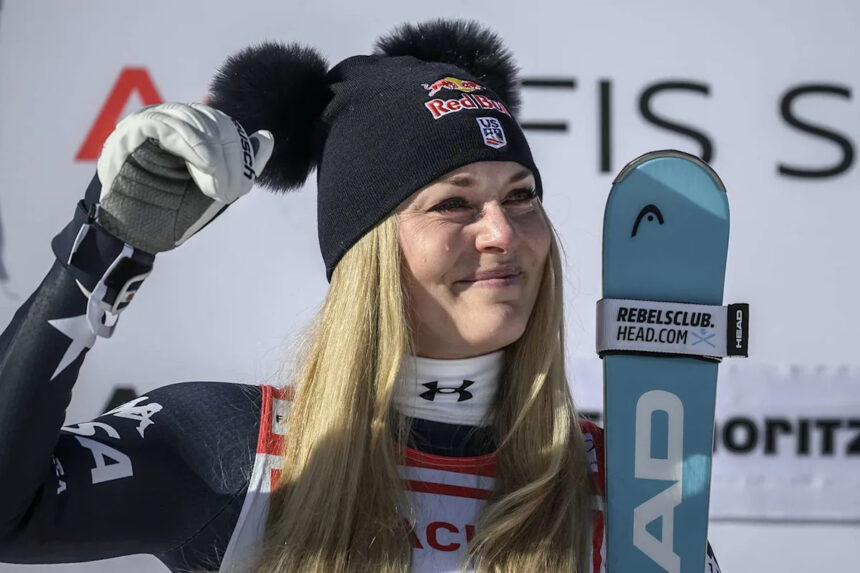
As Vonn crossed the finish line, the raw, unfiltered emotion was palpable. This was not the stoic, record-chasing champion of the 2010s. This was a woman confronting a ghost—the long, arduous shadow of injury, retirement, comeback, and doubt—and finally laying it to rest. On the podium, tears welled in her eyes as the American national anthem played, a soundtrack she had not heard in victory since March of 2018. The image, captured by Fabrice COFFRINI / AFP via Getty, says it all: a portrait of catharsis.
In her post-race comments, Vonn revealed a startling vulnerability that underscored the mental battle of her return. “I was emotional on the podium because I wasn’t aware of my own speed,” she admitted. For an athlete whose career was built on the precise, fearless management of velocity, this confession was profound. It spoke to a journey back not just to physical peak form, but to a state of competitive trust—trust in her surgically-repaired knees, her training, and her legendary instincts. “I know now how fast I am,” she declared, a statement that served as both a personal affirmation and a stark warning to the World Cup field.
Deconstructing the Comeback: The Anatomy of a Historic Win
Vonn’s victory is not a fluke or a fortunate result. It is the product of a meticulously engineered return to the sport, a testament to modern sports science and an indomitable will. To understand the magnitude, one must examine the pillars of this comeback:
- Strategic Patience: Vonn did not rush her return to the World Cup circuit. Her initial starts were carefully selected, focusing on courses that suited her technical strengths while managing the physical toll on her body.
- Technical Evolution: At 41, Vonn can no longer rely solely on the brute force that defined her earlier career. Her St. Moritz run showcased refined technique, cleaner lines, and a veteran’s wisdom in reading the terrain—turning potential energy into unmatched efficiency.
- Mental Fortitude: Overcoming the psychological barrier of past injuries, particularly the catastrophic knee surgeries that preceded her 2019 retirement, is perhaps her greatest triumph. Conquering the fear of re-injury at top speed is a hurdle few athletes ever face, let alone clear.
- Physical Preservation: Her training regimen is undoubtedly revolutionized—a blend of cutting-edge recovery, targeted strength work to protect vulnerable joints, and intelligent periodization. She is not training harder than her 20-year-old self, but infinitely smarter.
This win redefines what is possible in a sport where athletes are often considered past their prime in their early 30s. Vonn’s performance proves that peak athletic performance can have an expiration date that is self-determined, not dictated by tradition.
The Ripple Effect: What Vonn’s Victory Means for Skiing and Beyond
Lindsey Vonn’s impact now transcends her 82 World Cup victories. This latest chapter sends seismic waves through the world of sports.
For Alpine Skiing: She has instantly revitalized the women’s downhill circuit. The narrative is no longer about who will inherit her throne, but about the queen actively defending it against a generation she inspired. Her presence elevates the competition’s prestige and intensity. Younger rivals now must beat not just a legend, but a current, winning athlete.
For Women in Sports: Vonn is providing a powerful, visible blueprint for extended career longevity in women’s sports. In an era where conversations about equality often focus on pay and opportunity, she is demonstrating that the opportunity to compete at the highest level can—and should—extend deeper into an athlete’s life.
For the Culture of Comebacks: In a sports landscape often obsessed with “next,” Vonn commands attention on “now.” She challenges the linear career arc and celebrates the non-linear journey. Her story is one of sustained passion, a quality that resonates with fans who see in her not just an athlete, but a person relentlessly pursuing a love for her craft.
The Road Ahead: Predictions for the Rest of the Season
With the psychological dam broken and speed confirmed, what can we expect from Lindsey Vonn for the remainder of the World Cup season?
- Selective Dominance: Look for Vonn to target specific, technically demanding downhill courses. Venues like Cortina d’Ampezzo and the Hahnenkamm in Kitzbühel (should she choose to compete there) become must-watch events. She will likely skip some speed events to prioritize recovery and peak performance for her best opportunities.
- A Mentor & Rival: Her role in the finish area will be dual-faceted. She will be a sought-after source of wisdom for younger American skiers while simultaneously being the fiercest competitor they face. This dynamic is unprecedented.
- Pushing the Pace: Her proven speed raises the bar for the entire field. To beat Vonn, rivals cannot simply ski well; they must ski perfectly, under the pressure of knowing a living legend is still setting the standard.
- Olympic Dreams Rekindled? While the 2026 Milano-Cortina Olympics remain a distant goal, this victory will inevitably fuel speculation. Her approach will be year-to-year, but the tantalizing possibility of a final Olympic chapter at age 42 is now a legitimate conversation, not a fantasy.
Conclusion: More Than a Victory, A Testament to Will
Lindsey Vonn’s victory in St. Moritz is a landmark moment that will be etched in alpine skiing lore. It is a story that began with tears of frustration and pain and has now culminated in tears of triumphant validation. At 41, she is not merely participating; she is winning, rewriting her own legacy in real-time. This win answers the question of “why come back?” with resounding clarity: because she can. Because the champion within does not recognize a calendar. Because the love for the rush of speed and the smell of the mountain air is ageless.
Her statement, “I know now how fast I am,” is the key. It is the culmination of a long, lonely journey back to self-belief. Lindsey Vonn has not just returned to the World Cup podium; she has returned to herself. And in doing so, she has given the world of sports a timeless gift: the undeniable proof that heart, wisdom, and relentless passion can forge a champion for any age. The final chapter of her racing story is now being written, and it is already one of her most compelling.
Source: Based on news from Yahoo Sports.