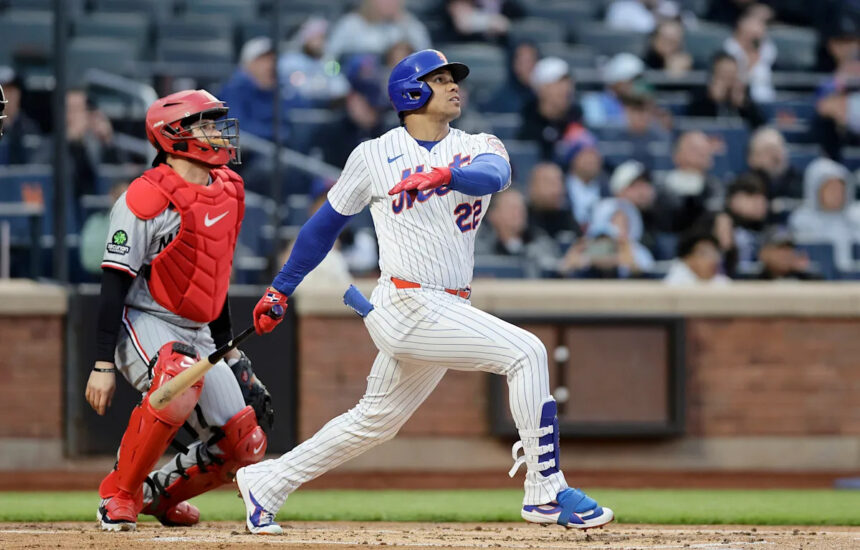
Juan Soto’s Silent Return: A Symptom of a Deeper Mets Malaise?
NEW YORK — The cavalry arrived at Citi Field on Wednesday, but without a rallying cry. Juan Soto, the Mets’ $40 million offseason linchpin, was activated from the injured list, his presence meant to stanch the bleeding of a catastrophic 12-game losing streak. Yet, his return was met not with a roar of salvation, but with a quiet, unsettling revelation. During his 15-day exile on the IL with a bruised hand, Soto admitted he had not been in consistent contact with his struggling teammates. In the vacuum of that silence, a franchise’s deepest fears about its own identity are screaming for attention.
The Echo of Absence: Soto’s Silence Speaks Volumes
Clubhouse chemistry is an intangible, often overused term in baseball parlance. It’s cited in victory and scrutinized in defeat. For the 2024 Mets, it is now the central question. Soto’s admission wasn’t malicious, but it was profoundly telling. While rehabbing, his primary focus was on his own health, a perfectly rational approach for any player. However, in the context of a team in freefall, that rational choice becomes a cultural indictment.
This is not to villainize Soto. He is a hired superstar, a mercenary bat of the highest order brought in to transform an offense. But his integration appears transactional, not transformational. When asked for his analysis of the team’s historic skid in his absence, Soto offered a stark, seven-word postmortem: “We haven’t won any games.” The statement was factually flawless but analytically barren. It revealed a player observing outcomes, not dissecting processes or connections. In a clubhouse desperate for leadership and a unifying voice, Soto’s return felt like the insertion of a spectacularly talented island into a sea of disconnected fragments.
Beyond One Savior: A Systemic Offensive Collapse
Manager Carlos Mendoza was quick to publicly manage expectations, a necessary move to shield his returning star. “I can’t put all the pressure on him,” Mendoza stated. “Especially with this stretch that we’re in right now.” His words underscore a painful truth the Mets’ front office must confront: this collapse is systemic. Soto’s bat can provide a jolt, but it cannot rewire a broken circuit.
The numbers during the losing streak are not just bad; they are historically anemic. The lineup has been a black hole of production, with veterans and role players alike failing to perform. This has created a cascading effect:
- Daily Lineup Chaos: Mendoza has been forced into near-daily lineup shuffles, searching for any combination that sparks a rally, undermining rhythm and consistency.
- Pitcher Pressure: Every mistake by the pitching staff is magnified, as even a two-run deficit feels insurmountable, crushing morale on the mound.
- No Offensive Identity: The team lacks a discernible approach—no consistent ability to work counts, move runners, or deliver a timely hit outside of Pete Alonso.
Placing Soto into this environment is like installing a Formula One engine in a car with four flat tires. The potential for speed is there, but the foundation cannot support it. The Mets’ offensive drought is a full-roster failure, and expecting one man to solve it is a blueprint for further disappointment.
Rewriting the Narrative: Can the Mets Save Themselves?
The most poignant line to emerge from this saga came not from a player, but from a beat reporter: “To snap this streak and rewrite the narrative of the season, the Mets will have to save themselves.” This is the core challenge. Front-office acquisitions can build a roster, but only shared struggle and commitment can build a team.
Soto’s silent stint on the IL exposes a potential void in player-driven accountability. In eras past, or in other clubhouses, a veteran core might have organized early batting practice or a players-only meeting to confront the struggle head-on. The question now is whether this group has, or can develop, that internal engine. The return of a superstar should be a catalyst for collective energy, not just individual hope. The responsibility falls on established leaders like Francisco Lindor, Pete Alonso, and even Soto himself to now actively forge the connections that were absent during the losing streak.
Clubhouse chemistry isn’t about being best friends; it’s about shared investment. It’s about the subtle communication during a slump, the unspoken support during a rehab, the collective will to dissect and solve problems. The Mets’ current test is less about baseball skill and more about building this very fabric under the most intense pressure imaginable.
The Path Forward: Predictions for a Critical Stretch
Where do the Mets go from here? The immediate future hinges on more than Soto’s swing.
Short-Term (Next 10 Games): Expect a slight offensive bump from Soto’s presence, but likely not a streak-snapping explosion. The real metric to watch is competitive at-bats from the entire lineup. Can they show a more disciplined, unified approach? The pitching staff, remarkably resilient thus far, will need to see early run support to maintain its edge.
Mid-Season (Trade Deadline): The Soto saga will heavily influence the front office’s calculus. If the team rallies and shows cohesion, they may look to add complementary pieces. If the disconnect persists and the record languishes, the Mets could become dramatic sellers, with even Soto’s long-term future with the team thrown into doubt despite his talent.
Long-Term (Season’s End): This episode will be a case study for the organization. It highlights the critical need to evaluate not just a player’s on-base percentage or slugging, but his fit within a club’s existing culture and leadership structure. The Mets’ losing streak is a baseball problem, but its roots may be cultural.
Conclusion: More Than a Bat, The Need for a Heartbeat
Juan Soto’s injured list silence is not the cause of the New York Mets’ woes, but it is a powerful symptom. It illuminates a team that operates as a collection of individuals rather than an interconnected organism. His prodigious talent can win games, but it cannot, alone, win a season. The 12-game skid exposed fatal flaws in offensive construction and perhaps in team building.
The narrative of the Mets’ season is now at a stark crossroads. One path sees Soto’s return as the spark that finally ignites a dormant but talented roster, forcing a cohesion that was missing. The other sees his quiet absence as a prophetic symbol of a team that never truly found its heartbeat. The saves, as the saying goes, will not come from the bullpen alone. To salvage their year, the Mets must execute the most difficult play in sports: they must save themselves, and they must start by learning how to truly connect.
Source: Based on news from Yahoo Sports.