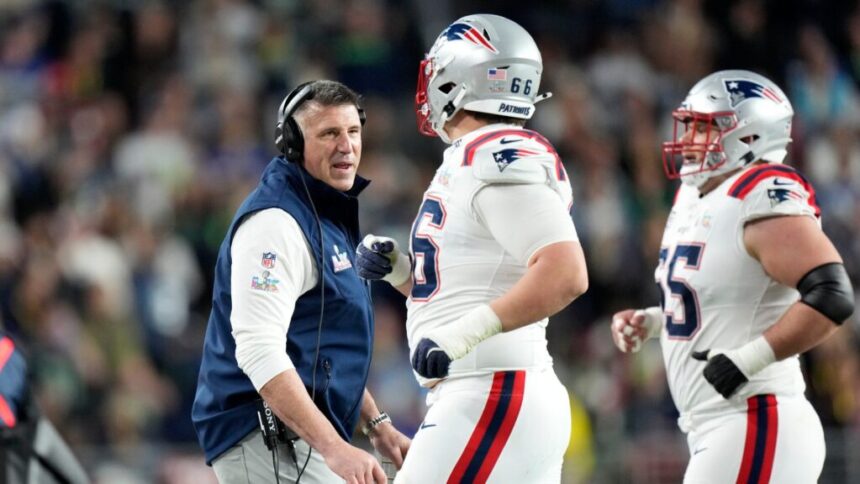
Mike Vrabel’s Post-Super Bowl Message to Patriots: A Blueprint for the Future in Defeat
The confetti in Seattle was a shade of blue and green, a cruel, alien color to the New England Patriots and their faithful. Super Bowl LX, an improbable destination for this rebuilt team, ended not with a dynasty’s revival but with a stark reminder of the NFL’s razor-thin margins. The 24-10 loss to the Seahawks was a comprehensive breakdown, a night where the bright future represented by quarterback Drake Maye and head coach Mike Vrabel faced its most glaring adversity. In the quiet of a losing locker room, amidst the sting of a dream deferred, Vrabel delivered a post-game message that was less about a single game and more about the foundational bedrock of what he is building in Foxborough.
The Sting of Defeat and the Weight of “Front-Runner” Culture
For Patriots fans, the performance was a difficult echo of past franchise lows. Drake Maye, the rookie sensation who electrified the regular season, looked every bit a first-year player on the grandest stage, his throws uncharacteristically off-target and his decision-making rushed. Mike Vrabel’s defensive game plan, so often a masterpiece of adjustment, was picked apart by Seattle’s veteran quarterback. It was, as Vrabel acknowledged, perhaps the worst collective game from the team’s most important figures all season.
Yet, when asked about his message to the team, Vrabel’s words were pointedly forward-looking. “I’m proud of everything they did,” Vrabel stated, a testament to a journey that saw the Patriots surge from a projected rebuilding year to AFC contenders. But the core of his philosophy was revealed in a single, loaded term: front-runner.
“Part of our identity is to not be a front-runner,” Vrabel told his team. This is a profound statement in the instant-gratification era of sports. A “front-runner” is a team, or a person, that thrives only when things are easy, when the momentum is favorable, when the path is clear. Vrabel’s entire ethos, forged in the fires of his own playing career in New England, is the antithesis of that. His message was clear: true identity isn’t forged in the champagne spray of victory, but in how you stand, together, in the wreckage of a defeat you never saw coming.
Decoding Vrabel’s 307-Day Blueprint: Process Over Prize
The most analytically intriguing part of Vrabel’s remarks was his specific timeframe. “We’re 307 days into what is hopefully a long and successful relationship and program.” This is not a coach speaking in platitudes. This is a CEO of a football team framing the journey with precise, long-term metrics.
- It contextualizes the loss: Super Bowl LX was not an endpoint, but a checkpoint—albeit a painful one—in a multi-year construction project.
- It reinforces daily commitment: By highlighting the exact number of days, Vrabel underscores that the program is built on daily, incremental work, not on any single game’s outcome.
- It manages expectations while raising the bar: It acknowledges the incredible progress made in less than a year, while firmly setting the expectation that this is merely the beginning.
This perspective is Vrabel’s greatest asset. He is asking his players, and the fanbase, to trust the process in a way that is deeply familiar to the Patriot Way, yet distinctly his own. The message to Drake Maye is implicit: your legacy is not defined by one bad night, but by how you respond over the next 307 days, and the 307 after that.
Expert Analysis: The Psychological Playbook of a Leader
From a leadership psychology standpoint, Vrabel’s address was a masterclass in managing high-stakes disappointment. He skillfully balanced several critical emotional layers:
Validation of Emotion: “It’s okay to be disappointed. We have to be disappointed and upset together.” This permission to feel the pain prevents emotional stagnation. It bonds the team in shared vulnerability, which is the precursor to shared resilience.
Gratitude as an Anchor: In the depths of professional despair, he expressed being “appreciative,” “thankful,” and “grateful” to coach them. This reframes the relationship from one of pure results to one of shared purpose, strengthening loyalty and buy-in for the harder days ahead.
The Mandate of Memory: “Every year somebody is going to lose this game, and we have to remember what it feels like and make sure it’s not repeated.” This is the ultimate motivator. He is not allowing the loss to be filed away. He is demanding it be internalized as fuel. The Super Bowl loss becomes a permanent part of the team’s institutional memory, a reference point for every future moment of adversity.
This approach is starkly different from a fiery rant or a somber eulogy. It is strategic, emotional architecture designed to ensure that the pain of February is converted into the power of September.
Predictions: How This Loss Shapes the Patriots’ 2025 Ascent
While the immediate aftermath is raw, Vrabel’s message provides a clear roadmap for the Patriots’ immediate future. Here’s what to expect:
1. A Hyper-Focused Drake Maye Offseason: Maye will not be coddled. The offseason program will be a forensic review of his Super Bowl performance, with an intense emphasis on pocket presence under duress and pre-snap recognition. Expect a sophomore leap born from this specific humiliation.
2. Strategic Roster Additions with an Edge: The Patriots will likely seek veterans—particularly on the offensive line and at receiver—who are known for their toughness and resilience, not just athletic talent. Vrabel will prioritize players who embody the “non-front-runner” mentality.
3. The 307-Day Mantra as a Locker Room Code: This number will become a touchstone. You will hear players reference it in training camp interviews. It will be a shorthand for the collective grind and the understanding that they are still in the early chapters of their story.
4. The AFC East on Notice: A motivated, unified, and humbled Patriots team led by a coach with a crystal-clear blueprint is a dangerous proposition. They entered Super Bowl LX ahead of schedule. They will enter the 2025 season with a hardened edge and a vengeance, making them the team to beat in the division.
Conclusion: The Foundation Forged in Heartbreak
Mike Vrabel did not give a speech about X’s and O’s after Super Bowl LX. He gave a speech about time, memory, and identity. In a league obsessed with winners and losers, he spoke to the space in between—the grueling, unglamorous work that ultimately decides which side you end up on. The atrocious defeat to the Seahawks will be recorded in the history books as a loss. But in the internal ledger of the New England Patriots, it may be recorded as the necessary trial that solidified a culture.
By refusing to let the moment break his team’s spirit or distort their long-term vision, Vrabel demonstrated why he was the right man for this new era. The message was clear: This was not the end of a dream, but the difficult, essential beginning of a true contender’s resolve. The relationship is 307 days old. The program is just getting started. And the memory of this Seattle night will be the engine for every single day that follows.
Source: Based on news from Yahoo Sports.