Kirsty Muir’s Agony: Fourth-Place Big Air Finish Repeats Olympic Heartbreak for Team GB Star
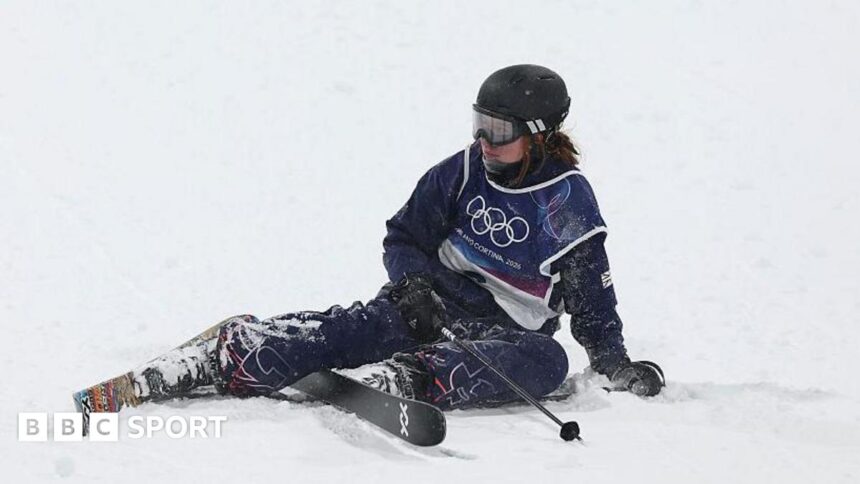
The cruelest number in Olympic sport is not last. It is fourth. It is the excruciating purgatory between the ecstasy of the podium and the consolation of a valiant effort. For Kirsty Muir, the prodigiously talented freestyle skier from Aberdeen, the number four has become a haunting, repetitive motif in Beijing. Exactly one week after missing a slopestyle bronze medal by a margin almost too small to comprehend—0.41 points—Muir found herself in an agonizingly familiar position. In the women’s big air final, she soared, she spun, she dazzled, but when the scores settled, she was once again the first name off the podium, finishing fourth in a devastating near-miss that solidifies her status as both Britain’s brightest star and its most heartbroken Olympian.
A Week of Deja Vu: The Narrowest of Margins
The narrative was painfully similar, only the backdrop changed. Instead of the intricate rails and jumps of the slopestyle course, the stage was the daunting Big Air Shougang ramp. The goal remained the same: land three explosive jumps, with the best two scores combined. Muir, competing with a poise that belied her 22 years, put down a formidable series of runs. She opened with a stylish left double cork 1080 safety, scoring 90.25. Her second jump, a switch left double cork 1080, earned an 84.50. The pressure was on for her final attempt.
Needing to improve her second score to climb into medal contention, Muir launched herself into the Beijing sky one last time. She executed a clean and powerful left double cork 1260, a significant upgrade in difficulty, and stomped the landing. The score flashed: 90.25. Her combined total of 174.75 points was a monumental effort, a testament to her consistency and big-match temperament. Yet, as the final competitor’s scores were calculated, the cruel arithmetic of the Olympics took hold. Italy’s Flora Tabanelli, the penultimate skier, posted a total of 178.25. The difference was a mere 3.5 points—the equivalent of a slight hand drag or a minor degree of rotation in a judge’s eye.
- Slopestyle Deficit: 0.41 points from bronze.
- Big Air Deficit: 3.5 points from bronze.
- Cumulative Heartbreak: Two fourth-place finishes in seven days.
This twin disappointment is unprecedented for Team GB at a Winter Games. Muir’s performances were of the highest caliber, yet the podium remained just out of reach, a testament to the brutal competitiveness of modern women’s freeskiing.
Analyzing the Podium: Gu’s Reign Challenged, A New Gold Standard
While Muir’s story captured the emotional core of the event, the battle for the medals wrote its own compelling chapter. All eyes were on China’s Eileen Gu, the defending champion and global superstar. Gu, competing in her first big air contest since winning gold in 2022, was characteristically spectacular but not untouchable. She laid down a stunning first jump—a left double cork 1620—to take an early lead, but couldn’t quite find the same perfection on her subsequent attempts. Her silver medal signaled a shifting landscape; the field has caught up to the phenom.
Seizing the moment was Canada’s Megan Oldham, whose victory was built on astounding amplitude and technical precision. Oldham’s gold-winning run showcased a level of progression that is defining this era. Meanwhile, Flora Tabanelli’s bronze for Italy was a breakthrough, achieved by marrying high difficulty with flawless execution under ultimate pressure. This podium composition reveals a critical insight: the era of single-athlete dominance in freeskiing is over. The Olympic big air competition is now a volatile, deep, and unpredictable battleground where any of a dozen athletes can win on any given day.
For Muir, this context makes her fourth-place finishes all the more impressive and all the more agonizing. She is not an outsider; she is a core member of this elite group, consistently delivering scores that would have medaled at previous Olympics. The benchmark has simply been raised to a stratospheric level.
The Muir Trajectory: From Prodigy to Perennial Contender
Kirsty Muir’s journey is far from a story of failure. At just 17 in her first Olympics in Beijing 2022, she was a wide-eyed talent finishing fifth in big air. Today, she is a polished, world-class operator who expects to win. This evolution is crucial. The anguish she displayed at the finish area is not the disappointment of an also-ran, but the fury of a champion who knows she belongs on the podium.
Her performance in Beijing demonstrates critical strengths:
- Elite Consistency: Landing five out of six competition jumps across two finals under extreme pressure.
- Technical Breadth: Displaying a versatile trick book with both forward and switch take-offs.
- Mental Resilience: Returning from the slopestyle heartbreak to nearly medal again a week later.
What separates fourth from third at this level is often the finest of details: a perfect grab held for a fraction of a second longer, a landing absorbed with slightly quieter skis, the intangible “wow” factor that sways judges. Muir possesses all the raw materials. The refinement of these microscopic elements will be the focus moving forward.
Looking Ahead: Milan-Cortina 2026 and the Path to the Podium
So, where does Kirsty Muir go from a double fourth? The path is paradoxically clear. At 22, her peak Olympic years are directly ahead. The 2026 Winter Olympics in Milan-Cortina will present her third and likely most potent opportunity. The experience gained from these searingly close calls is invaluable. Champions are often forged in the fire of such disappointment.
Predictions for Muir’s trajectory are overwhelmingly positive. The sporting world has a long memory for athletes who come so close. The narrative for 2026 will not be about whether she can compete, but whether she can finally convert her world-class talent into an Olympic medal. Expect to see her:
- Introducing new, even more complex rotations (like 1440s or 1620s) into her competition repertoire.
- Dominating the World Cup circuit to build ranking points and psychological momentum.
- Using these two fourth-place finishes as relentless motivation in every training session.
The pressure will be immense, but Muir has now stared down Olympic pressure twice and delivered scores that challenged for medals. She has proven she can handle the moment.
Conclusion: The Bitter Precursor to Glory
Kirsty Muir’s Beijing 2024 campaign will be remembered not for medals, but for mettle. To finish fourth once is a tough Olympic story. To do it twice, by a combined margin of less than four points, is a tragicomic twist of sporting fate that would break a lesser competitor. Yet, in this repeated heartbreak, the outline of a champion becomes visible.
History is littered with athletes who endured Olympic agony before ascending the podium. Muir’s near-miss for Team GB is not an ending; it is a brutal, necessary chapter in what is destined to be a triumphant career. She leaves China not with hardware, but with something perhaps more powerful for the long journey ahead: an unquenchable fire. The ski world knows her name, respects her talent, and now awaits her response. For Kirsty Muir, the climb from fourth to the podium begins today, and the sporting world should be wary of an athlete with a point to prove and a score to settle with destiny itself.
Source: Based on news from BBC Sport.