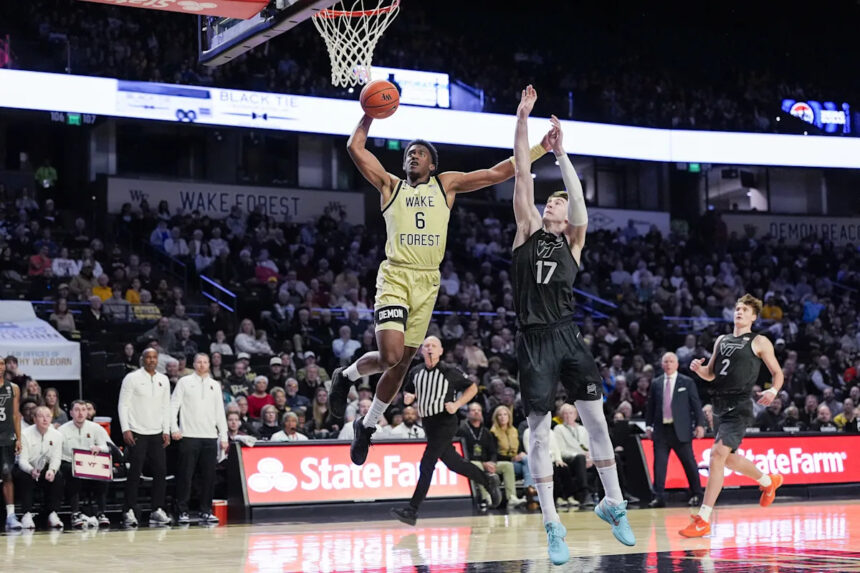
Myles Colvin Enters Transfer Portal: A Crushing Blow Resets Wake Forest’s Rebuild
The exodus from Winston-Salem has reached a critical, and perhaps definitive, point. In an offseason defined by departures, the Wake Forest basketball program has sustained its most significant loss. Junior forward Myles Colvin, the team’s most impactful portal addition just a year ago, has entered the transfer portal, leaving the Deacons’ roster in a state of near-total deconstruction. For Head Coach Steve Forbes and his staff, the mission for the 2025-26 season has abruptly shifted from building upon a foundation to pouring an entirely new one.
The Staggering Impact of Colvin’s Departure
To call Myles Colvin a mere transfer would be a profound understatement. After two seasons at Purdue, the 6-5 wing arrived at Wake Forest as a beacon of hope—a high-major talent with proven athleticism and untapped potential. He didn’t just meet expectations; he shattered them, evolving into the team’s most dynamic two-way threat. Colvin’s exit isn’t just another name in the portal; it is the removal of the central pillar around which next season’s team was supposed to be constructed.
His statistical leap was monumental. Colvin finished his junior season with career-high averages across the board:
- 11.6 points per game (2nd on the team)
- 4.4 rebounds per game
- 1.4 assists per game
- 1.2 steals per game
But numbers only tell half the story. Colvin possessed the rare, game-breaking ability to single-handedly shift momentum. His season was punctuated by explosive performances that showcased his ceiling: a 33-point eruption against Queens and a 32-point masterpiece against Syracuse. In both of those contests, he was virtually unguardable, shooting a combined 14-for-16 from three-point range. Perhaps the most iconic moment of Wake Forest’s season belonged to him—a cold-blooded, buzzer-beating three-pointer to stun Memphis in the Baha Mar Championship, a shot that encapsulated his confidence and clutch gene.
Analyzing the Ripple Effect on Wake Forest’s Roster
The term “rebuild” is often overused in college sports, but for the 2025 Wake Forest Demon Deacons, it is now the only applicable term. Myles Colvin’s transfer portal decision reduces the returning core to a startling reality: Isaac Carr is now the lone returning scholarship player who logged significant minutes last season. The entirety of last year’s starting lineup and its top six scorers are now gone, either to graduation or the portal.
This creates a multifaceted crisis for Coach Forbes. First, there is the immediate talent vacuum. Colvin was not just a scorer; he was a versatile defender capable of guarding multiple positions, a capable rebounder from the wing, and the team’s third-most reliable three-point shooter at 36%. Replacing that specific combination of skills in one portal acquisition is nearly impossible.
Second, and perhaps more critically, it strips the program of continuity and leadership. Teams often rely on returning players to instill culture, teach systems, and provide stability during inevitable rough patches. With Carr as the sole experienced holdover, Wake Forest will be a collection of strangers next season. The coaching staff must now not only recruit talent but also hastily engineer chemistry and a collective identity from scratch.
What’s Next for Myles Colvin and the Deacs?
Colvin’s entry into the portal will make him one of the most coveted wings available. His proven production in the ACC, combined with his athletic pedigree and clear upside, will attract high-major suitors from across the country. Programs seeking an immediate-impact scorer who has already weathered Power Conference play will line up. His journey, from Purdue to Wake Forest and now to a third stop, is a testament to the modern era’s transient nature, where players seek the perfect fit to maximize their final collegiate chapters.
For Wake Forest, the path forward is daunting but not uncharted for Forbes, who has built a reputation as a portal maestro. The entire offseason strategy must now be recalibrated. The focus will shift from complementary pieces to finding a new primary scorer, additional ball-handlers, and veteran presence. The staff’s evaluation and recruitment prowess in the portal will be tested like never before.
Expect Forbes to aggressively target:
- High-Volume Scorers: Players with a track record of carrying an offensive load at the mid-major or high-major level.
- Experienced Guards: With Carr as the only backcourt constant, adding multiple seasoned ball-handlers is paramount.
- Graduate Transfers: Older players who can provide immediate maturity and leadership to a brand-new squad.
A Program at a Crossroads
The departure of Myles Colvin is more than a single transaction; it is a seismic event that defines an era of transition for Wake Forest basketball. It underscores the brutal reality of today’s landscape: even successful portal acquisitions can be fleeting, and roster building is a year-round, high-stakes endeavor with no guarantees.
While the immediate outlook appears bleak, Steve Forbes has earned the benefit of the doubt for his ability to construct competitive teams through the portal. However, this challenge is of a different magnitude. The 2025-26 season will be a referendum on the program’s infrastructure and Forbes’s vision. Can he craft a cohesive unit from disparate parts under immense pressure? The loss of Colvin is a devastating setback, but the story of next season’s Deacons is now unwritten. The coaching staff holds the pen, and the next few months of portal work will determine whether this reset becomes a rebirth or a prolonged retreat.
One thing is certain: the Joel Coliseum floor will feature a team unrecognizable from the one that finished last season. The hope in Winston-Salem now rests on the hope that the next Myles Colvin is out there in the portal, waiting for a call, and that the staff can find not just one, but several of him.
Source: Based on news from Yahoo Sports.