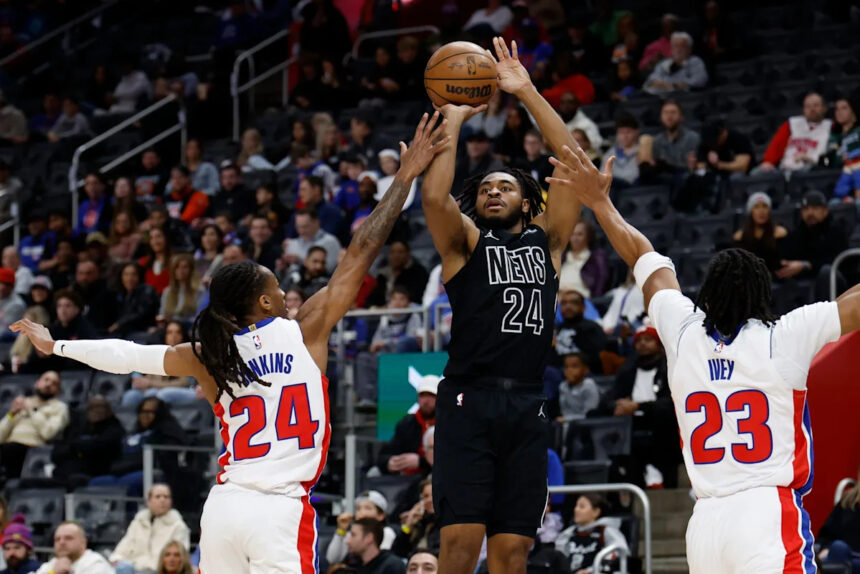
Nets Hit Rock Bottom in Historic 130-77 Demolition by Pistons
In the grueling marathon of an NBA season, every team faces a night where nothing goes right. For the 2024-25 Brooklyn Nets, that night arrived in Detroit with a force so emphatic, it rewrote the franchise record books for futility. What was billed as a tough test against the Eastern Conference-leading Pistons turned into a 53-point humiliation, a 130-77 loss that wasn’t just a defeat, but a systemic breakdown from opening tip to final buzzer. While Cam Thomas and rookie Drake Powell managed a team-high 12 points off the bench, their contributions were mere footnotes in a game that exposed every crack in Brooklyn’s foundation. This wasn’t just a loss; it was a statement on the vast chasm between a contender and a team adrift.
A Collapse of Historic Proportions
The final score—130-77—tells a brutal story, but the details are even more damning. The Nets’ 77 points set a new franchise low for the Brooklyn era, a stark symbol of an offense that completely flatlined. The 53-point margin of defeat is one of the worst in team history. Crucially, Brooklyn lost every single quarter by at least nine points, indicating a failure to adjust or muster any sustained resistance. The early competitive spirit evaporated under a relentless Pistons onslaught, led by first-time All-Star Jalen Duren (21 points, 10 rebounds) and maestro Cade Cunningham (18 points, 12 assists). Detroit’s dominance was rooted in defensive terror, forcing the Nets into 25 catastrophic turnovers that they converted into 39 points. When your opponent scores more off your mistakes than your entire bench produces, you are not simply losing; you are being dismantled.
Nets Player Grades: Searching for Silver Linings
Assigning grades after a performance of this magnitude feels like judging the deck chairs on the Titanic. The collective failure was so complete that individual efforts, however modest, were rendered irrelevant. Nonetheless, the game film reveals the specific areas of breakdown that Brooklyn must address with urgency.
- Cam Thomas (12 PTS, 3 AST): C- Tying for the team lead in scoring is typically a positive, but context is everything. Thomas’s 12 points came on inefficient 5-of-14 shooting, and his offensive spark, usually a reliable bench constant, was muted. In a game screaming for a scorer to halt massive Pistons runs, Thomas couldn’t provide the necessary volume or efficiency. His playmaking (3 assists) was a minor bright spot, but he was also part of the turnover plague.
- Drake Powell (12 PTS, 3 REB): C+ The rookie was one of the few Nets who played with palpable energy. Powell attacked the rim with purpose and was unafraid of the moment, even in a blowout. His scoring co-lead is a promising sign for his development and potential role moving forward. However, his defensive rotations, like those of all his teammates, were often a step slow against Detroit’s precise execution.
- Mamadou Traore (6 PTS, 4 REB): D Starting again due to injury, Traore’s ongoing offensive limitations were painfully highlighted. The Pistons’ game plan was clear: sag off and dare him to score away from the rim. He couldn’t. While his aggression driving is noted, until he develops a consistent mid-range or perimeter game, opposing defenses will wall off the paint and force him into difficult, contested finishes. He became a non-threat, allowing Detroit to focus its defensive energy elsewhere.
- Ilija Demin (4 PTS, 2-10 FG): F Coming off his best game of the season, Demin’s regression was severe. He looked utterly overwhelmed by the Pistons’ physical, top-ranked defense. His shot selection was poor, and his attempts to create were stifled. This performance underscored the rookie’s struggle with consistency and the dramatic adjustment to NBA-level physicality, especially against an elite defensive unit like Detroit’s.
- Team Defense & Ball Security: F This grade encompasses the entire roster. The 25 turnovers speak to a lack of poise and preparedness. Defensively, the communication was nonexistent, leading to wide-open looks for Detroit and a complete failure to contain Duren inside or Cunningham on the perimeter. It was a comprehensive schematic and effort-based failure.
Expert Analysis: What This Blowout Truly Reveals
Forget the score for a moment. This game was a diagnostic x-ray of the 2024-25 Brooklyn Nets, and the results are alarming. A 53-point loss is rarely just about a bad shooting night; it’s about systemic issues in culture, preparation, and resilience.
First, the turnover problem is not new, but its scale against an elite opponent shows a team that is mentally fragile under pressure. The Pistons applied defensive intensity, and the Nets crumbled, making errant passes and poor decisions. This points to a lack of on-court leadership and a roster still learning how to execute under duress.
Second, the offensive scheme appears easily neutralized. With Traore providing no spacing and primary scorers being hounded, the Nets devolved into stagnant, one-on-one play. There was no evident counter, no adjustment to create easy baskets. When your offense sets a franchise-low scoring output, the problem is philosophical as much as it is personnel-based.
Finally, the defensive effort was unacceptable. Competitive teams, even when overmatched, show pride on the defensive end. The Nets showed none after the first few minutes. The ease with which Detroit scored in the paint and from three indicates a team that has not bought into a defensive identity—a fatal flaw for any squad with playoff aspirations.
The Road Ahead: Predictions and Necessary Changes
Where do the Nets go from the lowest point of their season? The immediate future is fraught, but this loss can serve as a pivotal wake-up call if management and the coaching staff respond correctly.
We predict the front office will become aggressive sellers as the trade deadline approaches. This loss confirms this core, as currently constructed, has a ceiling far below contention. Veterans on expiring contracts may be moved to acquire future assets and give more minutes to developing players like Powell.
On the court, expect a renewed, almost obsessive, focus on fundamentals: ball security and defensive communication. Head coach Jordi Fernandez must simplify the offense to generate higher-percentage shots and limit isolation plays that lead to turnovers. The rotation may also see a shake-up, with energy players being rewarded over underperforming veterans.
The development of young players like Powell, Demin, and Thomas now becomes the unequivocal priority. The goal for the remainder of the season must shift from chasing a improbable play-in spot to establishing a hard-playing, defensively responsible culture. The lessons from Detroit are harsh, but they are clear: without a foundational change in mindset and execution, more nights like this are inevitable.
Conclusion: A Necessary Evil or a Sign of Deeper Trouble?
The Nets’ 130-77 evisceration in Detroit will live in franchise infamy. While Cam Thomas’s 12 points led the team, that fact alone encapsulates the barren state of the offense. This was more than a bad loss; it was a manifestation of every fear about this team’s direction—poor roster construction, shaky identity, and a glaring lack of toughness.
In the long view, such a stark nadir can sometimes catalyze necessary change. It strips away illusions and forces honest evaluation. For the Nets, the evaluation is in: this project, in its current form, has failed. The path forward is now one of difficult decisions, patient development, and a relentless pursuit of a new identity built on competence and fight. The season’s goals have been irrevocably altered by one historically brutal night in Detroit. How Brooklyn responds will define not just the remainder of this season, but the trajectory of the franchise for years to come.
Source: Based on news from Yahoo Sports.