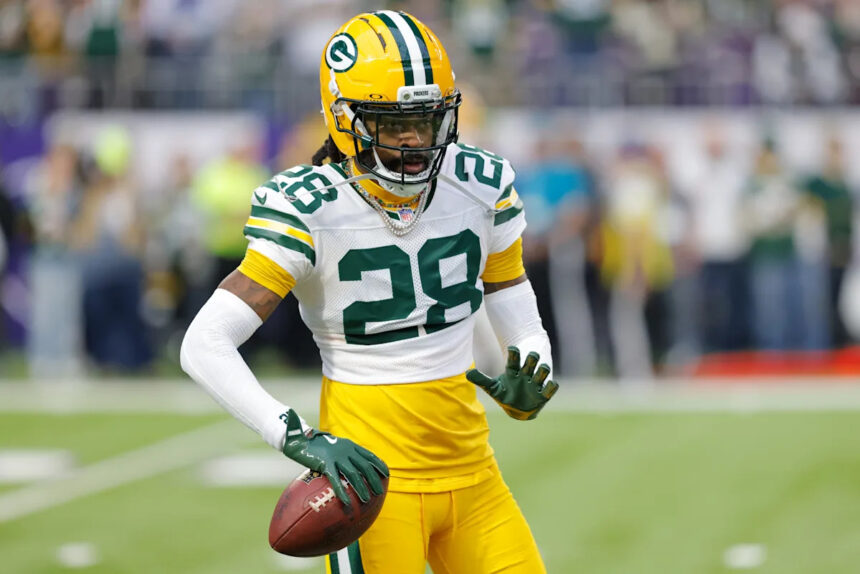
Packers’ Brief Diggs Experiment Ends: A Calculated Gamble That Paid Off
The transaction wire in the NFL is a constant, churning river of moves, most of which are forgettable. Every so often, a name appears that makes you do a double-take. Such was the case in late December 2025, when the Green Bay Packers claimed former Dallas Cowboys All-Pro cornerback Trevon Diggs off waivers. It was a headline-grabbing, curiosity-sparking move. Just over a month later, with a simple press release, the Packers closed the book on one of the most fascinating and fiscally prudent short-term rentals in recent league memory. The release of Diggs was not a surprise; it was the always-intended, masterfully executed final act of a savvy front office maneuver.
The Anatomy of a One-Week Rental
To understand the Packers’ decision to release Diggs, you must first understand the unique, low-risk nature of his acquisition. When the Dallas Cowboys made the stunning decision to waive Diggs late in the 2025 season, they absorbed a catastrophic financial hit. All of Diggs’ remaining guaranteed money—the dead cap charge—stayed on Dallas’s books for 2025 and 2026. This created a perfect storm for a contender with a need.
The Packers, navigating injuries and seeking depth for a playoff push, saw an opportunity. Claiming Diggs meant they were only responsible for the prorated portion of his base salary for the final week of the regular season. This was a calculated gamble with almost no long-term downside. The team secured a former All-Pro for:
- Depth for a playoff run at the league’s most volatile position.
- A one-game audition for a potential future role.
- The total cost: roughly $531,000 and a roster spot.
Diggs started the Packers’ meaningless Week 18 finale, a 33-snap tune-up where he shook off rust and collected two tackles. His more telling contribution, however, was simply being on the roster as an emergency option once the tournament began.
A Playoff Spectator and the Inevitable Financial Reality
The Wild Card round against the Chicago Bears revealed the Packers’ true evaluation of Diggs. In a game where starting cornerback Carrington Valentine struggled, defensive coordinator Jeff Hafley played Diggs for exactly one defensive snap. On that play, Diggs was involved in an explosive pass allowed and made an assisted tackle downfield. He was never seen on defense again.
That single snap was a deafening statement. It told the world that despite his pedigree, Diggs was not in football shape, not fully acclimated to the scheme, or simply not a better option than the players in front of him—even when they were faltering. His value was purely as a break-glass-in-case-of-emergency backup.
This football reality collided head-on with a financial cliff. Diggs’ contract, inherited from Dallas, was set to balloon in 2026. Keeping him would have meant committing to a massive base salary for a player who was a healthy scratch in all but the most dire circumstances. For a Packers front office led by Brian Gutekunst, celebrated for its shrewd salary cap management, the decision was elementary.
Releasing Diggs freed up over $15 million in immediate cap space for 2026, a windfall that can be used to re-sign key contributors, pursue free agents, or absorb new contracts for emerging stars. With zero dead money hitting Green Bay’s cap, the move was as clean as it gets in the modern NFL.
Looking Forward: Packers’ Cornerback Strategy Takes Shape
The Diggs release is less about the player himself and more a clarifying moment for the Packers’ defensive direction. It signals unwavering confidence in their young core and their financial model. The team is now poised to build around Jaire Alexander and the developing Eric Stokes, while continuing to cultivate 2025 contributors like Valentine. The freed-up capital directly aids this mission.
Furthermore, the Packers immediately began shaping the edges of their roster for the future, announcing futures contracts for two players. These signings, typical for the offseason, are for depth and competition, but they underscore a philosophy: develop your own, invest in your system, and use cap space deliberately. The Diggs saga was a brief, expensive tangent from that core team-building principle.
What can we expect next for the Packers’ secondary?
- A renewed focus on extending or securing their own key defensive backs.
- Potential for a mid-level free agent signing for competition, funded by the Diggs cap savings.
- A high likelihood of selecting a cornerback in the 2026 NFL Draft to add young, cost-controlled talent.
Final Whistle on a Trivia Answer
So, what is the legacy of Trevon Diggs, Green Bay Packer? It will be a footnote, but an instructive one. He was not a failed reclamation project. He was a tactical, short-term asset acquisition—a luxury rental for a team in “win-now” mode. The Packers paid a relative pittance for a month of insurance at a premium position. When the insurance wasn’t needed, they canceled the policy before the premium skyrocketed.
This episode is a masterclass in modern NFL front office operations. It highlights the importance of financial flexibility, the value of understanding contract mechanics, and the discipline to walk away from a big name when the on-field evidence and the numbers dictate you should. The Packers didn’t fall in love with the allure of an All-Pro name; they coldly assessed his value, used him for their immediate purpose, and moved on when his cost outweighed his projected contribution.
Someday, Trevon Diggs will indeed be the answer to an obscure trivia question. But for the Packers, his brief tenure is the answer to a different question: How does a smart organization leverage every rule to its advantage? By turning a headline into a no-risk trial, and a no-risk trial into $15 million of future opportunity. In the end, the Packers’ gamble on Diggs wasn’t about his ability to return to All-Pro form; it was a bet on their own fiscal and strategic discipline. That’s a bet they just cashed in, big time.
Source: Based on news from Yahoo Sports.