Packers Release Trevon Diggs: A Brief, Failed Experiment Ends in Green Bay
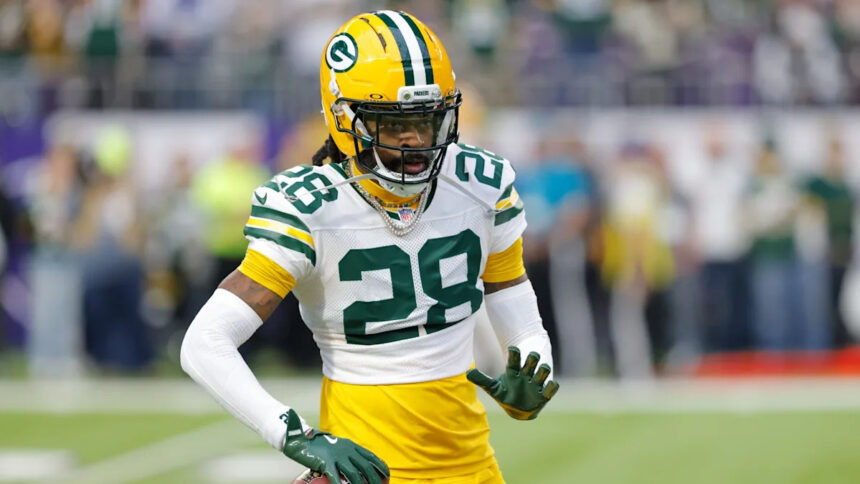
The Green Bay Packers’ attempt to catch lightning in a bottle has fizzled out. In a move that surprised few who followed the team’s late-season roster churn, the Packers announced on Tuesday the release of cornerback Trevon Diggs, abruptly ending a tenure that lasted less than two months. The transaction closes a brief and unimpactful chapter for both player and team, highlighting the harsh realities of NFL roster management and the difficulty of recapturing past magic after significant injury.
Diggs, the former Dallas Cowboys star who led the NFL with 11 interceptions in 2021, was a headline-grabbing waiver claim in late December. The move was seen as a low-risk, high-reward flyer for a Packers secondary navigating injuries. However, the experiment failed to yield any meaningful return on investment, culminating in his release after seeing just a single snap in the team’s postseason run.
The Rise, Fall, and Green Bay Gamble
Trevon Diggs’ trajectory is a stark tale of NFL volatility. His 2021 season was nothing short of spectacular, a ball-hawking masterpiece where he seemed to magnetically attract passes, earning him First-Team All-Pro honors. However, the narrative began to shift in subsequent years. Critics pointed to his high-risk, high-reward style that sometimes led to big plays given up. More crucially, his availability plummeted.
Since the end of his All-Pro campaign, Diggs has been defined by injury. He played just 22 games from 2022 onward. A torn ACL suffered in practice in September 2023 was the major blow. His attempted comeback was further hampered by an additional knee surgery in December 2024 and a stint on injured reserve in 2025 due to concussion symptoms. When the Cowboys, facing their own roster decisions, released him, the Packers saw a flicker of opportunity.
Green Bay’s claim was a classic post-deadline gamble: acquire a former elite talent for the league minimum, with no commitment beyond the current season. The hope was that Diggs, even at 80% of his former self, could provide depth or a situational spark. As the facts show, that hope was never realized.
A Non-Impact in Green and Gold
The statistical footprint of Diggs’ time with the Packers is remarkably thin, underscoring why his release was inevitable. His role was marginal from the start and diminished to virtually nothing when games mattered most.
- Regular Season Finale: Diggs saw his most extensive action—33 defensive snaps—in Week 18 against Minnesota. This game, however, was characterized by the Packers resting numerous starters for the playoffs, making it more of an evaluation period than a competitive contest.
- Postseason Disappearance: The telling sign came in the Wild Card round against the Chicago Bears. With the season on the line, Diggs was on the field for just one defensive snap. The coaching staff’s clear lack of trust in his ability to contribute in a high-stakes environment sealed his fate.
- No Statistical Contribution: Diggs recorded zero tackles, passes defended, or interceptions during his Packers tenure. He was a non-factor on the stat sheet and, by all observations, on the field.
This lack of impact speaks volumes. It wasn’t merely about Diggs being rusty; the Packers’ defensive scheme under coordinator Jeff Hafley is demanding and requires precise communication and agility. Diggs, still working his way back from multiple knee procedures and other health issues, likely couldn’t meet those physical or schematic demands in the limited time he had.
Expert Analysis: Why This Was Always a Long Shot
From a roster construction perspective, this move was a textbook “no-harm, no-foul” scenario for General Manager Brian Gutekunst. The cost was negligible, and the release now carries no dead cap hit. However, the experiment’s failure was predictable to many analysts.
“The Packers took a swing on pedigree, not on current film,” says a veteran NFC scout who requested anonymity. “Recovering from an ACL is one challenge, but the additional knee surgery in late 2024 was a massive red flag. It suggested complications or a setback that often delays a return to peak form by another full year. Asking a player with that recent history to learn a new system and contribute in January was always a monumental ask.”
The scout also pointed to the schematic fit. Diggs’ legendary 2021 season was built on aggressive, instinctive play in a system that allowed him to take risks. Green Bay’s current defense, while still aggressive, relies on more pattern-matching and specific zone principles. Diggs had no offseason or training camp to absorb these nuances.
Ultimately, the move highlights the chasm between a player’s reputation and his current physical reality. The Packers bet that the name “Trevon Diggs” still held value. They discovered that the player, in his present condition, did not fit their immediate or future plans.
What’s Next for Diggs and the Packers’ Secondary?
The future for both parties now diverges sharply. For the Green Bay Packers, the path is clear. The release reaffirms their commitment to the young core of their secondary. Players like Jaire Alexander, Eric Stokes, Carrington Valentine, and 2025 draft picks will be the focus. The Diggs episode was a brief, inconsequential sidebar that does not alter their offseason blueprint, which likely still involves seeking stability and health at the cornerback position.
For Trevon Diggs, the road ahead is murkier. He now hits the free agent market as a 27-year-old cornerback with an All-Pro pedigree but a medical chart that will give every team pause.
- Best-Case Scenario: A team with a deep need at cornerback and a patient coaching staff signs him to a veteran-minimum deal with minimal guarantees for the 2025 season. He would be given a full, healthy offseason and training camp to truly compete for a role.
- Likely Reality: He may have to wait until after the 2025 NFL Draft, or even until a team suffers an injury in training camp, to find his next opportunity. His market will be limited to one-year, “prove-it” contracts.
- The Major Question: Can his knee ever regain the elite burst and change-of-direction ability that made him a special player? The multiple procedures suggest a complicated recovery, and his non-impact in Green Bay is an ominous data point.
Conclusion: A Cautionary Tale of Timing and Health
The Trevon Diggs saga in Green Bay will be quickly forgotten, a minor footnote in the Packers’ 2024 season. Yet, it serves as a potent reminder of the NFL’s unforgiving nature. Talent is ephemeral, and health is the ultimate currency. A player can go from the apex of the sport to a waiver-wire afterthought in the span of three seasons, victimized by cruel twists of fate like non-contact knee injuries.
For the Packers, the decision was straightforward and correct. Sentimentality has no place in the pursuit of a championship. They took a calculated, cost-free risk on a famous name, saw it provide no tangible benefit, and moved on without a second thought. For Diggs, the release is another difficult step in a career that has been derailed. His challenge is no longer about proving he is an All-Pro; it is about proving he can be a reliable, healthy NFL player again. The Packers’ brief experiment concluded he is not that—at least not yet. The next team to consider him will be looking at the same daunting medical reports and the same glaring lack of recent production, making his path back to relevance a steep climb indeed.
Source: Based on news from Yahoo Sports.