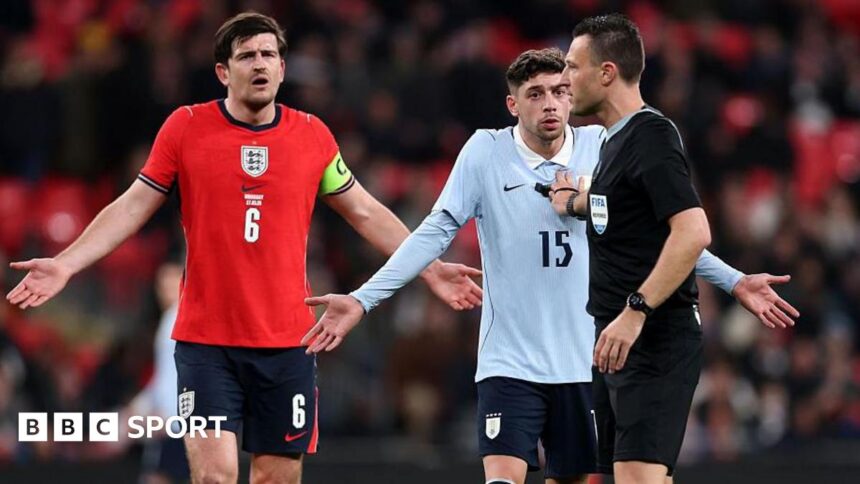
VAR’s Nightmare: Red Card Chaos & Contentious Calls Mar England’s Friendly
The international friendly is designed as a polished dress rehearsal, a chance to fine-tune tactics and build cohesion away from the high-stakes pressure of competitive fixtures. What unfolded between England and Uruguay on Friday, however, was less a symphony and more a cacophony of confusion, with the match officials, led by referee Sven Jablonski, conducting a performance that left players, managers, and fans utterly bewildered. In a 1-1 draw light on entertainment but heavy on controversy, Video Assistant Referee (VAR) protocol and basic disciplinary procedures seemed to unravel, prompting England manager Thomas Tuchel to label it a “bad day at the office” for the officials—a damning indictment of a system designed to eliminate such errors.
A Bizarre Sequence: From Elation to Despair and Disbelief
The match appeared to be drifting towards a narrow, forgettable England victory, sealed by a late Ben White header. The Three Lions’ defensive resilience, a hallmark of Tuchel’s tenure, seemed to have earned a clean sheet. Then, in stoppage time, chaos ensued. Uruguayan forward Darwin Núñez went down under minimal contact from White in the area. Referee Jablonski initially waved play on, but was summoned to the pitchside monitor by his VAR team.
After a lengthy review, Jablonski astonishingly overturned his own decision, pointing to the spot. Federico Valverde duly converted, stealing a draw for Uruguay. The decision was soft at best, non-existent at worst, undermining the high threshold for “clear and obvious error” that VAR is meant to uphold. The incident transformed what should have been a moment of triumph for White into one of profound frustration, raising immediate questions about consistency and the subjective interpretation of contact in the modern game.
The Unseen Scandals: Two Yellows and a Forgotten Red
While the penalty dominated post-match headlines, it was merely the crescendo in a match riddled with officiating anomalies. Two earlier incidents were arguably more damaging to the integrity of the match officials’ performance.
- Manuel Ugarte’s Phantom Red Card: The Uruguayan midfielder was shown a yellow card in the 58th minute for a cynical foul. Later, in the 74th minute, he committed an almost identical, bookable offense. Broadcast replays and live commentary clearly indicated he was shown a second yellow card by Jablonski, yet Ugarte remained on the pitch. No VAR intervention occurred to correct what appeared to be a monumental administrative error—forgetting a first caution.
- Ronald Araujo’s Unpunished Assault: In the first half, Uruguay’s center-back launched into a heavy, studs-up challenge on England’s Phil Foden. The tackle was late, reckless, and caught Foden high on the ankle. It was a textbook red card offense in the contemporary interpretation of the laws. Jablonski produced only a yellow, and VAR, inexplicably, did not recommend a review for serious foul play.
These two moments created a pervasive sense of lawlessness. If a player can avoid a second yellow, and a dangerous tackle goes severely under-punished, the foundational principles of player safety and fair play are compromised.
Expert Analysis: Systemic Failure or Human Error?
This collection of errors points beyond a simple “mistake.” It suggests a systemic breakdown in communication and procedure. VAR is not an autonomous robot; it is a tool operated by humans. The failure to intervene on the Araujo challenge is a critical lapse from the video officials. The Ugarte situation is more baffling, hinting at a potential failure in the referee’s match control logistics or a catastrophic miscommunication with the fourth official overseeing disciplinary records.
Thomas Tuchel’s “bad day at the office” remark is a diplomatic understatement. For managers, such inconsistency is a nightmare. It makes tactical planning—like instructing players to target an opponent on a yellow card—irrelevant. It also erodes trust in the match officials completely. If the system cannot get the basic arithmetic of yellow cards correct, or protect players from dangerous tackles, its credibility is shattered.
This friendly served as a stark reminder that technology does not eliminate controversy; it often merely relocates it. The focus shifts from the referee’s real-time error to the VAR room’s judgment—or lack thereof. The “clear and obvious” mantra felt entirely absent, replaced by a hair-splitting review for the penalty and a baffling indifference to clear red card incidents.
Predictions: Repercussions and the Road to the Next Tournament
The fallout from this match will be significant, though largely behind closed doors.
- Official Scrutiny: Referee Sven Jablonski and his VAR team can expect a difficult debrief with UEFA’s refereeing committee. While friendly matches are lower profile, this level of performance is unlikely to go unnoticed and could impact their appointments for upcoming competitive fixtures.
- Managerial Leverage: Tuchel, and other top managers, will use this match as a key example in their ongoing dialogues with governing bodies about officiating standards. It provides a perfect case study of multiple failures in one game.
- Player Mentality: For England’s squad, this is a harsh lesson in the non-negotiable truth of international football: you cannot rely on officials. It will reinforce Tuchel’s message about controlling the controllable and seeing games out beyond any doubt.
- VAR Protocol Review: While no major rule changes will stem from a friendly, such a public relations disaster for the officiating team adds fuel to the eternal debate about the speed, transparency, and application of VAR.
Conclusion: A Friendly That Offered a Hostile Warning
England’s draw with Uruguay will not be remembered for its football. It will be remembered as the match where the officiating lost the plot. From the unjust penalty that erased a win to the unpunished red card offenses and the mystical case of the vanishing second yellow, this was a 90-minute anthology of officiating errors. It was a “bad day at the office” that exposed the fragile human element still at the heart of the game’s technological aids. For fans and purists, it was a frustrating spectacle. For UEFA and refereeing bodies, it must serve as a glaring red flag—a warning that the pursuit of accuracy must be matched by unwavering competence in the fundamentals of the game. The road to major tournaments is paved with lessons, and this was a costly, confusing one that everyone will hope is not repeated when the real action begins.
Source: Based on news from BBC Sport.