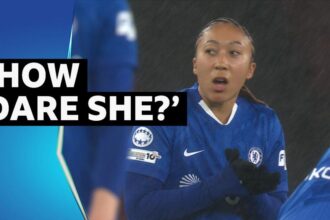
‘I Think She’s Made an Obvious Error’: Pundits Unite in Criticism of Controversial Chelsea Disallowed Goal
The thin line between glory and grievance in football is often drawn by the referee’s whistle. In the high-stakes cauldron of the Women’s Champions League quarter-final, that whistle blew with decisive, and deeply contentious, force. A pivotal Chelsea goal was chalked off for a foul in the build-up, a decision that has ignited a firestorm of debate, with high-profile pundits Nikita Parris and Ellen White leading a chorus of disagreement, arguing the official was “hasty” and made an “obvious error.” The incident, involving Chelsea’s Veerle Buurman and Arsenal’s Laia Codina, has become the defining flashpoint of the tie, raising urgent questions about consistency, interpretation, and the VAR process at the very pinnacle of the women’s game.
The Incident: A Split-Second Decision That Changed the Tie
As Chelsea pressed for a crucial advantage, a seemingly routine aerial duel in the Arsenal penalty area became the center of the footballing universe. Chelsea defender Veerle Buurman challenged Arsenal’s Laia Codina as a cross sailed into the box. There was contact, Codina went to ground, and the Chelsea attack continued, culminating in the ball hitting the back of the net. However, the referee’s whistle had already sounded, penalizing Buurman for a push on Codina. The goal was disallowed. Replays showed a tangle of arms and a competitive jostle for position, typical of physical battles in the box. For the officials, it was a clear foul. For a growing number of observers, including those with immense credibility, it was a catastrophic misjudgment that robbed the match of a legitimate goal and unfairly altered the competitive landscape.
The key facts of the controversy are:
- The Call: On-field referee immediately whistled for a foul by Veerle Buurman on Laia Codina.
- The Outcome: A subsequent Chelsea goal was ruled out.
- The Replay: Broadcast angles showed contact that appeared mutual and debatable in its severity.
- VAR Check: The decision was reviewed but not overturned, as VAR cannot intervene on subjective foul calls unless they are a “clear and obvious error.”
Pundit Consensus: “Hasty” and “An Obvious Error”
What makes this incident particularly resonant is the rare unanimity among pundits, who are often divided. England and Arsenal star Nikita Parris, providing analysis, did not mince words. “I think she’s made an obvious error,” Parris stated, dissecting the replay. She emphasized the natural physicality of the game, arguing that Buurman’s action was a standard part of competing for the ball and did not constitute a foul worthy of disallowing a goal. Her sentiment was powerfully echoed by England legend Ellen White. White agreed with Parris’s assessment, labeling the referee’s decision as “hasty.” This dual condemnation from two of the most respected figures in the women’s game, one a current elite player and the other a recently retired icon, carries significant weight. Their analysis shifts the narrative from mere fan frustration to a pointed critique from within the sport’s inner circle.
This pundit disagreement highlights a fundamental clash in interpretation. The refereeing perspective likely focused on Buurman’s arm making contact and Codina’s loss of balance. The pundits’ perspective, informed by a lifetime of playing in the box, focused on the context of the challenge: minimal force, a simultaneous battle for space, and a lack of clear, unfair advantage gained. This chasm between how a rule is written and how it is applied in the dynamic, physical reality of the sport is at the heart of the controversy. When experts like Parris and White see an “obvious error,” it suggests the decision failed the essential test of footballing logic.
Broader Implications: VAR, Consistency, and the Growth of the Game
This incident is not an isolated one; it is a symptom of ongoing tensions in modern football. The Women’s Champions League is experiencing unprecedented growth, with scrutiny and stakes higher than ever. With this growth comes an expectation of officiating that matches the elite level of play. The Buurman decision forces an uncomfortable conversation about refereeing consistency in critical moments. Fans and players are left wondering: would that same call be made in a men’s quarter-final? Is the threshold for a foul different?
The role of VAR in women’s football is also under the microscope. The system was used, yet it provided no correction. This is because VAR protocol restricts intervention on subjective decisions unless they are deemed “clear and obvious.” The officials in the VAR hub apparently did not view the call as such, creating a frustrating paradox for viewers: a decision that looks like a mistake to elite pundits and a global audience is not considered “clear and obvious” enough to overturn. This erodes confidence in the technology meant to bolster fairness. The incident underscores the need for continuous dialogue and potentially refined protocols to ensure VAR serves the game’s best interests, not just its technical guidelines.
Looking Ahead: Repercussions and the Road to Lyon
The immediate fallout from this moment is tangible. While the final result of the tie was decided over two legs, the psychological and tactical impact of that disallowed goal in the first leg cannot be discounted. It protected a scoreline, altered Chelsea’s approach, and handed Arsenal a reprieve they may not have deserved. For Chelsea, it is a “what if” moment that may linger.
Predictions for the future are twofold:
- Increased Scrutiny: Officials in high-profile women’s matches will face even more intense examination, with calls for a higher standard of officiating to match the quality on the pitch. Pundit commentary will likely become more vocal in holding decisions to account.
- Protocol Review: Governing bodies like UEFA must analyze incidents like this to improve consistency. This could involve enhanced training for officials on the specific dynamics of the women’s game and clearer communication on the “clear and obvious” threshold for VAR.
The ultimate goal is to ensure the headlines are made by the players, not the referees. As the women’s game charges toward a blockbuster future, the demand is for officiating that facilitates brilliant, fair competition, not hinders it.
Conclusion: A Defining Moment for Refereeing Standards
The disallowed Chelsea goal, dissected and denounced by Nikita Parris and Ellen White, has transcended a single match. It has become a catalyst for a necessary conversation about excellence in officiating at the summit of women’s football. When two of the sport’s most authoritative voices declare a decision an “obvious error,” the governing structures must listen. This moment is not about vilifying an individual official but about advocating for a system—encompassing training, VAR application, and consistent philosophical interpretation—that is as world-class as the athletes it serves. The beautiful game, in its women’s and men’s iterations, deserves nothing less than clarity and courage in decision-making. The hope is that from this controversy emerges a renewed commitment to ensuring that the outcome of epic battles in the Champions League is determined solely by the skill, heart, and strategy of the players on the pitch.
Source: Based on news from BBC Sport.
Image: CC licensed via www.rawpixel.com