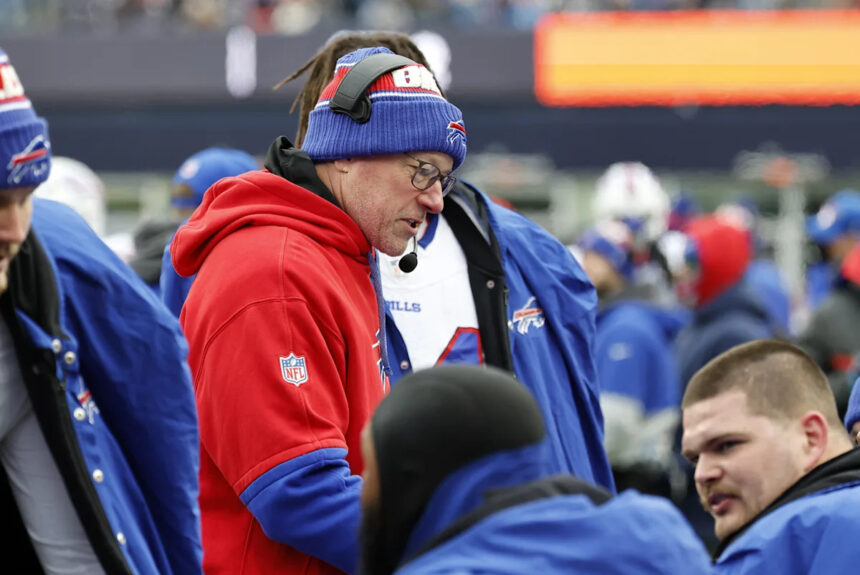
End of an Era: Bills Offensive Line Coach Aaron Kromer Announces Retirement After Playoff Heartbreak
The sting of a season-ending playoff loss is profound, a cocktail of immediate anguish and lingering questions about the future. For the Buffalo Bills, that pain was compounded just hours after their crushing 33-30 overtime defeat to the Denver Broncos in the Divisional Round. As players packed their lockers and fans began the long offseason autopsy, a seismic shift in the team’s foundation emerged: highly respected offensive line coach Aaron Kromer is set to retire, closing the book on a remarkable 24-year NFL coaching career.
Kromer’s departure marks the end of a critical chapter for a Bills offense that has been among the league’s most potent. His decision, coming on the heels of such a devastating loss, signals a period of significant transition in Orchard Park. This isn’t just a coach leaving; it’s the architect of the trenches, the man responsible for protecting Josh Allen and paving the way for the running game, stepping away at a pivotal moment.
A Coaching Odyssey: From Miami (OH) to the NFL’s Brightest Lights
Aaron Kromer’s football journey is a testament to longevity, adaptability, and earned respect. His coaching roots trace back to the college ranks at Miami of Ohio in 1990, a cradle of coaches where he honed his craft for a decade. His NFL break came with the Oakland Raiders in 2001, where he served as assistant offensive line coach under the tutelage of the legendary Bill Callahan. This foundational period was crucial, embedding in him the technical precision and tough-minded approach that would become his hallmark.
Kromer’s career is a map of modern NFL offense. His path intersected with some of the game’s most influential minds:
- Reunion with Jon Gruden in Tampa Bay (2005-2007) as a senior assistant, absorbing the intricacies of the “Gruden Grinder” mentality.
- A transformative stint with Sean Payton’s New Orleans Saints (2008-2012), where he initially coached running backs before masterfully handling dual roles as run game coordinator and offensive line coach. This period culminated in the unique challenge of serving as interim head coach during Payton’s 2012 suspension, a testament to his leadership and the organization’s trust.
- An offensive coordinator role with the Chicago Bears (2013-2014), where he oversaw a record-setting 2013 offense that showcased both his strategic acumen and the volatility of NFL success.
Each stop added a layer to his philosophy, culminating in his impactful tenure in Buffalo, where he synthesized these experiences into one of the league’s most consistent units.
The Buffalo Legacy: Building a Wall for a Superstar
When Aaron Kromer arrived in Buffalo, the mission was clear: fortify the protection around a young, dynamic, but sometimes reckless Josh Allen. The results were undeniable. Under Kromer’s guidance, the Bills’ offensive line evolved from a question mark into a undeniable strength. He developed mid-round picks and seasoned veterans alike into a cohesive, intelligent, and physically imposing group.
Kromer’s offensive line was the silent engine of the Bills’ offensive explosion. They provided Allen with the time to unleash his deep-ball prowess and created the lanes for a relentless rushing attack. His ability to scheme protection and teach technique allowed Offensive Coordinator Ken Dorsey (and later Joe Brady) to operate with creative freedom, knowing the front five could handle complex assignments. The unit’s performance was a key reason Buffalo remained a perennial AFC powerhouse and Super Bowl contender throughout his tenure.
His retirement leaves a massive void. The relationship between a quarterback and his line is sacred, and Allen enjoyed a rare stability and synergy with the men in the trenches, all orchestrated by Kromer. Replacing that level of teacher, tactician, and motivator will be one of General Manager Brandon Beane’s most critical offseason tasks.
What’s Next for the Buffalo Bills’ Offensive Line?
The immediate question for the Bills is one of succession and philosophy. Kromer’s retirement is the first domino in what could be an offseason of significant change. The search for his replacement will be scrutinized as heavily as any player acquisition.
Potential directions for Buffalo include:
- Promoting from within: Does an assistant like quality control coach Austin Gund or assistant OL coach Ryan Wendell (a former Kromer pupil in New England) offer the continuity the Bills may crave?
- Seeking a veteran NFL voice: The Bills, in “win-now” mode, may look for a coach with proven experience, possibly someone with ties to Head Coach Sean McDermott’s network or the offensive staff.
- A philosophical shift: Will the new coach continue Kromer’s zone-heavy, athletic scheme, or introduce new concepts? The answer will directly impact the type of linemen Buffalo targets in the draft and free agency.
Furthermore, the line itself faces personnel questions. With starting center Mitch Morse contemplating his future and the constant churn of NFL rosters, the new coach will not only have to teach but potentially rebuild. The timing of this exit adds a layer of complexity to an offseason already charged with emotion after another playoff disappointment.
A Respected Voice Exits the Stage
Aaron Kromer’s retirement closes a 24-year NFL chapter defined by resilience, expertise, and the quiet dignity of a line coach’s work. His career weathered storms, including the Bountygate scandal fallout in New Orleans and the turbulence in Chicago, yet his reputation for developing talent never wavered. In an era of flashy offensive schemes and superstar quarterbacks, Kromer represented the essential, gritty bedrock upon which those successes are built.
For the Buffalo Bills, the loss is immediate and profound. They must now find a new guardian for their most valuable asset, Josh Allen, while navigating the heightened expectations of a championship-starved fanbase. For Aaron Kromer, the final whistle comes after a career spent in the trenches, leaving behind a legacy of fortified pockets, cleared running lanes, and the ultimate respect of his peers and players. His departure, announced in the shadow of a heartbreaking loss, truly feels like the end of an era in Buffalo, and his absence will be felt long into the 2024 season and beyond.
Source: Based on news from Yahoo Sports.