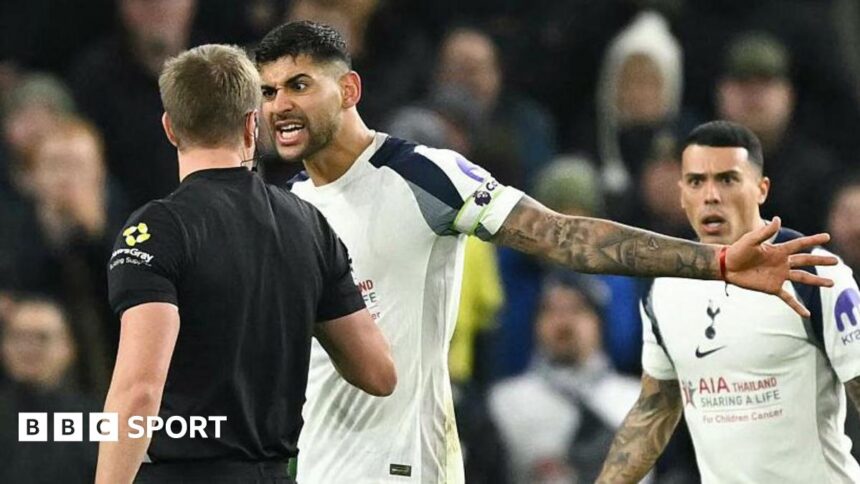
Thomas Frank Blasts Officials: ‘Romero Red Card Avoidable If Referee Did His Job’
In the fiery aftermath of a controversial Premier League clash at the Tottenham Hotspur Stadium, the focus has shifted from Liverpool’s gritty 2-1 victory to a searing indictment of the officiating. Tottenham Hotspur manager Thomas Frank launched a blistering critique, asserting that defender Cristian Romero’s pivotal red card would never have happened if referee John Brooks had simply “did his job” correctly. The dismissal, a key moment in a match where Spurs finished with nine men, has ignited a fresh debate about VAR intervention, proactive refereeing, and the fine margins defining football’s biggest matches.
A Cascade of Chaos: Dissecting the Pivotal Moment
The incident that sparked Frank’s fury occurred in the 55th minute with Liverpool leading 1-0. As a Liverpool attack broke down, Spurs attempted to launch a counter. However, referee John Brooks had spotted a foul by Dejan Kulusevski on Alexis Mac Allister moments earlier and signaled a free-kick to Liverpool, though play was not immediately halted.
In the ensuing seconds, Liverpool’s Virgil van Dijk cleared the ball. Tottenham’s Cristian Romero, perhaps not hearing the whistle or playing to the stop, followed through with a challenge on the Dutch defender. After a brief consultation with his assistant, Brooks showed Romero a yellow card for the late tackle. The scene then descended into the now-familiar VAR suspense.
The Video Assistant Referee recommended Brooks review the monitor for a potential red card for serious foul play. After reviewing the challenge, Brooks upgraded the sanction, sending a furious Romero off the pitch. It was this sequence—the initial foul, the delayed whistle, and the subsequent challenge—that formed the core of Thomas Frank’s argument.
Frank’s Fury: The Case for Proactive Officiating
Thomas Frank’s post-match comments were pointed and precise. He did not dispute the nature of Romero’s challenge in a vacuum but argued it was a direct consequence of the referee’s failure to control the game proactively.
“The frustration is that if the referee did his job properly, that situation does not happen,” Frank stated. “He called a foul for a challenge by Kulusevski on Mac Allister. He sees it, he calls it. But he doesn’t blow his whistle with any conviction or urgency. The players don’t hear it, the game carries on, and then Cristian makes a challenge that, in a flowing game, is a yellow card.”
Frank’s core critique hinges on game management:
- Immediate Communication: Referees must blow decisively and clearly to stop play the moment a foul is identified, especially in dangerous areas.
- Player Safety: A delayed whistle creates a grey area where players, operating at full speed, are unsure if play is live, leading to unnecessary collisions.
- VAR’s Role: While VAR corrected the challenge’s severity, it failed to account for the mitigating context of the referee’s initial error in game management.
This perspective frames Romero not as a reckless aggressor, but as a player caught in a procedural failure. The red card, therefore, becomes a symptom of a larger officiating mistake rather than an isolated act of misconduct.
The Bigger Picture: Spurs’ Resilience and Liverpool’s Grind
The match was already a test of Tottenham’s resolve after Xavi Simons’ first-half red card, another VAR-upgraded decision for a high boot on Ibrahima Konaté. Down to nine men after Romero’s dismissal, Spurs displayed remarkable fortitude. They reshuffled, defended doggedly, and found a late goal through substitute Richarlison, setting up a frantic finale.
Liverpool, meanwhile, secured a vital three points in the title race but will be concerned by their inability to kill the game against a numerically disadvantaged opponent for over 35 minutes. The performance highlighted their resilience but also a recent lack of cutting edge. Key takeaways include:
- Tottenham’s Character: Despite the double red cards, the team’s spirit and tactical discipline under duress were commendable.
- Liverpool’s Pragmatism: The win was more about grit and game management than the fluent football associated with Jurgen Klopp’s era.
- Top-Four Ramifications: The dropped points are a significant blow to Spurs’ Champions League qualification hopes, while Liverpool keeps pressure on the league leaders.
Expert Analysis: A Watershed for Refereeing Standards?
This incident transcends a single match result. It strikes at the heart of modern officiating dilemmas. Pundits and former referees are divided. Some argue that Romero’s challenge, judged on its own merits, was worthy of a red for endangering an opponent, and VAR rightly intervened. The referee’s initial management is irrelevant to the card’s color.
Others side with Frank, contending that officiating must be viewed holistically. The “clear and obvious error” VAR is meant to address should include the referee’s role in creating a dangerous, ambiguous situation. If Brooks had blown his whistle instantly and forcefully, Romero’s challenge never occurs. By this logic, the red card is a technical correction that ignores the root cause.
This controversy highlights a critical tension: is VAR a tool for cold, isolated forensic analysis, or should it be empowered to understand the flowing, cause-and-effect nature of the game? Thomas Frank’s outburst will resonate with many managers and fans who feel that common sense and match context are being stripped away by a slavish adherence to process.
Predictions and Repercussions
The immediate fallout is clear: Tottenham will be without their defensive linchpin, Cristian Romero, for crucial matches, while the PGMOL (Professional Game Match Officials Limited) will again face scrutiny. Looking ahead, we can expect:
- Managerial Pressure: More managers will echo Frank’s demand for referees to “do their job” with clearer, more authoritative real-time management to prevent such chain-reaction incidents.
- PGMOL Response: While the officiating body rarely comments publicly, internal guidance may emphasize the need for decisive whistle-blowing to protect player safety and game integrity.
- Season Impact: For Spurs, recovering from this psychological and tactical blow will define their season’s end. For Liverpool, it’s another step in a relentless title chase, but performances must improve.
Conclusion: A Red Card for the System?
Liverpool’s victory will be recorded in the history books, but the narrative of this match is owned by Thomas Frank’s powerful critique. The Cristian Romero red card incident has become a potent symbol of a growing disconnect between the letter of the law and the spirit of the game. While VAR provided a technically correct outcome for the challenge itself, it failed to address—or was powerless to address—the initial officiating error that precipitated it.
Frank’s core argument is compelling: the best referees are not just enforcers of rules, but proactive managers of the spectacle and its participants. When that foundational duty falters, the resulting chaos, even when later reviewed by technology, feels unjust. The question now is whether this incident becomes a forgotten flashpoint or a catalyst for a deeper conversation about empowering referees to control games with the authority and clarity the world’s best league demands. The whistle, it seems, needs to be heard as clearly as the whistle-blower.
Source: Based on news from BBC Sport.