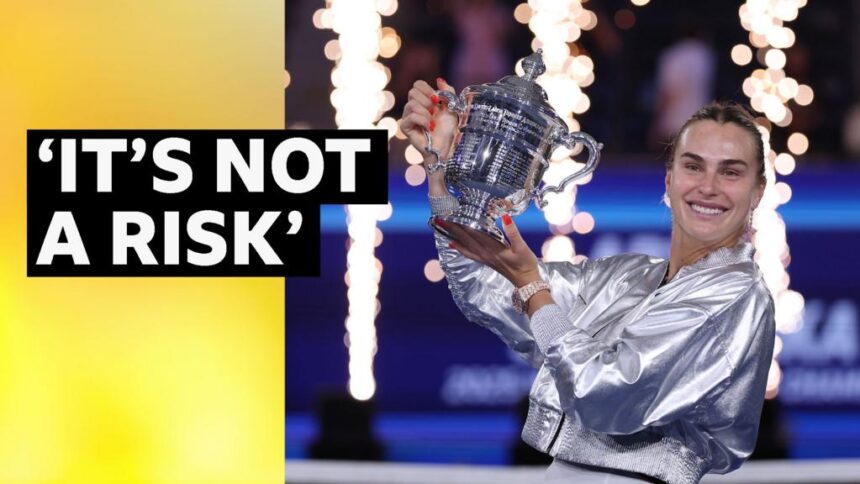
Sabalenka Defends Dubai ‘Battle of the Sexes’ Match: A Calculated Gamble or a Net Gain for Tennis?
The specter of the ‘Battle of the Sexes’ is set to return to the tennis court, but this time, the stakes are framed not in gender politics but in pure spectacle. In December, Dubai will host a headline-grabbing exhibition pitting women’s world number one Aryna Sabalenka against the mercurial, controversial men’s star Nick Kyrgios. The announcement has ignited a firestorm of debate, forcing the sport to confront its past, its present, and the complex optics of such a contest. At the eye of this storm stands Sabalenka, defiantly confident that this modern iteration is “not a risk” to her or to women’s sport. But is she right?
Beyond the Circus: Sabalenka’s Calculated Confidence
For Aryna Sabalenka, the rationale is refreshingly straightforward. This is not Billie Jean King versus Bobby Riggs in 1973, a match laden with the weight of societal progress. “It’s an exhibition,” Sabalenka told BBC Sport, framing it as pure entertainment. “It’s for fun, for the fans.” Her confidence stems from a seismic shift in the women’s game that she herself embodies. Sabalenka’s power-hitting game, built on a foundation of brute force and athleticism, has redefined what is possible from the baseline in women’s tennis.
Her stance is a powerful statement of the modern WTA’s evolution. She is not stepping onto the court to prove women can compete with men; she is stepping onto the court as the sport’s premier athlete, period. The subtext is clear: the match’s outcome, heavily favored towards Kyrgios due to inherent physiological differences, is irrelevant to the stature of the women’s tour. Sabalenka’s participation is an assertion of equality through entertainment value, not a direct athletic comparison. This perspective reframes the event from a risky anachronism to a showcase of tennis as global entertainment, where star power transcends gender.
The Kyrgios Conundrum: Can the Spectacle Be Separated from the Man?
If Sabalenka’s involvement sparks sporting debate, Nick Kyrgios’s presence ignites a moral one. The Australian’s undeniable talent and box-office appeal are shadowed by a troubling off-court record. His 2021 guilty plea for assaulting an ex-girlfriend and a history of comments widely deemed misogynistic have led many to question why he is being platformed in a match inherently about gender dynamics.
Kyrgios’s response to the criticism has been characteristically combative, yet he acknowledges the scrutiny. This creates a profound tension for the event’s organizers and viewers. Can the “spectacle” of his tennis be isolated from his personal history? The danger is that his participation inadvertently validates the very attitudes the original ‘Battle of the Sexes’ sought to dismantle. The event now carries a dual burden: navigating the legacy of gender in sport while confronting contemporary issues of athlete accountability and redemption. For many, the match is no longer just Sabalenka vs. Kyrgios; it’s a referendum on what behavior the sport is willing to overlook for a headline.
Key Points of Contention and Context
- Historical Context: The 1973 King vs. Riggs match was a pivotal cultural moment for gender equality. The 2023 version is a commercial exhibition, a distinction Sabalenka heavily emphasizes.
- The Power Parity: Sabalenka represents the new peak of physical power in women’s tennis, making the athletic gap less visually stark than in past cross-gender exhibitions.
- The Audience Equation: The event targets casual fans and social media buzz, operating in a different realm than the sanctity of Grand Slam competition.
- Modern Scrutiny: Kyrgios’s involvement ensures the conversation extends beyond sport into ethics, complicating the event’s simple promotional narrative.
Expert Analysis: A Net Gain or an Unforced Error?
Sports sociologists and marketing experts are divided. The potential benefits for women’s sport are tangible. Sabalenka, in this high-profile setting, commands equal billing and likely a comparable purse, reinforcing financial equity in tennis. It places the WTA’s biggest star in a global spotlight that sometimes eludes even world number ones outside of major tournaments. Furthermore, it could introduce her formidable game to a new audience, showcasing the explosive quality of the modern women’s game.
However, the risks are equally real. The primary fear is regression—that a lopsided scoreline, however expected, could be misused by bad-faith actors to undermine women’s tennis. While informed fans understand the biological realities, soundbites and social media clips can distort the narrative. Moreover, by sharing the stage with Kyrgios, there is a risk that the event’s controversial edges overshadow Sabalenka’s athletic prowess. The focus could shift from “look at Sabalenka’s amazing power” to the circus surrounding her opponent.
Prediction: A Flash in the Pan or a Lasting Impact?
The immediate aftermath will be noisy. Expect polarized takes, viral moments, and heated debate across sports media. The match itself will likely deliver entertainment, with Kyrgios’s trick shots and Sabalenka’s thunderous strikes providing highlight-reel material. In the short term, it will be deemed a commercial success, drawing eyes and driving digital engagement.
The long-term impact on women’s sport, however, will be minimal. Sabalenka is correct; the foundations of the WTA are too strong to be shaken by one exhibition. The true legacy will be personal. For Sabalenka, it solidifies her brand as a fearless, marketable superstar. For Kyrgios, it represents another chapter in his complex relationship with the sport’s establishment. The event is less a watershed moment and more a mirror reflecting tennis’s current state: a sport grappling with its entertainment identity, the power of its personalities, and the unresolved tensions between its progressive values and its thirst for spectacle.
Conclusion: A Serve into the Modern Media Arena
Aryna Sabalenka’s confidence is not misplaced. The ‘Battle of the Sexes’ exhibition is unlikely to damage women’s sport because the women’s game has long since won its most important battles for respect, equity, and recognition on its own merits. This match is not a step back but a step sideways into the chaotic arena of 21st-century sports entertainment, where narratives are complex and controversy is currency.
Ultimately, the event’s success or failure won’t be measured by games won, but by who controls the story. If the focus remains on Sabalenka’s elite athleticism and the fun of the spectacle, it can be a net positive. If it devolves into a referendum on Kyrgios’s past or simplistic gender comparisons, it will be a missed opportunity. Sabalenka, with her characteristic power and poise, has stepped up to the line. The question now is whether the tennis world can return the serve with the nuance it deserves.
Source: Based on news from BBC Sport.