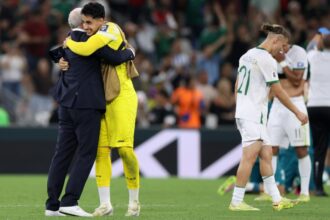
The Unwanted Encounter: Wales and Northern Ireland’s World Cup Wake
The silence after a dream dies is a deafening thing. For the players of Wales and Northern Ireland, that silence was shattered not by the roar of a World Cup crowd, but by the hollow echo of a fixture list that feels more like a punishment than a prize. This Tuesday, under the lights of the Cardiff City Stadium, two nations will play a friendly match that nobody wanted, born from the shared rubble of shattered qualification hopes. While Bosnia-Herzegovina and Italy battle in Zenica for a ticket to North America, the losers are consigned to a consolation game in the Welsh capital—a stark reminder of what might have been.
A Fixture Forged in Failure
To understand the peculiar gloom surrounding this match, one must rewind to the crushing events of last Thursday. Both nations entered their UEFA play-off semi-finals with generations of hope on their shoulders. Wales, dreaming of a third World Cup appearance and the first since 1958, fell to a disciplined Bosnia-Herzegovina in Cardiff. Northern Ireland, aiming for a fourth finals berth, were narrowly, agonizingly, edged out by a single goal against the giants of Italy.
The emotional whiplash was severe. The planning, the pressure, the national expectation—all of it was geared towards a winner-takes-all final. Instead, both Craig Bellamy and Michael O’Neill were left to pick up the pieces and steer their devastated squads towards a match that, in the immediate aftermath of defeat, felt meaningless. This is not a glamour friendly arranged for celebration or experimentation; it is an administrative obligation, a contractual ghost of a match that only exists because two dreams evaporated simultaneously.
Finding Purpose in the Periphery
So, what value can possibly be extracted from such an encounter? The answer lies not in the result, but in the margins. For the managers, this is a critical exercise in squad management and future planning. With pride wounded and morale fragile, their task is to reignite a spark and assess who possesses the character to build anew.
Expect line-ups filled with players eager for a chance to state their case. This match is a unique audition for:
- International newcomers and fringe players: Those with scant caps will be given a platform to prove they belong in the long-term project.
- Players returning from injury: A low-stakes environment to regain match sharpness and confidence.
- The next generation: With Euro 2024 qualification on the horizon, this is a first look at potential heirs in a senior setting.
Bellamy and O’Neill, both shrewd tacticians, will be keen to stress the value of this encounter in their team talks. They will speak of pride, of the honour of the shirt, and of using the 90 minutes as a first step on the road to redemption. For the fans, it is a chance to show support in a moment of disappointment, a testament to loyalty that extends beyond the glory of qualification.
Tactical Glimpses and Emotional Resets
On the pitch, the tactical battle will be intriguing, albeit within the context of a friendly. Will Bellamy use the opportunity to shift Wales away from the reliance on the now-retired Gareth Bale, experimenting with new systems or attacking combinations? Can O’Neill begin to mould a Northern Ireland side less dependent on the veteran savvy of Steven Davis and Jonny Evans?
The key battles may be in midfield, where younger players will vie to control the tempo, and up front, where both nations have struggled for consistent goal threats. This game offers a laboratory setting for solutions. However, the most significant contest will be psychological. Which team can better compartmentalize their heartbreak and muster the professional pride to perform? The side that shows more energy, more hunger, may reveal which squad has processed its grief more quickly and which manager has best rallied his troops.
Prediction: A Contest of Character Over Class
Predicting a winner in a match like this is fraught with difficulty. Motivation, not talent, will be the decisive factor. Expect a fragmented, open affair, especially in the early stages as players shake off the residual disappointment. There may be moments of quality, but the intensity of a competitive fixture will be absent.
Given the home advantage and the potential for a more vociferous crowd seeking to lift their team, Wales may have a slight edge. They will be desperate to avoid back-to-back home defeats in the space of five days. Northern Ireland, however, are renowned for their resilience under O’Neill and could easily frustrate the hosts. A low-scoring draw, perhaps 1-1, feels like a plausible outcome—a result that reflects the shared circumstance of the two nations more than any discernible gap in quality.
The most telling predictions, however, won’t be found on the scoreboard. They will be in the performances of a debutant who seizes his chance, in the leadership shown by a emerging figure, and in the collective response when the first tackle flies in. These are the metrics that will matter to Bellamy and O’Neill.
Conclusion: More Than Just a Friendly
Labeling Wales vs. Northern Ireland as “the match nobody wants” is accurate, yet incomplete. It is an unwanted child of circumstance, a direct consequence of failure. But within that framework, it becomes an unexpectedly vital fixture. It is the first, difficult step out of the darkness of elimination. For the associations, it fulfills a commitment. For the managers, it provides invaluable data and a chance to reset the culture. For the players, it is an audition and a therapy session rolled into one.
When the final whistle blows in Cardiff, the World Cup paths of Bosnia-Herzegovina and Italy will dominate the headlines. But in Wales and Northern Ireland, the real work for the next cycle begins in earnest. This friendly is the line in the sand. It is the moment to stop looking back at the play-off that got away, and to start building, piece by piece, towards a future where such consolation games are no longer their fate. The journey back starts here, in the most unwelcome of places.
Source: Based on news from BBC Sport.