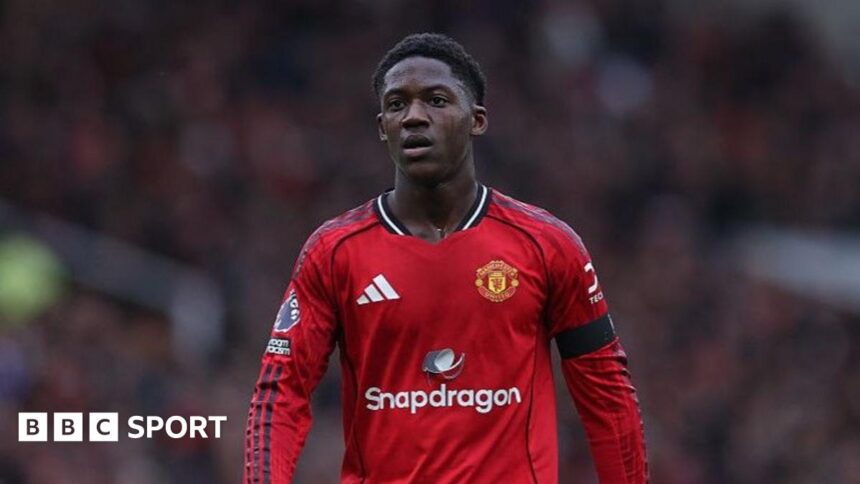
You Love Kobbie: How Mainoo’s Rise Forced Amorim’s Hand and Defines United’s Future
The relationship between a prodigious young talent and a pragmatic manager is one of football’s most compelling dramas. It’s a dance of potential versus process, hype versus hierarchy. For a brief, revealing moment last December, this very drama played out on the Old Trafford touchline, centering on a teenager from Stockport and a manager under immense pressure. The subject was Kobbie Mainoo, and the frustrated admission from then-Manchester United boss Ruben Amorim said it all: “You love Kobbie.” In that simple, exasperated phrase lay the entire story of a generational talent who can no longer be managed—only unleashed.
The Bench That Spoke Volumes: Amorim’s Calculated Gamble
Manchester United’s 1-1 draw with West Ham United in December was a microcosm of a troubled season. Old Trafford simmered with frustration as a relegation-threatened side held firm. Chances were squandered, momentum stalled. On the bench sat Kobbie Mainoo, already an England international, the player many fans saw as the sole source of midfield ingenuity and calm. As the clock ticked, Amorim made his final roll of the dice: a defensive shuffle, bringing on Lisandro Martinez for Luke Shaw.
The choice was a stark one. It prioritized defensive solidity and experience over creative risk. Post-match, when inevitably questioned about the omission, Amorim’s guard slipped. His response—”You always ask me the same thing. I understand… You love Kobbie. He starts for England, but that doesn’t mean I need to put Kobbie on when I feel I shouldn’t”—was a fascinating insight into managerial pressure. It was an acknowledgment of Mainoo’s undeniable public and media appeal, but also a defiant stance on a manager’s right to make unpopular calls based on tactical feel. In that moment, Amorim wasn’t just leaving a player on the bench; he was pushing back against a narrative he felt was constricting his choices.
Beyond the Hype: The Tangible Genius of Kobbie Mainoo
So why does “everyone love Kobbie”? The affection transcends mere potential; it is rooted in a tangible, rare set of attributes he displays consistently on the pitch. Mainoo isn’t just a promising youngster; he is a functional elite operator in a key area where United have floundered for years.
- Press-Resistant Dribbling: In the chaotic heart of midfield, Mainoo possesses an almost preternatural calm. His low center of gravity, close control, and sharp turns allow him to glide away from pressure, turning defensive situations into attacking transitions. This single skill alleviates immense pressure on United’s back line.
- Progressive Passing Vision: He doesn’t just keep possession; he advances it with purpose. Whether it’s a disguised pass through the lines or a sweeping switch of play, Mainoo’s execution is consistently forward-thinking and incisive.
- Tactical Maturity Beyond His Years: Perhaps his most striking trait is his game intelligence. His positioning, understanding of space, and decision-making mirror a player with a decade of experience. He knows when to hold, when to drive, and when to release—a maturity that makes his age a mere footnote.
This combination of skills makes him the team’s essential midfield catalyst. Without him, United’s play often looks disjointed; with him, there is a rhythm and a conduit between defense and attack. Amorim’s dilemma was that this was not just fan sentiment—it was an observable, statistical reality.
The Inevitable Ascendancy: From Managerial Decision to Undroppable Force
Amorim’s tenure at United was defined by such tough calls, but the arc of Mainoo’s season proved that some forces are too powerful to contain. The December benching became a pivotal point, not in diminishing Mainoo’s status, but in highlighting the growing disconnect between managerial caution and the player’s evident readiness to be a game-winner.
In the weeks and months that followed, any debate was extinguished by performance. Mainoo became the undroppable cornerstone of United’s midfield, showcasing his talent on the biggest stages. His stunning late winner in the FA Cup semi-final was not just a goal; it was a statement—the kind of decisive impact fans had craved against West Ham. He finished the season as the club’s Young Player of the Year, an England squad fixture, and the one player whose name was automatically etched on the team sheet.
Amorim’s initial reluctance can now be seen as the final flicker of an old paradigm. It represented a manager trying to manage minutes, manage pressure, and maintain a squad hierarchy. Mainoo’s response was to obliterate the very need for such management through sheer, consistent excellence.
Building the Future: Mainoo as Manchester United’s Bedrock
Looking ahead, the narrative has shifted entirely. The question is no longer *if* Mainoo should play, but *how* United builds their entire project around his unique abilities. He is the non-negotiable foundation upon which the next era must be constructed.
For the incoming manager—whoever that may be—the lesson from Amorim’s “You love Kobbie” moment is clear: This player is not a luxury or a mere crowd-pleaser. He is the essential engine. The strategic focus must now be on:
- Identifying the perfect midfield partner(s) to complement his skills, providing the defensive coverage and physicality to unleash his creative strengths.
- Designing a tactical system that flows through him, making him the primary hub in possession.
- Shielding him from burnout while recognizing that, from a footballing perspective, he is already a senior, influential leader.
Mainoo represents the most exciting homegrown talent at United in a generation. His rise has been a rare bright spot, a story of organic growth and breathtaking quality in a period often defined by chaos.
The conclusion is inescapable. Ruben Amorim’s candid press conference remark was a fleeting snapshot of a tension that has now been resolved. The public, the pundits, and the facts all aligned: they loved Kobbie for a reason. That love was not blind faith, but a recognition of a transformative talent. Today, Kobbie Mainoo does not need to be loved; he commands respect. He is no longer a delicate prospect to be managed, but the central pillar Manchester United must rely upon. The future at Old Trafford, for all its uncertainty, has one absolute certainty wearing the number 37.
Source: Based on news from BBC Sport.