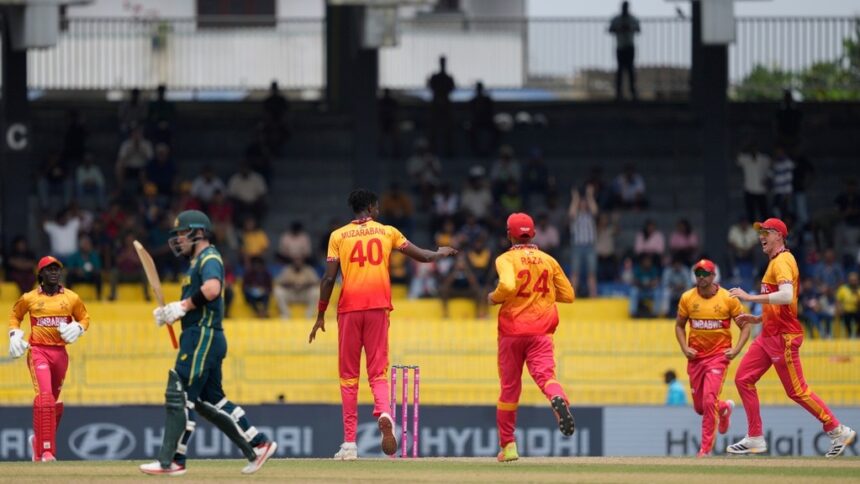
Blessing’s Curse: Muzarabani’s Wizardry Sparks Zimbabwe’s Historic T20 World Cup Upset Over Australia
The T20 World Cup, simmering in its second week, finally boiled over. After whispers of upsets and flashes of giant-killing intent, the tournament found its defining roar in the heart of Colombo. On a night charged with electricity, Zimbabwe, so often the nearly-men of world cricket, authored a performance of such stunning conviction that it has sent seismic tremors through the entire competition. Led by the towering, menacing figure of Blessing Muzarabani, they didn’t just beat the former champion Australia; they dismantled, out-thought, and utterly overwhelmed them by 23 runs. The result leaves the mighty Aussies staring at a shockingly early exit, while Zimbabwe have announced themselves as a force of thrilling, unpredictable potency.
A Colombo Crucible: Zimbabwe’s Gritty Foundation
Winning the toss and opting to bat, Zimbabwe’s approach was one of calculated accumulation, not explosive aggression. The R Premadasa pitch, already showing its sluggish character, demanded respect. Craig Ervine and Innocent Kaia provided a stable, if unspectacular, start, seeing off the initial threat of Starc and Hazlewood. The acceleration came through the composed brilliance of Sikandar Raza. The captain, playing the situation perfectly, crafted a masterful 72 not out from 55 balls. His partnerships, first with Kaia and then with a fluent Sean Williams (38*), were studies in intelligent T20 batting. They found boundaries when the opportunity arose but, more importantly, they never allowed the Australian bowlers to build sustained pressure. Their total of 169 for 2 felt competitive, perhaps 15 runs above par on that surface, but against Australia’s deep batting lineup, it was far from secure. It was a total built on grit, a necessary foundation for the seismic shift to come.
Blessing’s Spell: The Curse of Pace and Precision
If Zimbabwe’s batting was the steady hand, their bowling was the thunderclap. The Australian chase never found rhythm, suffocated from the outset by discipline and then shattered by moments of individual brilliance. The early wicket of David Warner, caught behind off Richard Ngarava, set the tone. But the protagonist of this drama, the man whose name will forever be etched in this upset, was Blessing Muzarabani. In a spell of fast bowling that blended raw pace with surgical accuracy, he broke the back of the Australian innings.
- Key Dismissal 1: Travis Head, looking dangerous, was undone by extra bounce and a clever catch at cover.
- Key Dismissal 2: Mitchell Marsh, the Australian captain, was castled by a thunderbolt that seamed in to clip the top of off-stump—a bowler’s dream.
- Key Dismissal 3 & 4: He returned at the death to clean up the tail, finishing with astounding figures of 4 for 17 in his four overs.
Muzarabani was not alone. The supporting cast was magnificent. The spinners, Raza and Wellington Masakadza, choked the run flow in the middle overs. Every fielder threw their body on the line, turning potential boundaries into dot balls. The pressure was a tangible force, and Australia, renowned for their chasing prowess, crumbled under its weight. From 73 for 3, they lost 7 wickets for 73 runs, bowled out for 146 in 19.3 overs. It was a collective bowling and fielding performance of the highest order.
Expert Analysis: Deconstructing the Australian Collapse
This was more than a bad day at the office for Australia; it was a systemic failure. Their batting approach seemed oddly passive on a pitch where proactive stroke-play was needed to force the issue. There was a glaring lack of partnerships. Once Glenn Maxwell fell to a fantastic running catch from Kaia off Raza, the innings lost its last recognized anchor. The middle order, including the likes of Tim David and Matthew Wade, were consumed by the mounting required rate and Zimbabwe’s relentless pressure. Tactically, they seemed second-best. Zimbabwe’s use of Muzarabani in short, impactful bursts, and the clever rotation of their spinners from one end, exposed a one-dimensional plan from the Aussies. The World Cup upset was not a fluke; it was a meticulously planned execution by Zimbabwe and a flat, error-strewn performance from a team that looked underprepared for the fight.
Group B Thunderstruck: Implications and Predictions
The fallout from this result is monumental. Group B, once seen as a straightforward path for Australia and England, is now a cauldron of chaos. Australia’s net run-rate has taken a massive hit, and with tough games still to come, their tournament life hangs by a thread. They must win emphatically and hope other results go their way. For Zimbabwe, this is a transformative victory. It grants them not just two crucial points but an immeasurable surge of belief. They are now genuine contenders to advance to the Super Eight stage. This result also throws the group wide open, giving hope to other teams and setting up a thrilling, unpredictable second round of fixtures. The message is clear: there are no easy games, and pedigree counts for nothing if you don’t match the opposition’s hunger and skill on the day.
A New Chapter: Zimbabwe’s Dawn and Australia’s Reckoning
February 13 in Colombo will be remembered as the day Zimbabwean cricket announced its arrival on the world stage with a statement of pure force. This was a victory built on smart cricket, unwavering heart, and the inspirational bowling of Blessing Muzarabani. For Australia, it is a humbling wake-up call, a stark reminder that in the volatile arena of T20 cricket, reputation is a currency that devalues rapidly. As the dust settles in Colombo, the narrative of the T20 World Cup has been irrevocably altered. We are no longer waiting for an upset; we have witnessed a classic. The tournament has its pulse, and it’s beating to the fierce, triumphant rhythm of Zimbabwe. The curse of the underdog has been lifted, and in its place stands a Blessing for all to see.
Source: Based on news from India Today Sport.