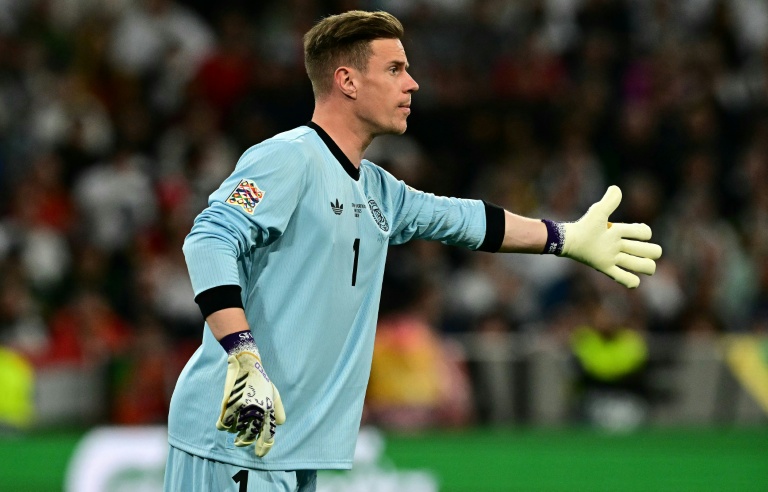
Nagelsmann’s Unwavering Faith: Why Ter Stegen’s World Cup Dream Isn’t Over
The life of a professional athlete is a fragile tapestry of peak fitness, fleeting form, and cruel fortune. For Marc-Andre ter Stegen, the threads have been brutally cut once again. Germany’s head coach Julian Nagelsmann, however, is already looking at the bigger picture, offering a powerful public backing for his sidelined goalkeeper despite a devastating new injury that threatens to derail the meticulous plans for the 2026 World Cup.
A Cruel Twist on the Road to Redemption
Just weeks ago, the narrative surrounding Marc-Andre ter Stegen was one of proactive ambition. Having ceded the undisputed number one spot for Germany to Manuel Neuer for over a decade, the 33-year-old made a bold winter move. A six-month loan from Barcelona to high-flying La Liga side Girona was a masterstroke designed for one purpose: to play. With Neuer approaching the twilight of his career, the 2026 World Cup in the United States, Canada, and Mexico represented ter Stegen’s clearest, and perhaps final, opportunity to claim the starting role on the biggest stage.
The plan unraveled in heartbreaking fashion. During only his second appearance for Girona last Saturday, ter Stegen suffered a muscle injury in his thigh. The club’s announcement that he would “undergo further tests” carried a grim, familiar tone. Early indications suggest a recovery period of several months, ruling him out of Germany’s March friendlies against Switzerland and Ghana and casting a long shadow over his immediate club future.
Nagelsmann’s reaction to the news was visceral and empathetic. “This is unbelievably cruel,” the coach told AFP subsidiary SID. “Marc had just returned and was on a good path. We were very much awaiting his return in the national team.” This statement does more than express sympathy; it explicitly confirms ter Stegen’s integral role in Nagelsmann’s evolving vision for the Nationalmannschaft.
Nagelsmann’s Calculated Backing: More Than Just Words
Julian Nagelsmann’s public support is a significant tactical and psychological play. In the high-pressure ecosystem of international football, where players are often reduced to assets, Nagelsmann is emphasizing the human element. His instruction that ter Stegen must now “get healthy in peace, without any additional pressure” is a directive to both the player and the often-ravenous media cycle.
This backing is rooted in several key strategic realities:
- Long-Term Vision for 2026: At 33, ter Stegen will be 34 by the time the World Cup kicks off in North America—prime years for a modern goalkeeper. Nagelsmann is clearly planning for a seasoned, elite presence between the posts, and ter Stegen’s technical profile remains unparalleled.
- Leadership and Experience: Beyond his shot-stopping, ter Stegen is a foundational build-up player, a trait Nagelsmann values immensely. His experience in leading Barcelona’s defense for a decade is an intangible asset for a German squad in transition.
- Managing the Goalkeeping Dynasty: With Manuel Neuer’s legendary status and eventual retirement looming, Nagelsmann is deftly managing the succession. This public faith ensures the transition, when it comes, is natural and respectful, avoiding a destabilizing “battle” for the shirt.
By stating “We’re all behind him,” Nagelsmann isn’t just offering comfort; he’s reinforcing that ter Stegen’s World Cup bid remains firmly on track, injury notwithstanding. This protects the player’s mental state, a crucial component of a successful long-term rehabilitation.
The Rocky Path Ahead: Rehabilitation and Rivalry
The immediate future for ter Stegen is one of monotonous rehab and patient recovery. Missing the March internationals is a setback for his aim to re-acclimatize to the national team setup under Nagelsmann. However, the broader timeline still favors him.
The true challenge will be upon his return. The loan to Girona, now compromised by injury, was meant to provide consistent, high-level match rhythm—the one advantage rivals like Neuer (when fit) and others like Oliver Baumann or Janis Blaswich inherently have. Can ter Stegen return to Girona next season and reclaim a starting spot? Will he return to Barcelona to serve as a deputy? His club situation becomes a complex puzzle.
Furthermore, the landscape is shifting. While Neuer remains the incumbent, his own injury history and age add variables. Meanwhile, a new generation, including Hoffenheim’s Oliver Baumann and the promising talent of Alexander Nübel, will see this extended absence as an opportunity to impress Nagelsmann in the upcoming friendlies and Nations League matches. The race for Germany’s number one shirt is now more open than ever, but Nagelsmann’s comments suggest ter Stegen remains the preferred finisher, if he can reach the starting line healthy.
Predictions: Patience, Pressure, and a North American Finale
Looking forward, several scenarios could unfold from this setback:
- The Patient Heir: Ter Stegen uses the coming months for a comprehensive physical and mental reset. He returns for the 2024-25 club season fully fit, plays consistently, and seamlessly steps into a larger role for Germany in the latter stages of Euro 2024 qualification and the tournament itself, solidifying his status as the 2026 starter.
- The Nagelsmann Bet: The coach’s faith becomes a self-fulfilling prophecy. By insulating ter Stegen from pressure, he allows the goalkeeper to recover without the specter of being “replaced.” This fosters loyalty and a determined comeback, with ter Stegen entering the 2025-26 season as the undisputed leader in the goalkeeping corps.
- The Wild Card: A rival goalkeeper seizes their chance in the coming international windows with such compelling form that Nagelsmann faces a genuine selection headache. This would create the most compelling narrative, but Nagelsmann’s unequivocal backing suggests he is willing to be patient with his chosen candidate.
The most likely outcome is a story of resilience. Nagelsmann has effectively extended a safety net, allowing ter Stegen to focus solely on recovery. The 2026 World Cup is still over two years away—an eternity in football, but a realistic window for a determined athlete to overcome this hurdle.
Conclusion: A Test of Faith and Fortitude
Julian Nagelsmann’s response to Marc-Andre ter Stegen’s “cruel” injury is a masterclass in modern man-management. It transcends the immediate disappointment and plants a flag for the future. In an era where players are often quickly discarded after setbacks, this public declaration of support is a powerful message about long-term planning and human-centric leadership.
For ter Stegen, the road to the 2026 World Cup has become steeper, longer, and more painful. But it has not been closed. In fact, his coach has just illuminated the path forward. The coming months will be a testament to ter Stegen’s physical fortitude and mental strength. But equally, they will test the conviction of Julian Nagelsmann’s words. If both men navigate this challenge successfully, Germany may arrive in North America not just with a world-class goalkeeper, but with one forged in the fires of adversity and unified by a shared, unwavering belief. The dream, for now, is on hold—but it is very much alive.
Source: Based on news from Yahoo Sports.