Seahawks Lower the Boom on Defense in Super Bowl Win: A New Era of Bad Boys Emerges
The confetti had barely settled, the Lombardi Trophy still gleaming under the stadium lights, when Ernest Jones IV made his statement. It wasn’t delivered with a shout, but with a quiet, undeniable swagger. The Seattle Seahawks linebacker, the 2021 Rams Super Bowl ring from a previous life glinting on his finger, a victory cigar waiting patiently on the table, leaned into the microphone. His words cut through the postgame cacophony, not just as a celebration, but as a declaration of identity. “That’s a bunch of bad boys,” he said of his defensive brethren. “For me to be in the middle, leading this group, boy I’m blessed.” With that, a new chapter in defensive lore was officially stamped, sealed, and delivered with bone-jarring authority.
The Anatomy of a Modern “Bad Boy” Defense
Gone are the days when defensive dominance could be defined by a single trait. The Seahawks’ championship unit, which suffocated the league’s most prolific offense in a 23-9 Super Bowl victory, is a masterpiece of modern schematic and personnel engineering. They are not a tribute act to the legendary Legion of Boom; they are its evolved, 21st-century successor. Where the LOB famously relied on press-man coverage and kamikaze hitting from the secondary, this iteration is built on a foundation of terrifying versatility and intellectual brutality.
Coordinator Clint Hurtt’s scheme is a nightmare for quarterbacks, a constantly shifting puzzle that disguises pressures and coverages until milliseconds after the snap. The defensive line, anchored by the unblockable Leonard Williams, wins not just with pure power but with surgical stunts and relentless rotation. The secondary, led by the transcendent cornerback Riq Woolen, combines elite length with ball-hawking instincts that erase half the field. But the soul of this unit, as Jones so aptly noted, resides in the middle.
The linebacker corps, featuring Jones and the explosive Jordyn Brooks, is the engine of the chaos. They are hybrids in the truest sense: stout enough to stonewall Derrick Henry on one play, fluid enough to carry a tight end down the seam on the next, and explosive enough to blitz the A-gap and decapitate a play before it develops. This positional fluidity creates what offensive coordinators call “conflict.” Every offensive read becomes a question with no right answer.
- Versatility as a Weapon: Players like safety/nickel Julian Love are deployed as chess pieces, moving from deep-middle safety to slot corner to box defender within a single drive.
- Disguise and Deception: Pre-snap, everything looks like a Cover 2 shell. Post-snap, it can morph into Cover 6, a fire zone blitz, or a trap coverage designed to bait a quarterback into a catastrophic mistake.
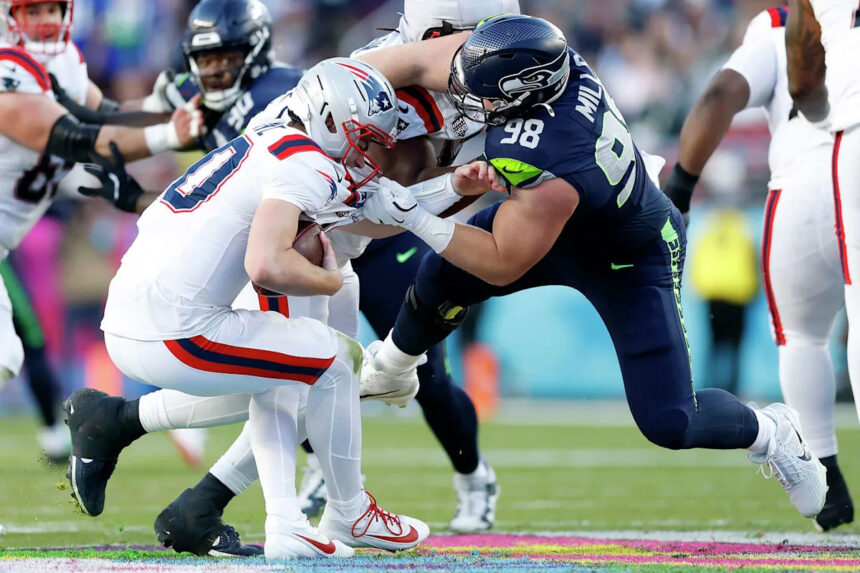
- Controlled Violence: The tackles are devastating, but they are disciplined. This unit led the league in fewest defensive penalties, proving their physicality is channeled, not reckless.
Historical Context: Where Do These “Bad Boys” Rank?
When a reporter dared to ask Ernest Jones the inevitable—where this group stands against the ghosts of defenses past like the ’85 Bears or the Legion of Boom—his answer was succinct and telling. “I’ll say this,” Jones began, a knowing smile playing on his lips. “I’ll match our defense against anybody.” It was neither brash nor dismissive; it was the calm confidence of a man who knows his evidence is irrefutable. The question, however, merits exploration.
The 1985 Chicago Bears were a cultural phenomenon, a monolithic force of personality and sheer destruction operating in a different NFL. Their dominance was rooted in a simpler, more violent time. The Seahawks’ challenge is far greater, built to solve the complex, spread-out, pass-happy puzzles of today’s game. Comparing them is an apples-to-oranges exercise in football evolution.
The more poignant comparison is internal: the Legion of Boom. That group changed the sport’s rulebook and philosophy. They were pioneers. This current Seahawks defense are the beneficiaries and the evolution of that revolution. They possess the same collective attitude, the same belief in their invincibility, but their toolkit is expanded. They face more sophisticated offenses with more sophisticated answers. The LOB had an aura of impending doom. These “Bad Boys” project an aura of inescapable complexity. They don’t just beat you; they outthink you while they’re doing it.
The Blueprint and the Future: Can This Dynasty Be Sustained?
The NFL is a copycat league, and the Seahawks have just provided the definitive blueprint for defensive construction in the 2020s. The focus will no longer be on finding the biggest hitters or the fastest corners in isolation, but on identifying multifaceted “positionless” defenders who can execute multiple assignments at an elite level. General Manager John Schneider’s ability to find these traits in the draft and via strategic trades (the acquisition of Leonard Williams being a masterstroke) will be studied for years.
Looking ahead, the Seahawks are uniquely positioned for sustained dominance. The core of this defense is young, hungry, and under contract. Key players like Woolen, Brooks, edge rusher Boye Mafe, and defensive tackle Jarran Reed are entering their primes. The championship experience they just gained is an intangible asset that cannot be purchased. They have now felt the pinnacle and, more importantly, they know the formula that got them there.
However, the league will adjust. Offensive minds will spend the entire offseason dissecting every snap, looking for tells, for weaknesses, however minute. The challenge for Hurtt and head coach Mike Macdonald is to stay ahead of the curve, to add new wrinkles, and to ensure the hunger that fueled this run does not dim amid the glow of victory. The salary cap will eventually demand tough choices, but the cultural foundation—the “Bad Boy” identity—is now firmly cemented.
A Conclusion Forged in Steel: The Bad Boy Standard is Set
As Ernest Jones finally lit that cigar, the smoke curling into the bright lights of the interview tent, it signaled more than just a personal celebration. It was a punctuation mark on a season defined by defensive excellence. The Seattle Seahawks did not just win a Super Bowl; they reasserted a philosophy. In an era obsessed with offensive fireworks and quarterback wizardry, they proved that defense not only still wins championships—it can dominate them.
The “Bad Boys” moniker is not about penalties or intimidation; it’s about an attitude of supreme competence. It’s the confidence that on any given down, against any given opponent, your unit has the answer. It’s the belief that you are the most prepared, the most versatile, and the most violent collective on the field. When history looks back on this Seahawks team, they will not be seen as a nostalgic echo of a past great defense. They will be seen as the standard-bearers of a new defensive age. They are the blueprint, the benchmark, and the “bunch of bad boys” who lowered the boom on an entire league. And as Jones so confidently stated, they’re ready for anyone, anytime, any place. The rest of the NFL has been put on notice.
Source: Based on news from Yahoo Sports.